


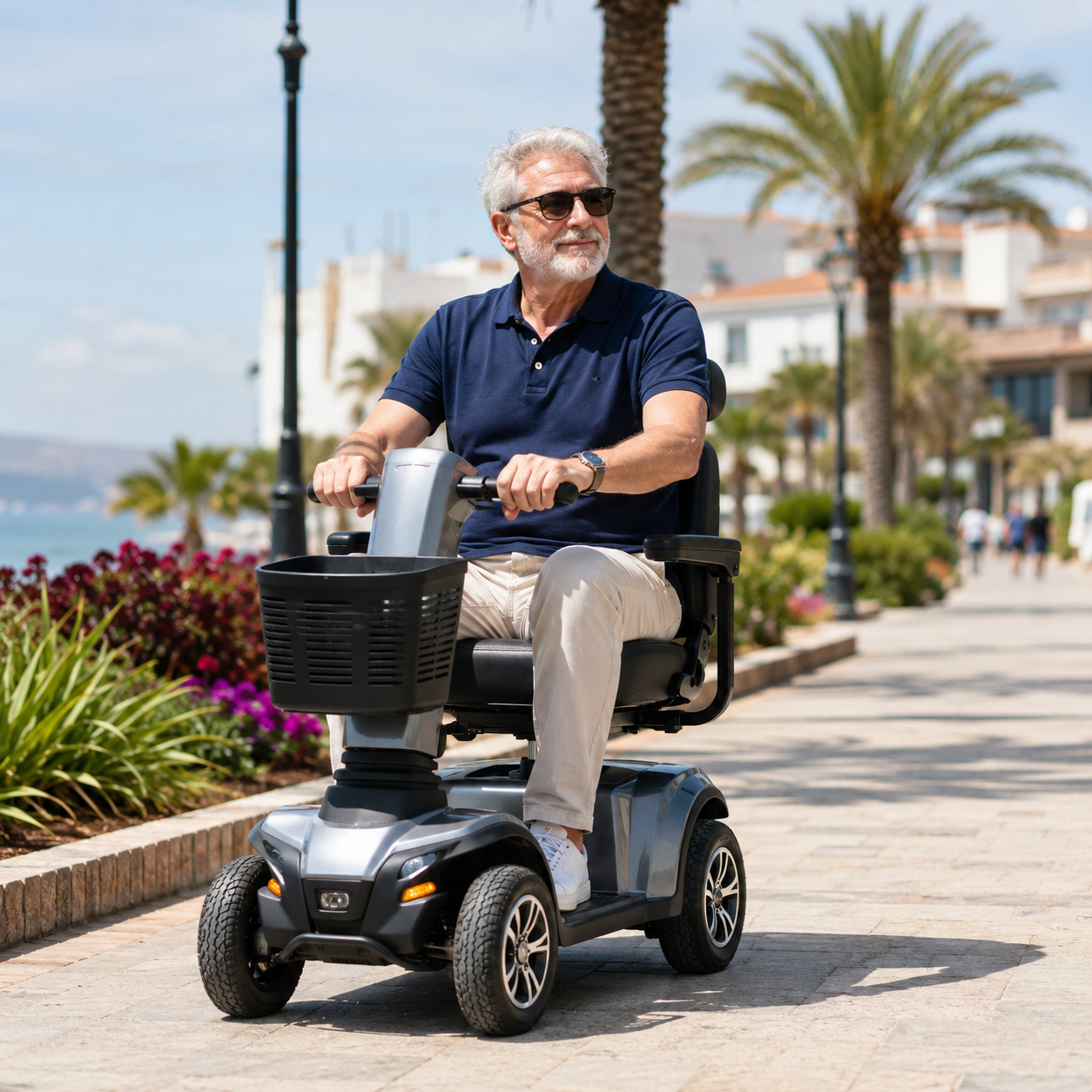
Mobility Scooter Myths Debunked: What You Really Need to Know
Mobility scooters can provide greater freedom, confidence and independence, but outdated assumptions sometimes stop people from considering one. This guide separates fact from fiction and explains the UK rules, practical limitations and choices available.
They are not only for older people
Mobility scooters can help people of different ages who have difficulty walking because of an injury, disability or medical condition.
There is no single scooter type
Models range from lightweight folding scooters to road-legal, long-range, all-terrain and weather-protected designs.
UK rules depend on the scooter class
Class 2 and Class 3 scooters have different speed, registration and road-use requirements.
Mobility scooters are a familiar sight on pavements, shopping streets and local roads, yet many misconceptions continue to surround them.
Some people assume that scooters are only for older users. Others believe they are difficult to control, impossible to transport or only suitable for someone who cannot walk at all.
There are also misunderstandings about speed, insurance, driving licences, battery range and where a scooter may legally be used.
The reality is more nuanced. Mobility scooters vary considerably, and the right product depends on the user, their physical abilities, their home and the journeys they want to make.
Choosing to use a scooter does not mean giving up on walking or becoming less active. It can help preserve energy for the activities and journeys that matter most.
Mobility Scooter Myths at a Glance
| Common myth | The reality |
|---|---|
| They are only for older people | People of different ages may use them when injury, disability or a medical condition makes walking difficult. |
| You must be unable to walk | Many users can walk shorter distances but need help with longer journeys. |
| A scooter reduces independence | The right scooter can make independent shopping, appointments and social activities possible. |
| All scooters are large and bulky | Folding, dismantling and lightweight models are designed around transport and storage. |
| They are difficult to operate | Controls are generally straightforward, but users should receive a demonstration and practise safely. |
| Every scooter is limited to 4mph | Class 2 scooters travel at up to 4mph. Class 3 scooters can travel at up to 8mph on roads. |
| You always need a licence and insurance | Standard Class 2 and Class 3 scooters do not normally require a driving licence or compulsory insurance. |
| Advertised range is guaranteed | Hills, temperature, surfaces, tyre pressure and battery condition can reduce range. |
| Scooters are completely waterproof | They can cope with normal outdoor use, but electrical components must be protected from heavy rain and deep water. |
| You must pay the full cost upfront | Eligible customers may have access to finance, Motability or other forms of financial assistance. |
Swipe horizontally across the table to see the complete myth and fact comparison.
Myth 1: Mobility Scooters Are Only for Older People
Mobility scooters are often associated with older users, but age alone does not determine whether someone may benefit from one.
They can help people who experience difficulty walking because of:
- A physical disability.
- A long-term medical condition.
- Chronic pain or fatigue.
- Reduced balance or stamina.
- The effects of an injury.
- Recovery following surgery or treatment.
The important considerations are whether the user has a genuine mobility difficulty and can safely transfer, sit, steer and respond to the environment around them.
Mobility requirements are individual. Two people of the same age may have completely different levels of mobility, stamina and independence.
Myth 2: You Must Be Completely Unable to Walk
Many mobility scooter users can stand and walk for short distances. The difficulty may arise when walking further, negotiating hills or remaining on their feet for an extended period.
A scooter can help someone preserve energy for:
Shopping
Travel to the shops without using all available energy before arriving.
Appointments
Reach medical, personal and social appointments more independently.
Family visits
Complete longer local journeys that may not be manageable on foot.
Days out
Enjoy attractions, parks and accessible routes with less pain or fatigue.
The NHS describes mobility scooters as potentially useful for people who struggle to walk, need to travel longer distances and can get on and off the scooter safely.
Using a scooter for longer journeys does not prevent someone from continuing to walk where it remains safe and manageable.
Myth 3: Using a Mobility Scooter Means Losing Independence
Some people worry that accepting mobility support represents a loss of independence. In practice, struggling without the right equipment can make someone more dependent on family, carers or taxis.
A suitable scooter may allow the user to:
- Complete shopping independently.
- Visit friends and family more often.
- Attend appointments without relying on a lift.
- Take part in local activities.
- Walk when appropriate without exhausting their energy.
- Remain connected with their community.
Independence does not mean completing every journey without equipment. It means having the right support to make your own choices and participate in everyday life.
For many users, a scooter increases independence by reducing reliance on other people.
Myth 4: All Mobility Scooters Are Large and Bulky
Large road and all-terrain scooters do require substantial storage, but they represent only one part of the market.
Modern mobility scooters include models designed specifically for portability and restricted storage spaces.
Folding scooters
Fold into a more compact shape for storage, travel and occasional car transportation.
Car-boot scooters
Dismantle into several sections so each component can be loaded separately.
Lightweight scooters
Use lighter frames and compact batteries to reduce the total lifting and transport weight.
Larger road scooters
Prioritise comfort, range, suspension and road equipment rather than easy lifting.
Check the exact total weight and the weight of the heaviest section. A scooter described as lightweight may still be unsuitable for a particular user or car.
Scooters are available in a wide variety of sizes, weights, colours and designs for different lifestyles.
Myth 5: Mobility Scooters Are Difficult to Control
Most mobility scooters use relatively straightforward controls. A tiller steers the scooter, while finger or thumb levers control forward and reverse movement.
Common controls include:
- Forward and reverse drive levers.
- A speed adjustment dial.
- A battery-level display.
- A horn.
- Lights and indicators on appropriately equipped models.
The controls still need to suit the individual user. Someone with reduced hand strength, limited shoulder movement or arthritis may benefit from a delta tiller or alternative lever design.
Before using a new scooter independently
- Adjust the seat and tiller correctly.
- Learn how the braking system works.
- Practise at the lowest speed.
- Practise turning and reversing in an open area.
- Learn how to approach dropped kerbs safely.
- Understand the freewheel or manual-release lever.
Mobility scooter controls are generally designed to be intuitive, but a full demonstration and safe practice remain essential.
Myth 6: Every Mobility Scooter Is Limited to 4mph
UK mobility scooters are commonly divided into Class 2 and Class 3 products.
| Classification | Maximum speed | Where it can generally be used |
|---|---|---|
| Class 2 | Up to 4mph | Pavements, pedestrian areas and separated cycle tracks |
| Class 3 | Up to 8mph on roads and no more than 4mph on pavements | Pavements, pedestrian areas, separated cycle tracks and roads |
Class 3 scooters require suitable road equipment and must be registered with the DVLA.
Although 4mph is the maximum permitted speed on a pavement, users should travel more slowly when the area is crowded, narrow or shared with people who may not hear or see the scooter approaching.
Read the official GOV.UK mobility scooter class guidance .
Class 3 mobility scooters can travel at up to 8mph on roads, but all Class 2 and Class 3 scooters are limited to no more than 4mph in pedestrian areas.
Myth 7: Every Scooter Needs a Driving Licence, Road Tax and Insurance
The rules depend on the scooter’s classification.
Driving licence
You do not normally need a driving licence for a standard Class 2 or Class 3 mobility scooter.
DVLA registration
Class 3 mobility scooters must be registered with the DVLA. Class 2 scooters do not normally require registration.
Vehicle tax
You do not pay vehicle tax when the product is registered with the DVLA as a mobility scooter or powered wheelchair.
Insurance
Insurance is not legally compulsory for standard Class 2 or Class 3 scooters, although the government recommends having it.
A product that falls outside Class 2 and Class 3 can be subject to additional driving-licence, registration and insurance requirements.
Read the GOV.UK guidance on registration, vehicle tax and insurance .
Standard Class 2 and Class 3 scooters do not require vehicle-tax payments or compulsory insurance, although insurance can provide valuable protection.
Myth 8: The Advertised Battery Range Is Guaranteed
Published range figures are useful for comparing scooters, but they are normally achieved under controlled testing conditions.
Real-world range can be affected by:
Hills
Steep and repeated inclines require more battery power.
Temperature
Cold weather can temporarily reduce battery performance.
Surface
Grass, gravel and soft ground create more resistance than a smooth pavement.
Weight
The user, shopping, accessories and other equipment all contribute to the load.
Tyre pressure
Underinflated pneumatic tyres increase rolling resistance.
Battery condition
Older or poorly maintained batteries may provide less usable range.
Choose a scooter with more range than your normal return journey requires and maintain a sensible battery reserve.
Advertised range is a comparison figure. The distance achieved during an individual journey will vary.
Myth 9: Mobility Scooters Are Completely Waterproof
Mobility scooters are designed for outdoor journeys, but that does not mean they are fully waterproof.
Electrical controls, charging connections, batteries and motors can be damaged by excessive water exposure.
Wet-weather precautions
- Avoid deep puddles and flooded routes.
- Reduce speed on wet or slippery surfaces.
- Protect the controls in accordance with the manual.
- Use the lights when visibility is poor.
- Store the scooter somewhere dry and secure.
- Allow a wet scooter to dry according to the manufacturer’s instructions.
- Do not connect the charger where the socket or connections are wet.
A compatible control-panel cover, lap cover or integrated canopy can make outdoor use more comfortable, but it does not make the entire scooter waterproof.
Customers who travel regularly throughout winter may prefer a scooter with purpose-designed weather protection.
Explore canopy mobility scooters .
Most scooters can cope with normal outdoor conditions, but heavy rain, standing water and unsuitable storage can damage them.
Myth 10: You Must Pay the Full Cost Upfront
Paying the full price is one option, but it is not the only way someone may obtain a mobility scooter.
Purchase finance
Eligible customers may be able to spread the cost through a regulated credit agreement, subject to status, affordability and lender approval.
Motability Scheme
Eligible recipients of qualifying mobility allowances may be able to lease a scooter through Motability.
Charitable support
Certain charities and trusts may provide assistance depending on individual circumstances and available funding.
Buying a pre-owned scooter
A properly inspected used scooter may cost less, but battery condition, servicing, warranty and parts availability should be checked carefully.
When comparing finance, look beyond the weekly or monthly payment. Check the cash price, deposit, APR, agreement term and total amount payable.
Finance is subject to status, affordability and lender approval. Repayments must remain affordable throughout the agreement, and terms and conditions apply.
Explore Mobility Connect finance options .
Customers may have several ways to obtain a scooter, although eligibility and overall cost vary between the available options.
How to Choose a Mobility Scooter That Fits Your Life
The right decision should be based on your everyday needs, not assumptions about what a mobility scooter user should look like or how a scooter should be used.
- Consider where and how often the scooter will be used.
- Decide whether you need a Class 2 or Class 3 product.
- Calculate the distance of your usual return journey.
- Allow additional battery range for hills and cold weather.
- Try the controls and braking response.
- Check that you can transfer safely on and off.
- Check the seat width, depth and adjustment.
- Confirm the maximum user and luggage weight.
- Measure your entrance and storage area.
- Measure your vehicle boot where transport is required.
- Check the total weight and heaviest lifting section.
- Confirm where and how the battery will be charged.
- Ask about warranty, servicing and breakdown support.
- Request a full demonstration before using the scooter independently.
A scooter that looks suitable on a product page may feel very different once you sit in it, operate the controls and test the turning circle.
Mobility Scooter Myth FAQs
Are mobility scooters only for older people?
No. People of different ages may use a mobility scooter when they have trouble walking because of an injury, physical disability or medical condition. Suitability depends on mobility and the ability to operate the scooter safely rather than age alone.
Can I use a mobility scooter if I can still walk?
Yes. Many users can walk short distances but experience pain, fatigue, poor balance or reduced stamina during longer journeys.
Do I need a driving licence for a mobility scooter?
You do not normally need a driving licence for a standard Class 2 or Class 3 mobility scooter. Different rules can apply to unusually large, heavy or fast vehicles that fall outside those classes.
Do mobility scooters need road tax?
Class 3 scooters must be registered with the DVLA, but no vehicle-tax payment is required when the vehicle is registered as a mobility scooter or powered wheelchair.
Is mobility scooter insurance compulsory?
Insurance is not legally compulsory for standard Class 2 or Class 3 scooters, but the government recommends having it. Insurance may cover theft, accidental damage and liability involving other people or property.
Can mobility scooters be used on pavements?
Class 2 and Class 3 scooters may be used on pavements and other pedestrian areas. They must not exceed 4mph, and the user should give pedestrians priority.
Can a mobility scooter be used on the road?
A properly equipped and registered Class 3 mobility scooter may be used on the road. Class 2 scooters are intended primarily for pavements and pedestrian areas.
Are mobility scooters difficult to drive?
Most use straightforward tiller and lever controls. The user should still receive a demonstration, adjust the scooter correctly and practise steering, stopping and reversing in a safe area.
Can mobility scooters be transported in a car?
Folding and dismantling scooters are designed with car transport in mind. Check the folded dimensions, total weight, heaviest component and the size of the vehicle’s boot opening.
Can mobility scooters be used in the rain?
Many can be used in ordinary outdoor conditions, but they are not completely waterproof. Avoid deep water and prolonged heavy rain, protect the electrical controls and follow the manufacturer’s storage and drying instructions.
Is the advertised battery range accurate?
It is useful for comparing scooters but is not a guaranteed real-world distance. Hills, cold weather, soft ground, tyre pressure, additional weight and battery condition can reduce range.
Do mobility scooters reduce independence?
For many people, the opposite is true. A scooter can make it possible to shop, attend appointments and visit family without relying as heavily on another person.
Discover a Mobility Scooter That Fits Your Needs
Mobility Connect can help you compare folding, portable, pavement, road-legal and all-terrain scooters based on your comfort, journeys, storage and transport requirements.