


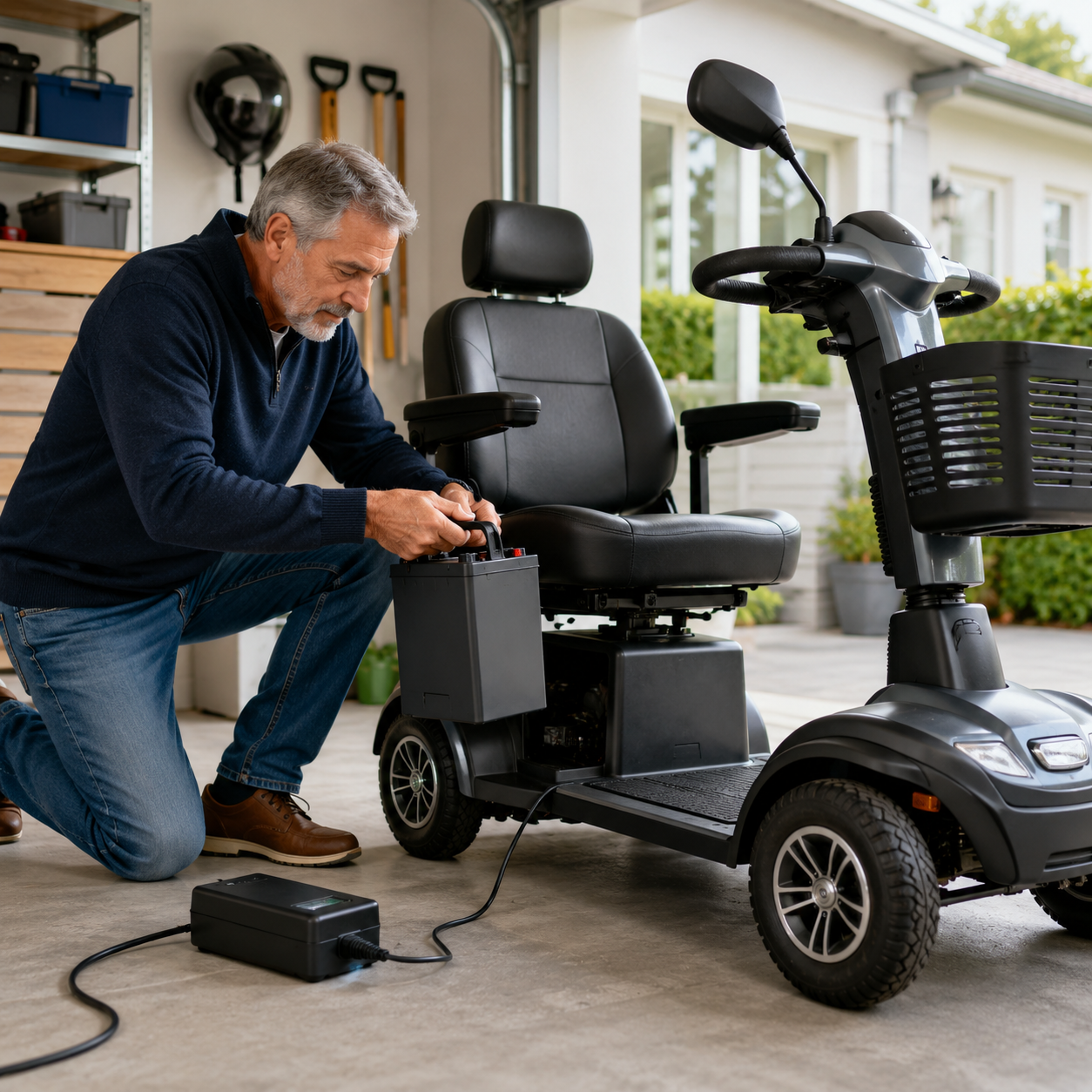
Mobility Scooter Battery Care: How to Charge, Store and Extend Battery Life
Correct charging and storage can make a significant difference to mobility scooter battery life, reliability and real-world range. This guide explains how to care for AGM, gel and lithium batteries, what damages them and when a replacement may be needed.
Charge after regular use
Do not routinely run the battery completely flat. Recharge it according to the instructions supplied with your particular scooter and battery.
Use the correct charger
Chargers are matched to battery chemistry, voltage and capacity. A plug that fits does not necessarily mean the charger is compatible.
Store it charged and dry
Protect the scooter from temperature extremes and moisture, and maintain the battery during longer periods without use.
The batteries are among the most important and expensive components of a mobility scooter. They determine how far the scooter can travel, how confidently it climbs hills and whether it is ready when you need it.
Many premature battery problems are caused by charging habits, prolonged storage at a low state of charge, an unsuitable charger, extreme temperatures or regularly attempting to use every available mile of range.
Battery advice is not identical for every mobility scooter. Larger scooters commonly use sealed AGM or gel lead-acid batteries, while many lightweight folding scooters use a removable lithium battery.
The instructions supplied with your scooter, battery and charger should always take priority over general advice.
Do not apply charging advice for a sealed lead-acid battery to a lithium battery, or vice versa. Each battery requires the correct charger, storage routine and safety precautions.
What Type of Battery Does Your Mobility Scooter Use?
Identifying the battery type is the first step because AGM, gel and lithium batteries have different characteristics and charging requirements.
| Battery type | Commonly found in | Main characteristics |
|---|---|---|
| AGM | Car-boot, pavement and road mobility scooters | Sealed lead-acid battery with dependable performance and a comparatively affordable replacement cost |
| Gel | Larger scooters and products used regularly for deeper discharge cycles | Sealed lead-acid battery designed for repeated deep-cycle use, but usually heavier than lithium |
| Lithium-ion | Folding, travel and lightweight mobility scooters | Lower weight, removable designs and strong energy density, with battery-management electronics and specific safety requirements |
They are maintenance-free sealed units. Do not open them, add water or attempt to alter their internal components.
How to identify your battery
- Read the mobility scooter user manual.
- Check the label on the battery or battery pack.
- Look for the battery specification on the product page.
- Contact the retailer using the scooter make and model.
- Check whether the battery uses a separate charging dock.
Do not remove covers, disconnect terminals or dismantle a battery pack simply to identify it. Ask an experienced mobility technician where access is not straightforward.
A Simple Mobility Scooter Battery-Care Routine
A consistent routine is generally more effective than waiting until the scooter begins losing range.
| Frequency | Battery-care task |
|---|---|
| After use | Check the battery indicator and recharge in accordance with the manual rather than leaving the battery partly discharged |
| Before a journey | Confirm that charging has completed and that the scooter has enough range for the return journey |
| Weekly | Inspect the charger, plug, cable and charging socket for damage, dirt or moisture |
| Monthly | Check the battery during periods of storage and recharge when required by the product manual |
| Seasonally | Review storage temperature, tyre pressure, range and battery performance before winter or longer journeys |
| During servicing | Ask for the batteries, charger, connections and charging voltage to be professionally checked |
Keep a note of normal range and charging time. A gradual change is easier to recognise when you know how the scooter usually performs.
How to Charge a Mobility Scooter Battery Correctly
The precise connection and disconnection order can vary. Follow the instructions supplied with your scooter and charger.
A typical charging process
1. Park safely
Position the scooter on a dry, level surface in a ventilated location that does not obstruct an exit.
2. Switch it off
Remove the key or switch off the main power before connecting the charger unless the manual states another procedure.
3. Inspect the equipment
Check the plug, cable, casing, charging socket and battery for damage, moisture or unusual heat.
4. Connect the approved charger
Connect the charger in the order stated by the manufacturer and plug it directly into a suitable electrical outlet.
5. Allow charging to complete
Check the charger indicators and allow it to complete its normal charging cycle.
6. Disconnect safely
Switch off or unplug the mains supply and disconnect the charger in the sequence stated in the manual.
The charger must match the battery chemistry, voltage, capacity and charging system. An unsuitable automotive, fast or generic charger can damage the battery and create a serious safety risk.
Charging-area safety
- Keep the scooter and charger away from flames, heaters and other ignition sources.
- Do not cover the charger or battery during charging.
- Do not charge on a bed, sofa or other soft surface.
- Keep cables away from doorways and walking routes.
- Do not sit on or operate the scooter while it is charging.
- Keep the charger dry and away from direct sunlight.
- Keep children and pets away from the charging equipment.
- Ensure working smoke alarms are fitted in the home.
How Often Should You Charge a Mobility Scooter?
The correct routine depends on the battery type, scooter and manufacturer’s instructions.
Daily or frequent users
Sealed AGM and gel batteries are commonly recharged after each day of use, including after shorter journeys.
Occasional users
Charge before an intended outing and recharge after meaningful use. Do not leave the battery depleted between journeys.
Lithium-battery users
Follow the lithium battery and charger instructions. Charging frequency, storage charge and automatic shut-off behaviour vary between battery systems.
Scooters in storage
Fully prepare the battery for storage and check it at the interval stated in the manual, commonly around once a month for sealed lead-acid systems.
AGM and gel mobility batteries do not need to be run flat before charging. Regular deep discharge generally causes more wear, not less.
How Long Does a Mobility Scooter Take to Charge?
Many mobility scooter batteries need several hours to recharge. Depending on the battery capacity, charger and remaining charge, a normal cycle may take approximately eight to twelve hours.
New batteries, heavily discharged batteries and larger battery sets may require longer. The product manual may also specify an extended initial charge.
Charging time can be affected by:
- Battery chemistry and capacity.
- The approved charger’s output.
- How deeply the battery has been discharged.
- Battery temperature.
- Battery age and condition.
- Charger temperature and ventilation.
A higher-output charger is not automatically suitable. Using a charger with the wrong output can overheat or permanently damage the battery.
Check the charger’s indicator lights rather than relying only on the number of hours it has been connected.
Avoid Running the Battery Completely Flat
Deeply discharging a mobility scooter battery places it under greater stress and can reduce its usable capacity. Leaving it empty for an extended period can cause further damage.
A severely discharged battery may fall below the voltage required for the standard charger to begin its charging cycle. This can make it appear as though the charger is faulty when the batteries have actually been discharged too far.
Reduce the risk of complete discharge
- Charge before the battery display reaches its final warning level.
- Avoid planning journeys that use the scooter’s complete advertised range.
- Allow additional range for hills, cold weather and soft ground.
- Switch off lights and accessories when the scooter is parked.
- Check that the key has been removed or power switched off.
- Recharge promptly after an unexpectedly long journey.
The battery indicator is an estimate rather than a precise fuel gauge. Aim to return home with useful charge remaining.
How to Care for New Mobility Scooter Batteries
New sealed lead-acid mobility batteries may not provide their maximum range immediately. Some manufacturer guidance describes a conditioning or break-in period of approximately 10 to 20 charging cycles.
During the first few weeks
- Fully charge the batteries before first use.
- Follow any extended initial-charge instruction.
- Begin with shorter, familiar journeys.
- Avoid testing the maximum advertised range.
- Recharge fully according to the manual after use.
- Expect range to improve gradually during the initial cycles.
Battery conditioning does not normally require repeatedly draining the battery to zero. Follow the specific manufacturer’s break-in instructions.
Storing a Mobility Scooter Battery Correctly
Batteries continue to lose charge gradually even when the scooter is not being used. Long-term storage therefore requires preparation and periodic checks.
Before storing the scooter
- Fully charge the battery according to the manual.
- Switch off the scooter and remove the key.
- Clean and dry the scooter and battery area.
- Store it in a dry and ventilated environment.
- Avoid direct sunlight, heaters and freezing conditions.
- Disconnect or remove the battery only where the manual instructs you to do so.
- Keep the charger and battery away from escape routes.
- Record when the battery was last checked.
During storage
Check the charge regularly and recharge at the interval specified by the manufacturer. Many sealed lead-acid systems recommend a check approximately once a month when the scooter is not in use.
Lithium batteries can have different recommended storage charge levels and inspection intervals. Follow the battery-specific instructions rather than assuming they should remain continuously connected.
A battery left discharged for several months may be difficult or impossible to recover when the scooter is needed again.
How Heat and Cold Affect Mobility Scooter Batteries
Temperature affects charging, available range and battery ageing. Both extreme heat and extreme cold should be avoided.
Cold weather
Cold batteries can temporarily provide less usable power, reducing the range available for a journey.
Frozen batteries
Never attempt to charge a frozen battery. Move it to an appropriate environment and seek advice before charging.
Hot storage
Avoid leaving the scooter or removable battery in a hot vehicle, conservatory or direct sunlight for prolonged periods.
Charging temperature
Allow a very cold or recently used battery to return to an appropriate temperature before charging, as instructed by the manufacturer.
Do not immediately charge a lithium battery that is unusually hot following use. Stop using it and obtain advice if it remains hot, changes shape or develops an unusual smell.
What Reduces Mobility Scooter Battery Range?
Published range is normally measured under controlled test conditions. Real journeys place different demands on the scooter.
Hills
Climbing gradients requires more energy than travelling on a level surface.
Cold weather
Lower temperatures can reduce the power immediately available from the battery.
Grass and gravel
Soft or loose surfaces create more rolling resistance than a smooth pavement.
Tyre pressure
Underinflated pneumatic tyres increase resistance and make the motor work harder.
Additional weight
The user, shopping, accessories and medical equipment all contribute to the load.
Driving style
Frequent acceleration, stopping and high-speed use can reduce the distance achieved.
Electrical features
Lights, heated seats, heated handlebars and device charging draw power from the battery.
Battery age
Usable capacity normally reduces as the battery ages and completes more charge cycles.
How to improve practical range
- Begin longer journeys with a complete charge.
- Maintain pneumatic tyres at the recommended pressure.
- Remove unnecessary luggage and accessories.
- Choose smoother and less demanding routes where possible.
- Drive smoothly and at an appropriate speed.
- Arrange a battery check when range declines noticeably.
Keep the Battery, Connections and Charger Clean and Dry
Moisture, dirt, loose connections and damaged cables can interfere with charging and contribute to corrosion or electrical faults.
Regular visual checks
- Check the charger casing for cracks or impact damage.
- Inspect cables for cuts, crushing or exposed wiring.
- Check the plug and charging connector for bent or damaged pins.
- Keep the charging socket cover closed when not in use.
- Look for corrosion around accessible connections.
- Check that removable batteries lock securely into place.
- Keep vents free from dust and fabric.
- Dry the scooter before connecting the charger.
Switch off the scooter and disconnect it from the mains before cleaning. Do not spray water directly onto the battery, charger, control panel or electrical connections.
Sealed batteries do not require the owner to open them or replenish fluid. Internal servicing and terminal work should be completed by a suitably qualified technician.
Signs a Mobility Scooter Battery May Be Failing
Reduced range does not always mean the battery must be replaced immediately. The charger, connectors, tyre pressure or scooter itself may be contributing to the problem.
Common warning signs
- The scooter travels substantially less distance than it previously did.
- The battery indicator falls quickly during acceleration or on a hill.
- The scooter slows or cuts out under load.
- Charging finishes unusually quickly but range remains poor.
- The charger does not progress through its normal indicator sequence.
- The scooter requires charging more frequently.
- Performance is noticeably different between similar journeys.
- The battery or charger becomes unusually hot.
- The battery casing is swollen, cracked, leaking or distorted.
- There is an unusual smell, hissing, smoke or discolouration.
Do not charge or reuse a battery that is swollen, smoking, leaking, making unusual noises or becoming excessively hot. Move away, raise the alarm and call 999 if there is smoke or fire.
What to Check When a Mobility Scooter Battery Will Not Charge
Do not dismantle the charger or battery. Begin with simple external checks and contact the retailer or aftercare provider if charging does not begin normally.
- Check that the electrical socket is working.
- Confirm that the charger is connected fully at both ends.
- Check that the scooter is switched off.
- Confirm that the charging socket is dry and undamaged.
- Check the charger indicator lights against the user manual.
- Inspect the cable, plug and charger casing.
- Check that a removable battery is seated and locked correctly.
- Allow an excessively cold battery to reach a safe charging temperature.
- Consider whether the battery has been left completely discharged.
- Record any scooter fault code or flashing-light sequence.
A severely discharged battery should be tested by an experienced mobility technician using suitable equipment. Connecting an unsuitable charger directly to the terminals can cause injury or permanent damage.
A professional battery test can help distinguish between a weak battery, faulty charger, damaged connection and another electrical issue.
When Should Mobility Scooter Batteries Be Replaced?
There is no single replacement interval that applies to every scooter. Battery life depends on chemistry, usage, charging habits, storage, temperature and the depth of each discharge.
Replacement may be appropriate when testing confirms that the batteries no longer provide sufficient capacity for normal journeys or cannot hold a reliable charge.
Replacement considerations
- Use the exact chemistry approved for the scooter.
- Match the required voltage and amp-hour capacity.
- Check the physical dimensions and terminal arrangement.
- Do not mix AGM and gel batteries.
- Do not mix different capacities.
- Do not mix an old battery with a new battery in a paired system.
- Replace paired lead-acid batteries together.
- Use a qualified mobility technician where recommended.
- Confirm that the existing charger remains compatible.
- Recycle the old batteries through an approved service.
A larger battery may not fit the scooter, may exceed its intended weight or may be incompatible with the charger and control system.
Mobility Connect can check battery compatibility and advise whether reduced performance is being caused by the battery, charger or another part of the scooter.
Mobility Scooter Battery Mistakes to Avoid
- Regularly running the battery completely flat.
- Leaving a depleted battery for days or weeks.
- Using an automotive, borrowed or incompatible charger.
- Assuming every battery can be charged overnight.
- Leaving a lithium battery charging while asleep.
- Covering the battery or charger during charging.
- Charging in a hallway, landing or escape route.
- Charging a battery that is wet, frozen or excessively hot.
- Storing the scooter for months without checking the charge.
- Leaving the battery in a hot car or direct sunlight.
- Ignoring damage, swelling, heat or unusual smells.
- Mixing old and new batteries.
- Mixing battery chemistries or capacities.
- Opening a sealed AGM or gel battery.
- Assuming poor range is always caused by the battery.
- Planning journeys around the maximum advertised range.
How to Make a Mobility Scooter Battery Last Longer
- Identify whether the battery is AGM, gel or lithium.
- Read the scooter, battery and charger instructions.
- Use only the supplied or approved charger.
- Recharge in accordance with the manual after use.
- Avoid complete and prolonged discharge.
- Fully charge new batteries before first use.
- Allow for the manufacturer’s conditioning period.
- Keep the scooter and charger clean and dry.
- Charge in a dry and ventilated location.
- Keep charging equipment away from escape routes.
- Do not cover the battery or charger.
- Protect batteries from extreme heat and cold.
- Maintain the recommended tyre pressure.
- Allow a sensible range reserve on every journey.
- Prepare the battery correctly for long-term storage.
- Check stored batteries at the recommended interval.
- Arrange testing when range declines noticeably.
- Replace paired batteries together when required.
- Recycle old batteries responsibly.
Mobility Scooter Battery FAQs
How often should I charge my mobility scooter battery?
Follow the instructions supplied with your scooter and battery. AGM and gel batteries are commonly charged after each day of use, including after shorter journeys. Lithium charging routines vary between products.
Should I charge my mobility scooter after every use?
Many sealed lead-acid mobility batteries should be recharged after active use rather than left partly discharged. Check the manufacturer’s instructions for your particular battery, especially where a lithium pack is fitted.
Can I leave my mobility scooter charging overnight?
Some sealed lead-acid scooters use automatic chargers designed for an extended charging cycle. Lithium battery fire-safety guidance recommends unplugging once fully charged and before going to sleep. Follow the instructions for your exact battery and charger.
Can I leave the charger connected all the time?
Only leave a charger connected continuously where the scooter and charger manufacturers expressly permit it. Do not assume that every charger has a suitable maintenance or float mode.
How long does a mobility scooter battery take to charge?
Many charge cycles take approximately eight to twelve hours, but the exact time depends on battery capacity, remaining charge, temperature and charger output. Follow the manual and charger indicators.
How long should a mobility scooter battery last?
Battery lifespan varies considerably according to chemistry, usage, charging routine, storage, temperature and discharge depth. A battery should be assessed on its tested capacity and ability to complete normal journeys rather than age alone.
Why does my battery gauge drop when I go uphill?
A hill places the motor and battery under greater load, which can cause the displayed level to fall temporarily. A large or worsening drop may also indicate weak batteries and should be checked.
Why is my scooter losing range?
Possible causes include battery age, cold weather, hills, low tyre pressure, soft ground, additional weight, frequent stopping, charger problems or an electrical fault.
Can a completely flat mobility scooter battery be recovered?
Sometimes, but a deeply discharged battery may fall below the voltage needed for the normal charger to start. It should be tested by a mobility technician rather than connected to an automotive or unapproved charger.
Can I use a car battery charger?
No. Automotive chargers are not normally suitable for sealed mobility scooter batteries. Use only the charger supplied or approved for the scooter and battery.
Can I replace AGM batteries with lithium?
Not unless the scooter manufacturer or a qualified mobility specialist confirms that the conversion is approved. Lithium batteries require compatible charging, battery-management and electrical systems.
Should both scooter batteries be replaced together?
Where the scooter uses two matched lead-acid batteries, they should normally be the same type, capacity and age and replaced as a pair. Mixing an old battery with a new one can create uneven charging and performance.
How should I store my scooter during winter?
Prepare the battery according to its manual, store the scooter somewhere dry and protected from temperature extremes, and check and recharge the battery at the recommended interval. Never charge a frozen battery.
Can I charge a removable battery inside my home?
Many removable batteries are designed for indoor charging using their approved charger or dock. Choose a dry, ventilated position away from combustible materials and escape routes, and follow the battery-specific safety instructions.
When should I stop using a lithium battery?
Stop using or charging it immediately if it is swollen, damaged, leaking, excessively hot, smoking, making unusual sounds or producing an unusual smell. Call 999 and leave the area if smoke or fire develops.
Is Your Mobility Scooter Losing Range?
Mobility Connect can help check whether reduced performance is being caused by the batteries, charger, connections or another part of the scooter.