


Mobility Scooter FAQs: Your Complete UK Buying and User Guide
Clear answers to the most common questions about choosing, buying, financing, charging and safely using a mobility scooter.
Buying a mobility scooter can open up more opportunities to shop, visit family, enjoy days out and travel independently. However, with different scooter classes, sizes, battery types and legal rules to consider, knowing where to begin is not always straightforward.
This mobility scooter FAQ guide answers the questions people most commonly ask before and after purchasing a scooter. It covers everything from choosing the right model to using it on pavements and roads, looking after the battery and taking a mobility scooter on public transport.
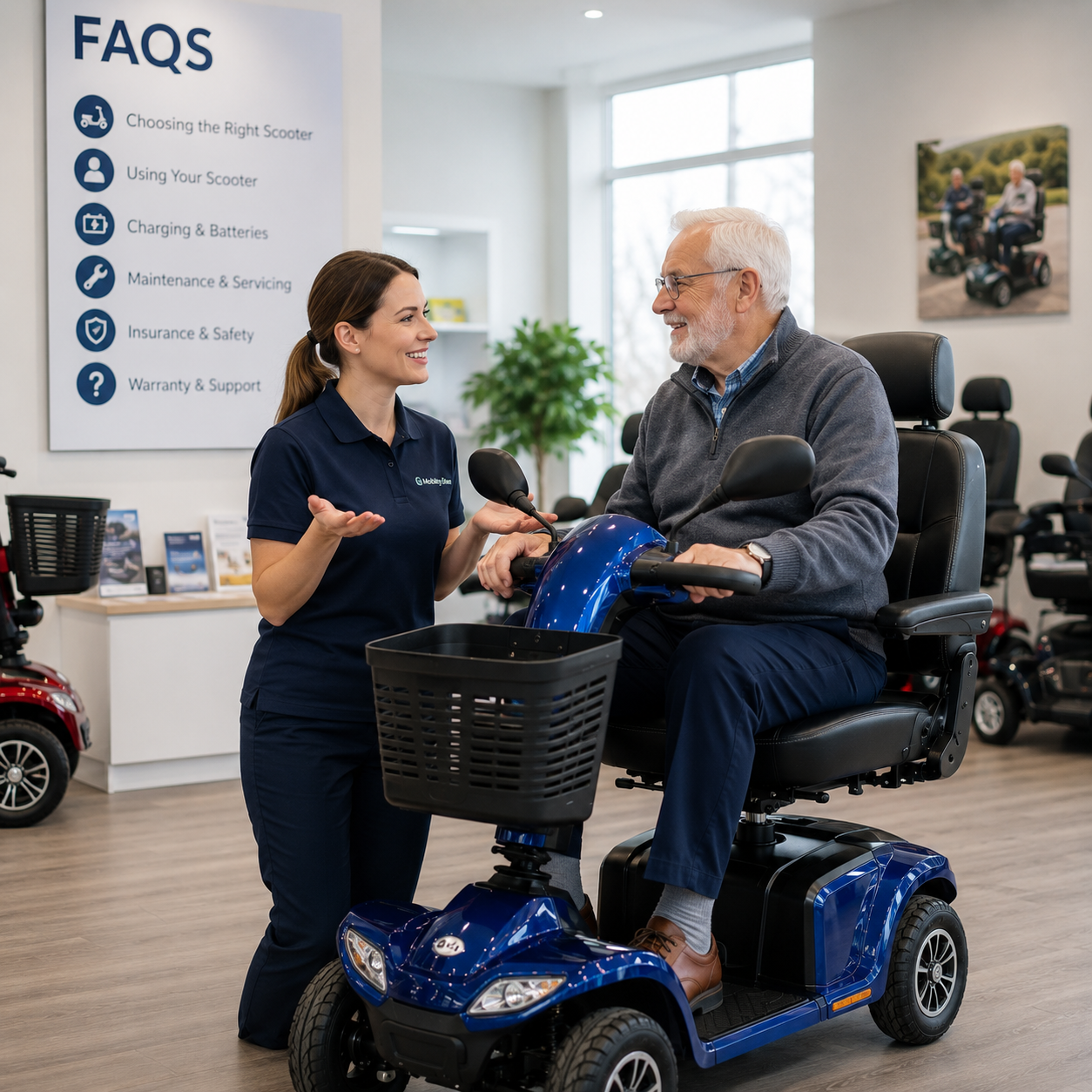
Need personalised advice? Every person, journey and home environment is different. Mobility Connect can arrange a full demonstration and help you compare scooters based on comfort, range, portability and the places you intend to travel.
Mobility Scooter Rules at a Glance
These are some of the most important UK mobility scooter rules to understand before setting off.
Choosing the Right Mobility Scooter
The best mobility scooter is not necessarily the largest, fastest or most expensive model. It is the scooter that suits your body, lifestyle, storage space and regular journeys.
What is a mobility scooter?
A mobility scooter is a battery-powered vehicle designed to help someone who has difficulty walking travel more independently.
Most models have a seat, armrests, a steering tiller, rechargeable batteries and either three or four wheels. Mobility scooters range from lightweight folding models for shorter journeys to larger road-legal scooters designed for everyday outdoor travel.
Who is allowed to use a mobility scooter?
In normal everyday use, a mobility scooter is intended for someone who has trouble walking because of an injury, physical disability or medical condition.
Other people may use one temporarily when demonstrating, testing, repairing or delivering it, or when training an eligible user.
How do I choose the right mobility scooter?
Start by considering where you expect to use and store the scooter. Important questions include:
- Will you mainly use it indoors, on pavements or on the road?
- How far do you usually need to travel?
- Does it need to fit inside a car boot?
- Can you lift the scooter or its heaviest individual component?
- Do you need suspension, additional legroom or a larger captain’s seat?
- Are there slopes, kerbs or uneven surfaces on your regular routes?
- Where will the scooter be stored and charged?
A demonstration is particularly valuable because comfort, steering position and ease of access can be difficult to judge from specifications alone.
Is a three-wheel or four-wheel mobility scooter better?
Three-wheel scooters generally offer a tighter turning circle, which can make them easier to use in shops, around the home or in confined spaces.
Four-wheel scooters usually provide a broader, more stable platform and are commonly chosen for longer outdoor journeys. However, the overall design, wheelbase, suspension and user position also affect stability, so the number of wheels should not be considered in isolation.
How much weight can a mobility scooter carry?
Maximum user weight varies significantly between models. Lightweight travel scooters may have a lower capacity, while larger heavy-duty scooters can support substantially more.
Choose a scooter with a maximum capacity safely above your body weight. Remember to account for coats, shopping, oxygen equipment and anything else regularly carried on the scooter.
What Type of Mobility Scooter Do I Need?
Mobility scooters can be grouped by their size, portability, speed and intended environment.
Folding and Portable Scooters
Compact models designed for transport, holidays, shorter journeys and easier storage.
Explore folding scootersPavement Scooters
Comfortable Class 2 models suited to local shops, pavements and regular everyday journeys.
Explore pavement scootersRoad-Legal Scooters
Larger Class 3 scooters with road equipment, increased range and a maximum speed of up to 8mph.
Explore road-legal scootersWhat is a folding mobility scooter?
A folding mobility scooter folds into a more compact shape for transport or storage. Some models fold manually, while automatic folding scooters use powered mechanisms.
Check the complete folded dimensions and overall weight before buying. A scooter described as lightweight may still be too heavy for one person to lift safely.
What is a car boot mobility scooter?
A car boot scooter is designed either to fold or separate into smaller components so it can be transported in a suitable vehicle.
Measure your boot opening as well as the internal space. You should also check the weight of the heaviest individual section rather than relying only on the scooter’s complete weight.
View the current range of car boot mobility scooters .
Do I need an all-terrain mobility scooter?
An all-terrain scooter may be useful when your regular routes include grass, gravel, uneven paths or rougher ground.
Look for suitable tyres, suspension, ground clearance and stability. “All terrain” does not mean a scooter can safely cross every surface, slope or weather condition.
UK Mobility Scooter Rules
The rules depend primarily on whether the scooter is Class 2, Class 3 or falls outside the normal classes.
| Feature | Class 2 mobility scooter | Class 3 mobility scooter |
|---|---|---|
| Typical maximum speed | Up to 4mph | Up to 8mph |
| Pavement use | Yes, up to 4mph | Yes, limited to 4mph |
| Road use | No | Yes, when correctly equipped |
| DVLA registration | Not normally required | Required |
| Driving licence | Not required | Not required |
| Vehicle tax payment | Not applicable | No payment required after registration |
| Insurance | Recommended | Recommended |
What is the difference between a Class 2 and Class 3 mobility scooter?
A Class 2 mobility scooter normally has a maximum speed of 4mph and is designed primarily for pavements, pedestrian areas and cycle tracks.
A Class 3 mobility scooter normally has a maximum speed of 8mph and can also be used on the road when it has the required lights, indicators, reflectors, mirror, horn and braking system.
Do I need a driving licence for a mobility scooter?
You do not need a driving licence to use a normal Class 2 or Class 3 mobility scooter.
Different requirements can apply to unusually large, heavy or fast vehicles that fall outside the standard mobility scooter classes.
Can I use a mobility scooter on the pavement?
Class 2 and Class 3 mobility scooters can be used on pavements and in pedestrian areas, but the maximum pavement speed is 4mph.
You must drive considerately, make way for pedestrians and avoid parking where the scooter would obstruct other people, including wheelchair users and parents with pushchairs.
Can I drive a mobility scooter on the road?
A properly equipped Class 3 mobility scooter can be driven on the road. Class 2 scooters cannot normally be used on the road except when crossing it.
Road users must follow the Highway Code. Mobility scooters must not be driven on motorways, in bus lanes or in painted cycle lanes.
Does a Class 3 mobility scooter need to be registered?
Yes. Class 3 mobility scooters must be registered with DVLA. A dealer will usually register a new scooter, but you should confirm this before using it on the road.
A used Class 3 scooter should already be registered. Check that the registration and V5C details are correct when ownership changes.
Do mobility scooters need tax or insurance?
You do not have to pay vehicle tax for a Class 3 mobility scooter once it is correctly registered with DVLA.
Insurance is not legally required for ordinary Class 2 or Class 3 scooters, but it is strongly recommended. Suitable cover may include theft, accidental damage, public liability and recovery following a breakdown.
Can mobility scooters use cycle lanes or cycle tracks?
Class 2 and Class 3 mobility scooters can use cycle tracks that are physically separated from the road.
They cannot use cycle lanes painted directly onto the road alongside normal traffic.
Legal information: This guide summarises the rules published at the time of its July 2026 review. Always check the latest GOV.UK mobility scooter guidance before using a scooter on public roads or pavements.
Mobility Scooter Costs, VAT and Finance
Price is important, but comfort, suitability, support and aftercare should also form part of the decision.
How much does a mobility scooter cost?
Mobility scooter prices vary according to size, range, battery technology, suspension, seating, weight capacity and additional features.
A compact travel scooter will usually cost less than a large road-legal or enclosed scooter. Compare the complete package, including delivery, setup, warranty, demonstration and ongoing support, rather than choosing on price alone.
Can I buy a mobility scooter without paying VAT?
Certain mobility scooters can qualify for VAT relief when both the product and the person using it meet HMRC’s eligibility requirements.
Class 2 pavement scooters can normally qualify when purchased for the personal use of someone who is chronically sick or disabled. A Class 3 scooter may qualify when it has been designed solely for use by disabled people.
The supplier is responsible for checking that the product qualifies, and the customer will normally complete an eligibility declaration.
Can I get a mobility scooter on finance?
Yes. Mobility Connect offers mobility scooters through manageable payment plans, allowing eligible customers to spread the cost instead of paying the full amount upfront.
Finance is subject to status, affordability and lender approval. Review the total amount repayable and make sure the proposed repayments are affordable before entering an agreement.
Learn more about Mobility Connect finance options .
Can I use PIP or DLA towards a mobility scooter?
Some customers choose to use income from PIP, DLA or another benefit towards their regular mobility scooter payments.
A Mobility Connect finance agreement is separate from your benefit award and is subject to the lender’s normal application and affordability checks.
Mobility Scooter Batteries, Range and Maintenance
Good charging habits and routine checks help keep a mobility scooter dependable and ready for each journey.
How far can a mobility scooter travel?
Manufacturer range figures provide a useful way to compare scooters, but they are normally based on controlled test conditions.
The real distance available from a charge can be affected by:
- User and luggage weight
- Hills and uneven ground
- Frequent stopping and starting
- Cold or very hot weather
- Tyre pressure
- Battery age and condition
- Use of lights, heating or other accessories
Select a scooter with more quoted range than your usual return journey requires, rather than relying on the maximum figure.
How often should I charge my mobility scooter?
Follow the charging instructions supplied with your scooter and battery. For many regularly used scooters, the recommended routine is to recharge fully after each use.
Use the approved charger, avoid repeatedly allowing the battery to become completely flat and do not leave a depleted battery uncharged for a prolonged period.
How long do mobility scooter batteries last?
Battery lifespan varies according to battery type, charging habits, frequency of use, temperature and how deeply the battery is discharged.
A gradual reduction in travelling range can be a sign that the batteries require testing or replacement. Have them checked if performance suddenly drops or the scooter struggles under normal use.
What maintenance does a mobility scooter need?
Routine owner checks should include the tyres, lights, indicators, horn, brakes, controls, charging cable and visible fixings.
The scooter should also be serviced in line with the manufacturer’s recommendations. A service can identify wear before it causes a breakdown and is particularly important for scooters used frequently or on the road.
Explore Mobility Connect aftercare for additional support and protection.
Can a mobility scooter be used in the rain?
Many mobility scooters can tolerate normal light rain, but they should not be treated as fully waterproof.
Avoid deep standing water, flooding and prolonged exposure to heavy rain. Dry the scooter after use, protect the controls where appropriate and store it in a dry, sheltered place.
Transporting and Storing a Mobility Scooter
Check dimensions, weight and operator policies before travelling with a scooter.
Can I put a mobility scooter in a car?
Many folding, portable and car boot scooters are designed for vehicle transport. Some fold as one unit, while others separate into several parts.
Before buying, check:
- The scooter’s folded dimensions
- The size and shape of your boot opening
- The heaviest component
- Whether you can lift it safely
- Whether there will still be space for luggage or other equipment
A vehicle hoist or ramp may be worth considering when manual lifting is difficult.
Can I take a mobility scooter on a bus or train?
Policies vary between transport operators and mobility scooters do not always have the same carriage rights as wheelchairs.
Some operators accept scooters only when they meet specific dimensions, weight limits and turning requirements. Others operate permit or mobility-aid card schemes.
Check with the bus or rail operator before travelling, particularly if the scooter does not fold or you intend to remain seated on it during the journey.
Can I take a mobility scooter on an aeroplane?
Many airlines carry mobility scooters, but you must contact the airline in advance and provide details about the scooter and battery.
Requirements vary according to battery chemistry, battery capacity, whether the battery can be removed and how the scooter is prepared for transport. Never assume that a scooter described as airline-friendly will automatically be accepted by every airline.
Where should I store and charge my mobility scooter?
Store the scooter somewhere dry, secure and protected from extreme temperatures whenever possible.
Charge it using the approved charger and a suitable electrical socket. Do not leave a scooter or charging cable obstructing a communal corridor, stairwell or escape route.
Tenants and residents of shared buildings should also check the landlord or building manager’s storage and fire-safety policy.
Using a Mobility Scooter Safely
Confidence comes from choosing a suitable scooter, understanding its controls and adapting your driving to the environment.
Can a mobility scooter go up hills?
Mobility scooters can manage slopes within their stated capabilities, but performance depends on the motor, battery, user weight, surface and gradient.
Approach slopes straight rather than diagonally, avoid turning on steep gradients and never exceed the manufacturer’s maximum safe slope guidance.
Can a mobility scooter go up and down kerbs?
Only attempt kerbs within the scooter’s stated ground-clearance and kerb-climbing capability. Use dropped kerbs wherever possible.
Approach straight, slowly and with both front wheels aligned. Attempting a kerb at an angle can make the scooter unstable.
Do I need training to use a mobility scooter?
Formal training is not normally compulsory for a standard Class 2 or Class 3 scooter, but a demonstration is strongly recommended.
Practise starting, stopping, reversing, turning and controlling speed in a quiet, level area before using the scooter in busier surroundings.
What should I do if my mobility scooter breaks down?
Move to a safe position where possible, switch the scooter off and avoid attempting repairs in traffic or another dangerous location.
Contact your breakdown provider, dealer or a family member. Carrying a charged mobile phone and keeping important contact numbers with you provides additional reassurance.
Get Help Choosing the Right Mobility Scooter
Mobility Connect can help you compare scooters based on your regular journeys, comfort requirements, storage space and preferred payment plan. Your scooter is delivered built and ready to drive, with a full demonstration to help you feel confident using it.
Last reviewed: July 2026. The Department for Transport has been reviewing the law relating to powered mobility devices. This article reflects the rules published at the time of review and will be updated when any confirmed changes take effect.
This guide provides general information and is not a substitute for the manufacturer’s instructions, an individual mobility assessment or current government guidance.