


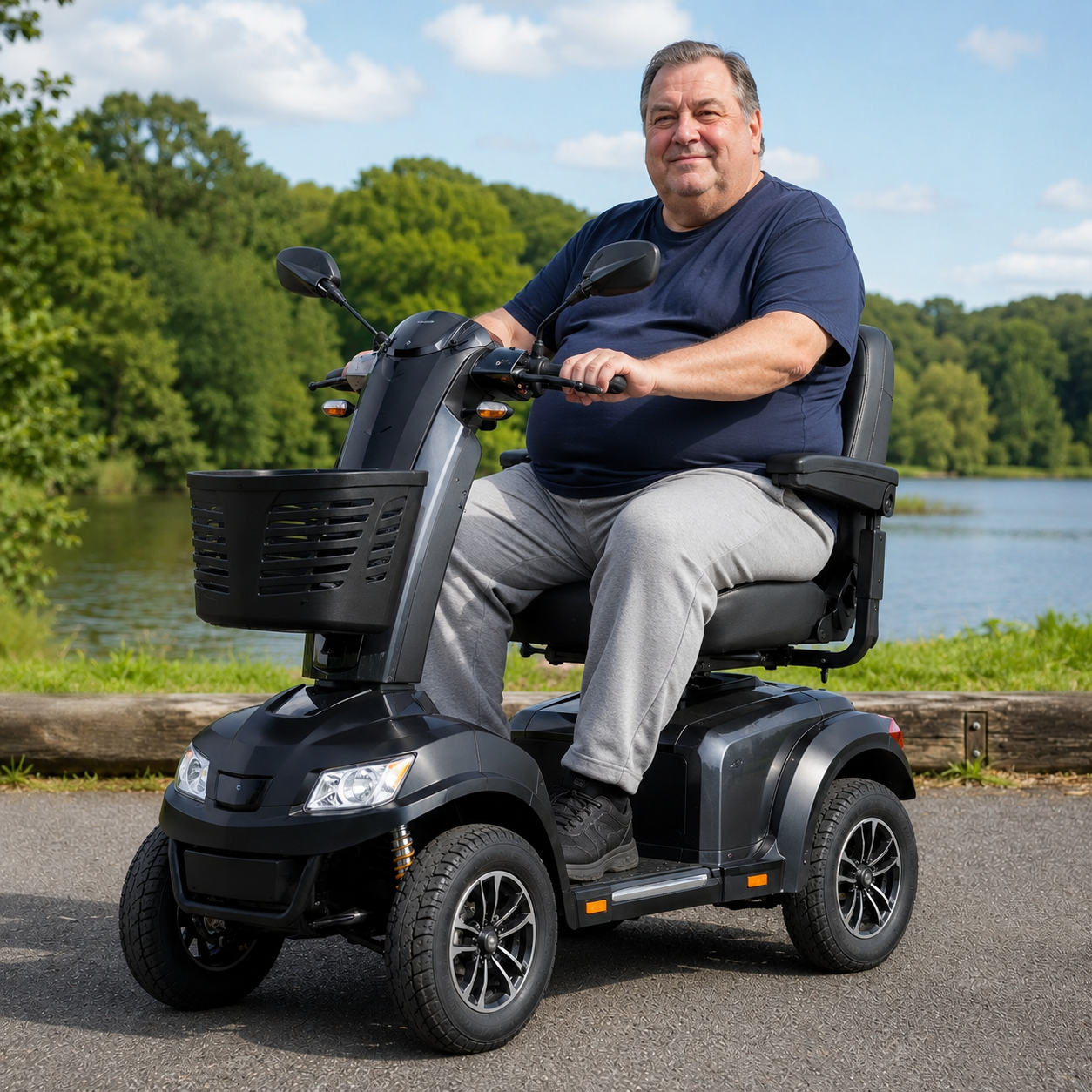
Best High-Weight-Capacity Mobility Scooters: 5 Heavy-Duty Models
A high-weight-capacity mobility scooter should provide more than a strong frame. The seat, suspension, legroom, stability, battery range and controls must all be suitable for the user. This guide compares five of the highest-capacity mobility scooters currently available from Mobility Connect.
The maximum user weight is one of the most important specifications when choosing a mobility scooter. It indicates the highest user weight that the scooter has been designed and tested to support.
This limit should never be exceeded. Operating a scooter above its permitted capacity can affect stability, braking, steering, range and the durability of its components.
However, a higher maximum user weight does not automatically make a scooter more comfortable. Seat width, seat depth, armrest spacing, legroom, suspension and ease of access must also suit the individual user.
The best scooter is one that provides suitable capacity, comfort, support and performance for the places you intend to travel. A free demonstration allows the user to assess the seating position and controls before making a decision.
Maximum capacities are safety limits rather than targets. Discuss your requirements honestly and include normal clothing, footwear and expected changes when comparing suitable models.
What Does Maximum User Weight Mean?
Maximum user weight is the highest permitted weight of the person using the scooter. It is established by the scooter manufacturer and should be treated as an absolute limit.
Baskets, storage boxes and other accessories may have their own separate carrying limits. Heavy shopping should never be hung from the tiller or placed where it could affect steering and stability.
| Specification | What it tells you | What else to check |
|---|---|---|
| Maximum user weight | The highest user weight permitted by the manufacturer | Seat dimensions, access and everyday comfort |
| Seat width | The usable width of the scooter seat | Armrest position and space for clothing |
| Seat depth | The support provided beneath the upper legs | Knee position and pressure behind the legs |
| Scooter width | The space required through gates and storage areas | Mirrors, armrests and accessories |
| Suspension | How the scooter absorbs uneven surfaces | Tyres, seating and intended terrain |
| Maximum range | Approximate maximum distance under favourable conditions | User weight, hills, weather and battery condition |
User weight is one of several factors that can affect battery range. Hills, rough ground, cold weather, tyre pressure and additional belongings can also reduce the distance available from each charge.
Read our guide explaining how to increase mobility scooter travel range .
High-Weight-Capacity Mobility Scooter Comparison
| Mobility scooter | Maximum user weight | Maximum range | Top speed | Ground clearance | Key strength |
|---|---|---|---|---|---|
| Rascal Vision | 32 stone / 204kg | 28 miles | 8mph | 120mm | 950W motor and all-round suspension |
| Kymco Maxi XLS | 32 stone / 203kg | 35 miles | 8mph | 100mm | Long range and relatively narrow design |
| Monarch Obsidian | 32 stone | 37 miles | 8mph | 130mm | Large wheels and extended travel range |
| Scooterpac Savvy 8 Plus | 31 stone / 200kg | 34 miles | 8mph | 135mm | Strong capacity with modern technology |
| Drive Royale 4 | 29 stone / 185kg | 32 miles | 8mph | 150mm | Large wheels and independent suspension |
These models are designed primarily for regular outdoor use and longer journeys. They require considerably more storage and transport space than folding or car-boot scooters.
Five Mobility Scooters with the Highest Weight Capacities

Rascal Vision
The Rascal Vision has the highest stated kilogram capacity in this comparison. Its heavy-duty construction, 950W motor and all-round suspension are designed to provide dependable performance across a variety of outdoor surfaces.
The scooter also includes pneumatic tyres, a supportive swivel captain’s seat and a digital display showing information such as battery usage, time and temperature.
Kymco Maxi XLS
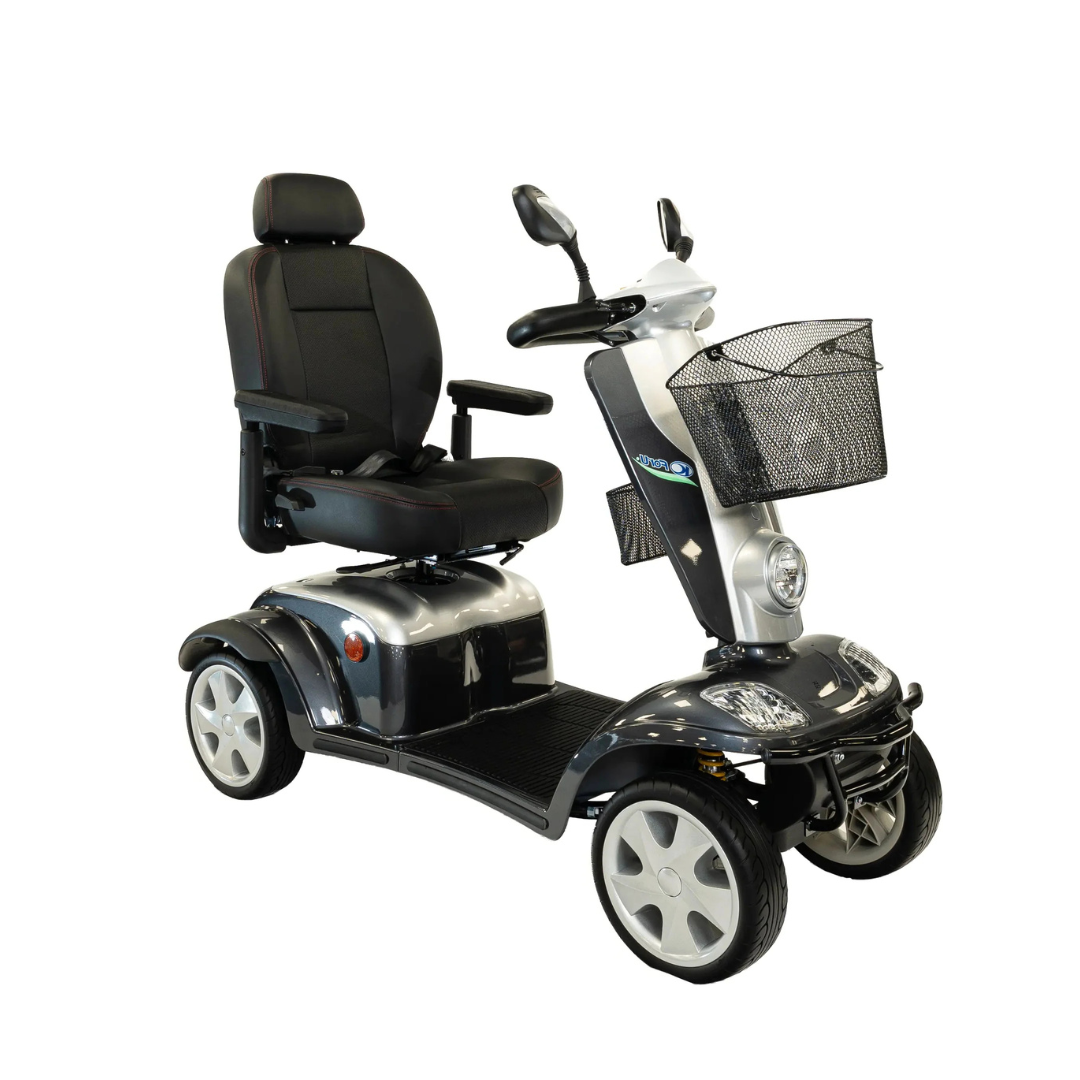
The Kymco Maxi XLS combines a 32-stone capacity with a maximum travel range of 35 miles. At 670mm wide, it is also the narrowest scooter in this five-model comparison.
Front and rear suspension, pneumatic tyres and a luxurious swivel captain’s seat help create a comfortable and supported riding position for regular journeys.
Monarch Obsidian
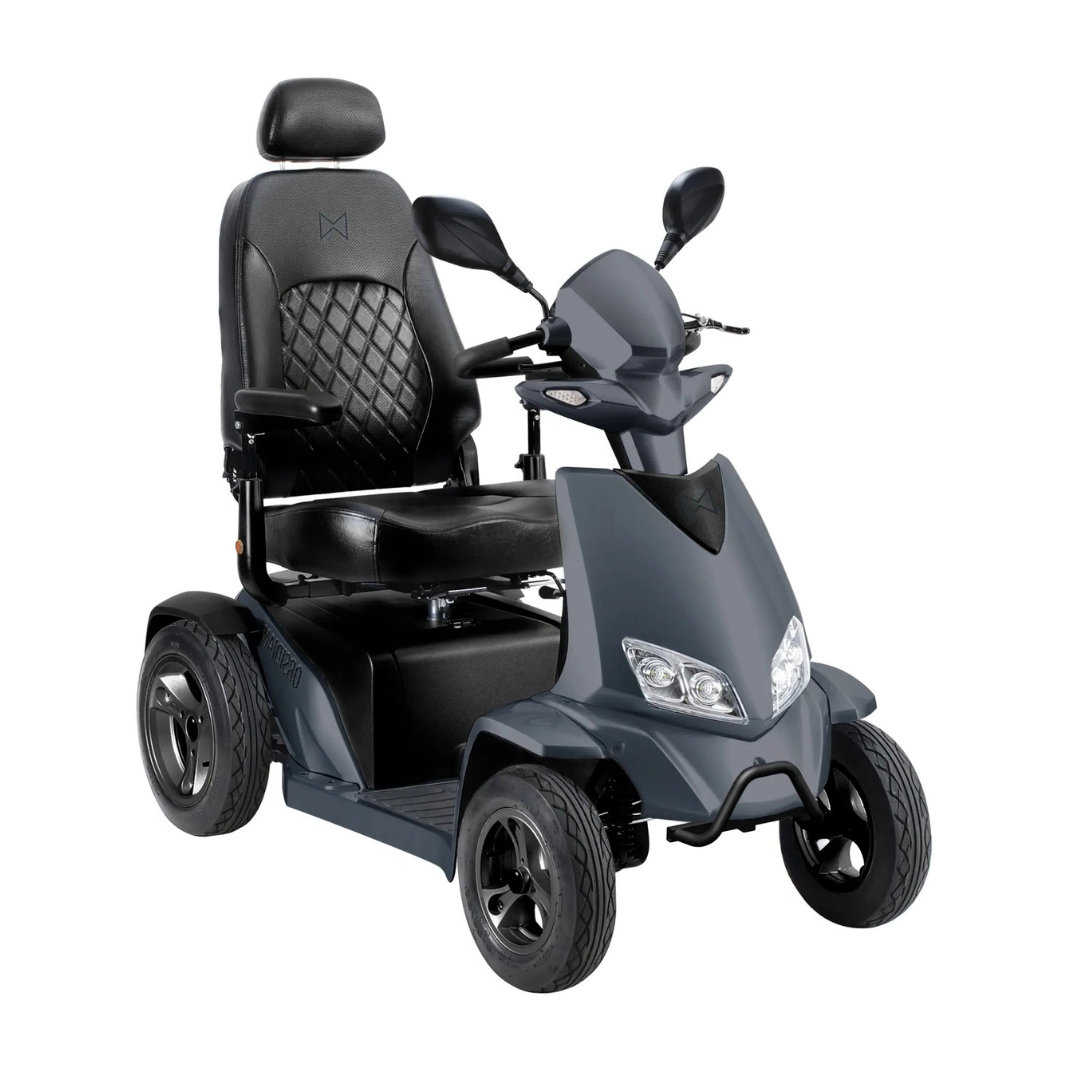
The Monarch Obsidian combines a 32-stone capacity with the longest published range in this comparison, travelling up to 37 miles per charge.
Its large 14-inch front and 16-inch rear wheels, 650W motor and 130mm ground clearance make it an option for users who expect to travel over varied outdoor surfaces.

Scooterpac Savvy 8 Plus
The Scooterpac Savvy 8 Plus provides a substantial 31-stone capacity, a maximum range of 34 miles and front and rear suspension.
It also includes modern conveniences such as Bluetooth audio, USB charging and a mobile-phone holder, alongside a plush captain’s seat and pneumatic tyres.

Drive Royale 4
The Drive Royale 4 combines a 29-stone capacity with fully active independent front and rear suspension and extra-large 16-inch rear wheels.
Its ergonomic sport seat and illuminated LCD display are designed around longer journeys, while the scooter offers a maximum range of 32 miles.
What to Look for in a Heavy-Duty Mobility Scooter
Maximum user weight is an essential starting point, but it should be considered alongside the complete design of the scooter.
| Feature | Why it matters | What to check |
|---|---|---|
| Seat size | The user needs sufficient support without pressure from the armrests | Width, depth, backrest height and armrest spacing |
| Legroom | Restricted space can create an uncomfortable knee and hip position | Tiller adjustment, seat position and footwell length |
| Suspension | Helps absorb uneven surfaces and road imperfections | Front, rear or all-round suspension |
| Tyres | Influence comfort, grip and resistance | Tyre size, pneumatic or solid construction |
| Ground clearance | Important on dropped kerbs, uneven paths and outdoor terrain | The lowest part beneath the scooter |
| Battery capacity | Larger scooters normally need substantial batteries | Practical range and charging arrangements |
| Braking and control | The scooter should feel predictable at both high and low speeds | Braking response, steering and acceleration |
| Access | Getting on and off comfortably is essential | Swivel seat, armrests and tiller adjustment |
A high-capacity scooter may be suitable when:
- A standard scooter does not provide sufficient permitted user-weight capacity.
- A wider or deeper seat is required.
- Additional legroom is important.
- Regular outdoor journeys require larger wheels.
- More substantial suspension is preferred.
- A supportive captain’s seat is needed.
- Longer travel range is important.
- The scooter can be stored and charged securely.
Seat Size, Posture and Comfort
A scooter can have the correct weight capacity and still be unsuitable if the seat is too narrow, too short or does not provide the required support.
Check the following during a demonstration
- The user can sit fully back against the backrest.
- The seat provides sufficient width without pressure from the armrests.
- The seat edge does not press uncomfortably behind the knees.
- Both feet can remain supported in the intended position.
- The knees do not contact the tiller.
- The tiller can be reached without leaning forward.
- The controls can be operated comfortably.
- The user can turn their head and check surroundings.
- The seat can swivel where required.
- The armrests support safe entry and exit.
Anyone who experiences pain, reduced sensation, posture problems or pressure concerns should discuss seating with an appropriate healthcare or seating professional.
Storage, Charging and Transport
High-capacity scooters are generally larger and heavier than portable mobility scooters. Most cannot be lifted into a standard car boot or dismantled into lightweight sections.
- Measure the intended storage area.
- Measure all gates and doorways on the route to storage.
- Allow space around the scooter for safe access.
- Confirm that the charger can be connected easily.
- Use a dry and secure charging location.
- Check whether ramps are required.
- Confirm that any ramp has sufficient capacity and width.
- Check the scooter’s complete weight with batteries.
- Use a suitable mobility vehicle, hoist or trailer for transport.
- Check the load capacity of any vehicle or lifting equipment.
- Secure the scooter using approved restraint points.
- Never rely on the scooter’s brakes alone during vehicle transport.
Large mobility scooters may not pass through narrow gates, side passages or domestic doors. Check the complete route from the delivery vehicle to the storage location.
High-Capacity Mobility Scooter Demonstration Checklist
- Confirm the published maximum user weight.
- Check the seat width and seat depth.
- Adjust the armrests.
- Adjust the seat position.
- Adjust the tiller position.
- Check the available legroom.
- Practise getting on and off.
- Check that the seat swivels and locks correctly.
- Test the scooter at low speed.
- Practise stopping progressively.
- Practise reversing.
- Complete turns in both directions.
- Test the scooter on a suitable incline.
- Test it on a representative uneven surface.
- Check visibility in the mirrors.
- Check that all controls are easy to reach.
- Confirm the practical battery range required.
- Measure the scooter’s width and length.
- Confirm storage and charging arrangements.
- Discuss servicing and breakdown support.
The demonstration is an opportunity to check comfort, access, controls and manoeuvrability rather than relying only on measurements from a website.
High-Weight-Capacity Mobility Scooter FAQs
Which Mobility Connect scooter has the highest weight capacity?
The Rascal Vision currently has the highest clearly stated kilogram capacity on the Mobility Connect website at 32 stone or 204kg. The Kymco Maxi XLS supports 32 stone or 203kg, while the Monarch Obsidian is also listed at 32 stone.
What is considered a high-capacity mobility scooter?
There is no single universal definition, but the term normally describes a more substantial scooter designed to support a higher maximum user weight than typical portable or pavement models.
Can I use a mobility scooter above its weight limit?
No. The manufacturer’s maximum user weight must not be exceeded. Doing so may affect stability, steering, braking, range and product reliability.
Does shopping count towards the scooter’s maximum user weight?
The published figure normally refers specifically to maximum user weight. Baskets and accessories can have separate limits, so ask the supplier how belongings should be carried on the chosen model.
Does a higher weight capacity mean the seat is wider?
Not necessarily. Weight capacity and seat width are separate specifications. Always check the actual seat dimensions and armrest spacing.
Are high-capacity mobility scooters more comfortable?
Many include captain’s seats, larger tyres and substantial suspension, but comfort depends on how well the seat and controls fit the individual user.
Does user weight affect mobility scooter range?
It can. Increased load can require more energy, particularly on hills and rough surfaces. Weather, tyre pressure, battery condition and driving style also affect practical range.
Can a high-capacity mobility scooter fit in a car?
Most of the scooters in this guide are too large and heavy for a normal car boot. Transport may require an adapted vehicle, suitable hoist, mobility trailer or professional transport solution.
Do high-capacity scooters need more storage space?
Yes. Heavy-duty road-legal scooters are normally longer, wider and heavier than portable models. Measure the complete access route and storage location before ordering.
Should I have a demonstration before choosing one?
Yes. A demonstration allows you to assess seat fit, posture, legroom, controls, turning, suspension and ease of getting on and off.
Are these scooters suitable for road use?
The five models in this comparison are listed as Class 3 road-legal mobility scooters. They are substantial outdoor models rather than compact indoor or car-boot scooters.
Need a Mobility Scooter with a Higher Weight Capacity?
Mobility Connect can help you compare user-weight capacity, seat size, legroom, suspension, storage and travel range before arranging a free demonstration.