


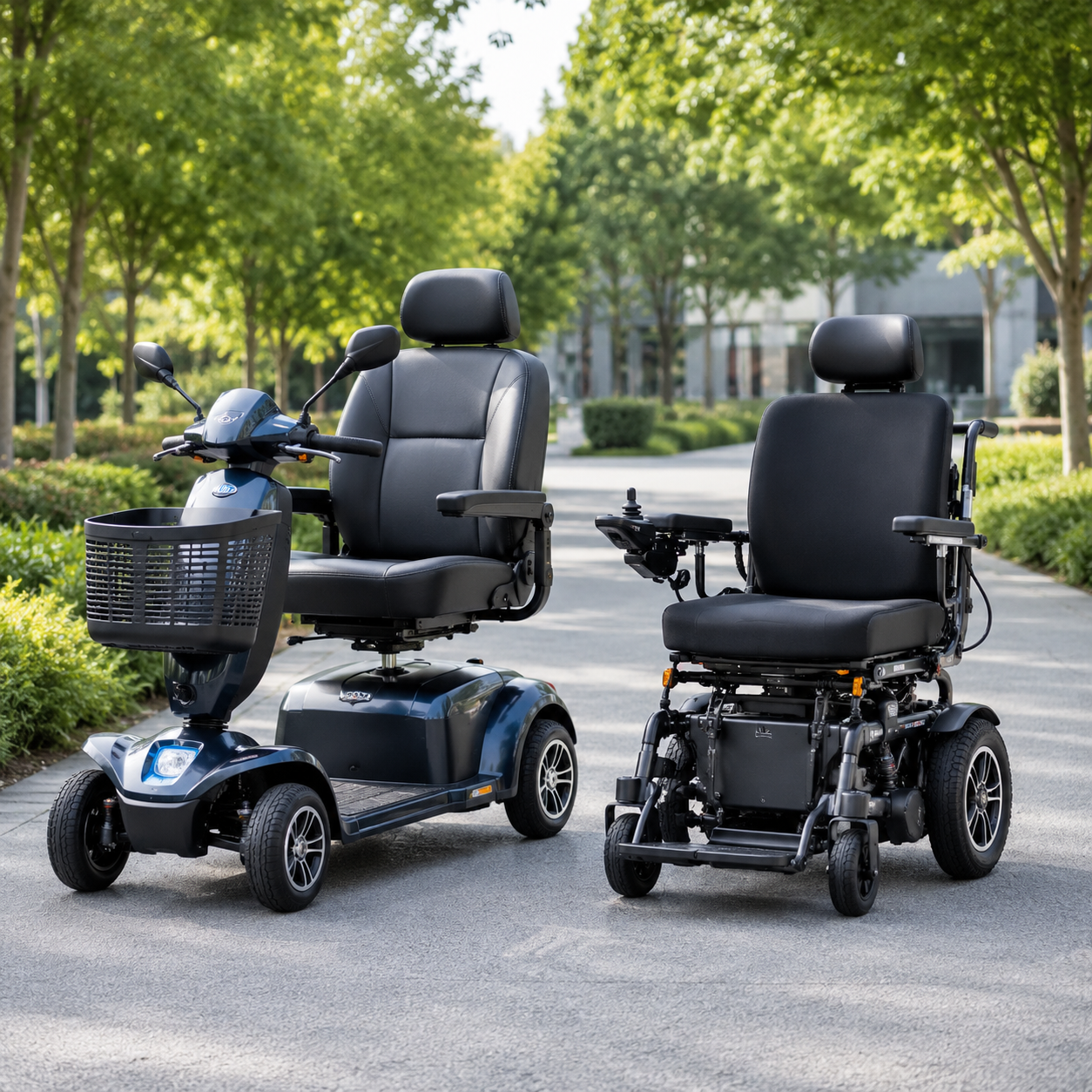
Mobility Scooter vs Powerchair: Which Is Right for You?
Mobility scooters and powerchairs can both provide greater freedom and independence, but they are designed around different needs. This guide compares their controls, seating, manoeuvrability, outdoor performance, transport requirements and everyday suitability.
Choose a scooter for outdoor journeys
A mobility scooter may suit you when you can transfer independently, operate tiller controls and mainly need help travelling longer distances outdoors.
Choose a powerchair for closer control
A powerchair may be more suitable when you need joystick control, a tighter turning circle or more supportive seating for regular use.
Assess the complete journey
Consider your home, transfers, posture, storage, transport, local routes and the environments in which the product will be used.
Choosing between a mobility scooter and a powerchair is not simply a matter of deciding which product looks more comfortable or has the longest advertised range.
The right choice depends on how you move, whether you can transfer in and out of the seat, how much upper-body control you have and where the product will be used. Storage, charging and transportation can be just as important as the product’s performance.
Mobility scooters are commonly associated with outdoor journeys and tiller steering. Powerchairs use joystick controls and can offer a more compact footprint, closer manoeuvring and a wider range of seating configurations. However, there is considerable variation within both categories.
A lightweight folding powerchair can be easier to transport than a large road mobility scooter. Equally, a substantial outdoor powerchair can be heavier and more specialised than many scooters.
Avoid choosing from specifications alone. Where possible, try the controls, check your seating position and confirm that the product will fit through your home, storage area and intended vehicle.
What Is the Main Difference Between a Mobility Scooter and a Powerchair?
A mobility scooter normally has a seat positioned behind a steering column known as a tiller. The user steers by moving the handlebars and usually controls forward and reverse movement using levers or paddles.
A powerchair is an electrically powered wheelchair. It is commonly controlled through a small joystick positioned on one of the armrests. The joystick controls both the direction and speed of movement.
Mobility scooter
Typically suited to people who can sit upright, transfer into the seat and reach and operate a tiller. Scooters are commonly selected for outdoor journeys.
Powerchair
Typically suited to people who benefit from joystick control, a tighter turning circle or more supportive seating for indoor and outdoor mobility.
These are general differences rather than strict rules. Outdoor powerchairs, folding powerchairs and compact indoor scooters can blur the boundaries between the two product types.
Mobility Scooter vs Powerchair: Quick Comparison
| Consideration | Mobility scooter | Powerchair |
|---|---|---|
| Primary control | Tiller or handlebars | Joystick on an armrest |
| Turning circle | Usually requires more room, particularly on larger models | Often tighter and better suited to restricted spaces |
| Transfer requirements | User normally transfers into and out of the scooter seat | May be used as the person’s main seating and mobility product |
| Upper-body requirements | Normally requires the ability to reach, hold and turn the tiller | A joystick can require less movement and may be repositioned |
| Indoor manoeuvrability | Compact models can be used indoors, but tillers need turning space | Often more suitable for hallways, shops and tighter rooms |
| Outdoor journeys | Wide choice of pavement, road-legal and all-terrain models | Outdoor-capable models are available, but suitability varies considerably |
| Seating support | Usually a conventional swivel or captain’s seat | Can offer more adaptable seating, cushions, supports and foot positioning |
| Transport options | Folding, dismantling and car-boot models are available | Folding powerchairs are available alongside heavier fixed-base models |
| Storage | Larger scooters can require substantial secure storage | Compact powerchairs may need less floor space, although fixed-base models can be heavy |
| Typical shopping storage | Often includes a front basket or optional rear storage | Storage bags and accessories are available, but capacity varies |
| Road-legal options | Class 3 road scooters are widely available | Some powered wheelchairs also meet Class 3 requirements |
Swipe horizontally across the table to view the complete comparison on a smaller screen.
Who Might Prefer a Mobility Scooter?
A mobility scooter may be appropriate when you can walk shorter distances or transfer independently but need help travelling further.
A mobility scooter may suit you when:
- You can transfer safely into and out of the scooter seat.
- You can sit upright without extensive lateral or postural support.
- You can reach and comfortably operate the tiller.
- You have sufficient vision, awareness and reaction time for the intended environment.
- Your main requirement is completing outdoor journeys.
- You want to travel to shops, appointments, parks or family visits.
- You need a larger basket or practical shopping storage.
- You would benefit from a long-range road or pavement model.
- You have suitable space to store and charge it.
- You can transport the scooter or its individual sections where car travel is important.
Scooters are available for very different journeys, from compact shopping-centre use to regular road travel and challenging countryside routes.
Portable scooters
Compact and dismantling models can be divided into smaller sections for transport in a suitable car.
Folding scooters
Manual and automatic folding systems reduce the scooter’s storage size for travel and occasional use.
Pavement scooters
Compact Class 2 models are designed for pedestrian areas and everyday local journeys.
Road-legal scooters
Class 3 scooters can provide greater range, comfort and road equipment for longer journeys.
Who Might Prefer a Powerchair?
A powerchair may be more appropriate when walking is considerably restricted or when a joystick is easier to use than a scooter tiller.
A powerchair may suit you when:
- You need powered mobility inside the home as well as outdoors.
- You find it difficult to hold or turn scooter handlebars.
- You have limited shoulder, arm or hand movement.
- You need a tighter turning circle for hallways, shops or smaller rooms.
- You need to approach tables, desks or work surfaces more closely.
- You require more supportive seating or better foot positioning.
- You expect to remain seated in the product for longer periods.
- You find transferring between different seats difficult.
- You want a lightweight folding powerchair for transport.
- You require a stronger fixed-base model for regular everyday use.
Folding powerchairs
Folding models prioritise portability and can be suitable for days out, holidays and car travel, subject to their lifting weight.
Fixed-base powerchairs
Fixed-base models can offer greater stability, comfort, outdoor capability and seating adjustment, but are usually more difficult to transport.
Lightweight folding powerchairs often use simpler seating to reduce weight. Where posture, pressure relief or significant physical support is required, request an appropriate seating and mobility assessment.
Tiller Controls vs Joystick Controls
The method of control is one of the most important differences between a scooter and powerchair.
Mobility scooter tiller
A scooter tiller is positioned in front of the user. It may need to be turned through a noticeable arc when steering, particularly during a tight manoeuvre.
The user normally operates forward and reverse levers using the fingers or thumbs. They may also need to reach switches for the horn, lights, indicators and speed control.
Before choosing a scooter, check that you can:
- Reach the tiller without leaning forward excessively.
- Hold and turn it comfortably in both directions.
- Operate the drive lever repeatedly without pain or fatigue.
- Maintain a safe and stable seated position while steering.
- Look behind and around the scooter when manoeuvring.
Powerchair joystick
A powerchair joystick normally moves through a much smaller range. Pushing it forwards, backwards or sideways controls both the direction and speed.
Joystick position can often be adjusted along the armrest, and it may be fitted on either side depending on the model. More specialised chairs may support alternative controls, although these require individual assessment.
Before choosing a powerchair, check that you can:
- Position your hand comfortably on the joystick.
- Make small and controlled movements in every direction.
- Release the joystick reliably to stop.
- Avoid accidental operation while transferring or repositioning your arm.
- Reach the power, horn and speed controls.
Some people find a tiller more natural, while others need the lighter movement of a joystick. Try both while seated in a realistic driving position.
Seating, Posture and Physical Support
Comfort during a brief demonstration does not always predict comfort after an hour of use. The seating must support your posture throughout the journeys you plan to make.
Typical mobility scooter seating
Many scooters use a swivel seat with armrests and a relatively upright backrest. Larger models may have padded captain’s seats, sliding adjustment, reclining backrests and headrests.
Scooter seating may be suitable when you have good sitting balance and can maintain a stable position without specialist lateral, pelvic or leg support.
Typical powerchair seating
Powerchairs can provide a more wheelchair-like position with separate footplates, adjustable armrests and the potential for different cushions or supports.
Fixed-base models may offer more adjustment than lightweight folding models. Specialist powered wheelchairs can include advanced seating functions, but these are different from standard retail folding powerchairs.
Check the following areas
- Seat width and depth.
- Backrest height and shape.
- Foot support and lower-leg position.
- Armrest height and width.
- Head and neck position where a headrest is required.
- Stability when turning, braking and travelling over uneven ground.
- Ability to relieve pressure or change position.
- Space for coats, cushions or medical equipment.
Seek an assessment where you have reduced trunk control, significant asymmetry, a history of pressure damage, progressive weakness, severe pain or difficulty maintaining a safe seated position.
Which Is Better for Indoor Use?
Powerchairs are often easier to manoeuvre indoors because the joystick controls the drive wheels directly and the product does not need a large tiller to swing through a turn.
Some powerchairs can rotate within or close to their own footprint, depending on the drive-wheel configuration. This can make them easier to use in hallways, shops, restaurants and smaller rooms.
Compact mobility scooters can be used in shopping centres and larger indoor spaces, but the tiller and longer frame may need more room.
Measure more than the doorway
- The narrowest doorway on the intended route.
- The usable opening with the door fully open.
- Hallway width and turning space.
- Space beside the bed, chair or toilet.
- Lift dimensions and maximum weight.
- Space needed to open cupboards and internal doors.
- Space required for transferring on and off.
A product may pass through a doorway but still be unable to turn immediately afterwards. Test the complete route rather than relying on one width measurement.
Which Is Better for Outdoor Journeys?
Mobility scooters provide the widest selection of products designed specifically for longer outdoor journeys. Larger models can include substantial suspension, higher ground clearance, road lighting, large wheels and long-range batteries.
Outdoor powerchairs are also available. Fixed-base models with suspension, larger drive wheels and suitable tyres can perform well on pavements and outdoor routes.
Lightweight folding powerchairs generally prioritise portability. They may not offer the same suspension, ground clearance or rough-ground capability as a larger fixed-base model.
| Journey type | Products commonly considered |
|---|---|
| Shopping centres and smooth indoor areas | Compact scooter or manoeuvrable powerchair |
| Short pavement journeys | Class 2 scooter, folding powerchair or compact fixed-base powerchair |
| Longer local journeys | Larger pavement scooter, Class 3 scooter or suitable outdoor powerchair |
| Regular road use | Class 3 mobility scooter or qualifying Class 3 powered wheelchair |
| Grass and uneven paths | All-terrain scooter or appropriately equipped outdoor powerchair |
| Car travel and holidays | Folding scooter, car-boot scooter or folding powerchair |
Product specifications should not be used in isolation. Ground conditions, slopes, user weight, tyre type and battery condition can all affect outdoor performance.
Transporting, Storing and Charging the Product
A product can be ideal to drive but unsuitable to own if it cannot be stored, charged or transported conveniently.
Questions about transport
- Does the product fold or dismantle?
- What is its total weight?
- What is the heaviest section you will need to lift?
- Will it fit through the vehicle’s boot opening?
- Can the battery be removed separately?
- Does it need a ramp, hoist or wheelchair-accessible vehicle?
- Who will perform the lifting and loading?
- Can it be secured safely during transport?
Questions about storage and charging
- Is there a dry and secure storage position?
- Does the product block a hallway or escape route?
- Is there enough space to turn and park safely?
- Is there a suitable electrical socket nearby?
- Can the battery be removed and charged separately?
- Do you have permission to store or charge it in a shared building?
- Can the product be protected from extreme cold, moisture and theft?
A folding product may still be too heavy for one person to lift safely. Test the intended loading process or measure the car before committing to a purchase.
Folding Mobility Scooter vs Folding Powerchair
Folding products have made both categories more suitable for travel, but their designs remain different.
Folding mobility scooter
Usually retains scooter-style tiller steering and a foot platform. Some models fold manually, while others use a powered folding mechanism.
Folding scooters may suit people who prefer scooter controls but need a smaller transport and storage footprint.
Folding powerchair
Uses joystick control and normally has separate footrests or a folding footplate. Carbon-fibre and aluminium models can be particularly lightweight.
Folding powerchairs may suit people who need joystick control and compact manoeuvrability while travelling.
Compare these details carefully
- Total folded dimensions.
- Total weight and lifting points.
- Battery weight and removal process.
- Seat width and depth.
- Backrest support.
- Ground clearance.
- Tyre size and suspension.
- Realistic range for your journeys.
- Maximum user weight.
- Ease of folding and unfolding.
UK Rules for Mobility Scooters and Powered Wheelchairs
UK legal classifications apply to both mobility scooters and powered wheelchairs. The product category alone does not determine whether it can use the road.
| Classification | General rules |
|---|---|
| Class 2 | Maximum speed of 4mph or less. Can be used on pavements, pedestrian areas and separated cycle tracks. |
| Class 3 | Maximum speed of up to 8mph. Can be used on pavements at no more than 4mph and can also be used on roads when legal requirements are met. |
| DVLA registration | Class 3 mobility scooters and powered wheelchairs must be registered with the DVLA. |
| Insurance | Insurance is not normally compulsory for Class 2 or Class 3 products, although the government recommends it. |
| Pavement speed | Class 2 and Class 3 products must not exceed 4mph in pedestrian areas and must give way to pedestrians. |
Class 3 products used on roads need the required equipment, including effective brakes, lights, reflectors, direction indicators, a mirror and an audible horn.
Check the latest official guidance before using a product on public roads or pavements:
Can Someone Use Both a Mobility Scooter and a Powerchair?
Yes. Some people use different mobility products for different parts of their lives.
For example, a compact powerchair may be used inside the home and in shops, while a larger scooter is used for longer outdoor journeys.
Other combinations might include:
- A fixed-base powerchair for everyday mobility and a folding powerchair for holidays.
- A walking aid indoors and a mobility scooter outdoors.
- A compact scooter for shopping and a larger road scooter for local journeys.
- A powerchair for independent movement and a manual wheelchair for certain transport situations.
The decision should reflect your current ability, available storage, transport arrangements and how your mobility needs may change.
Mobility Scooter or Powerchair Decision Checklist
- Can you transfer safely into and out of a scooter seat?
- Can you reach, hold and turn a tiller comfortably?
- Would a small joystick movement be easier to control?
- Do you need powered mobility inside your home?
- Can you maintain a stable seated position without specialist support?
- Will you remain seated in the product for long periods?
- Do you need to approach tables and work surfaces closely?
- What is the narrowest doorway on your route?
- How much turning space is available indoors?
- Will you mainly travel indoors, on pavements, on roads or over uneven ground?
- What realistic battery range do your usual journeys require?
- Does the product need to fit into a car?
- What is the heaviest component you can safely lift?
- Is there somewhere dry and secure to store it?
- Can the battery be charged safely in the intended location?
- Will you require a ramp, hoist or accessible vehicle?
- Are servicing, repairs and replacement parts readily available?
- Have you tried the product in a realistic driving environment?
When Should You Request a Professional Assessment?
A retail demonstration may be sufficient for someone with straightforward mobility needs who can transfer, sit safely and operate the controls confidently.
A more detailed assessment is advisable where the decision involves complex physical, medical or seating needs.
Request specialist advice when:
- You have reduced head or trunk control.
- You lean noticeably to one side when sitting.
- You have a history of pressure sores or skin damage.
- You experience significant pain while seated.
- Your condition is progressive or changes considerably through the day.
- You require specialist cushions, supports or powered seating functions.
- You cannot operate a standard tiller or joystick safely.
- You need help transferring or repositioning.
- The product will be your primary seating system throughout the day.
- You need to transport the product while remaining seated in it.
An occupational therapist, wheelchair service or suitably qualified healthcare professional can assess mobility, posture, transfers, pressure care and the home environment.
The NHS also provides general information about walking aids, wheelchairs and mobility scooters .
Mobility Scooter vs Powerchair FAQs
What is the main difference between a mobility scooter and a powerchair?
A mobility scooter normally uses a tiller or handlebars positioned in front of the user. A powerchair normally uses a small joystick on an armrest. Powerchairs often have tighter turning circles and can offer more adaptable seating, while scooters provide a wide selection of products for longer outdoor journeys.
Is a powerchair easier to use than a mobility scooter?
It depends on the user. A joystick requires smaller movements and may be easier for someone with limited reach or shoulder movement. Other people find scooter handlebars more familiar and reassuring. Both should be tried before making a decision.
Which is better for indoor use?
A powerchair is often easier to manoeuvre indoors because it usually has a tighter turning circle and does not have a large tiller. Compact mobility scooters can still be suitable for shopping centres and larger indoor spaces.
Which is better for outdoor use?
Mobility scooters provide the broadest range of outdoor-focused products, including pavement, road-legal and all-terrain models. Outdoor powerchairs are also available, but the tyres, suspension, ground clearance and battery range must suit the intended route.
Can a powerchair be used on the road?
A powered wheelchair can be used on the road when it qualifies as Class 3, is registered with the DVLA and has the equipment required for road use. A standard Class 2 powerchair cannot be used for normal road travel.
Can a mobility scooter be used inside the home?
Some compact mobility scooters can be used in larger homes where doorway and turning space are sufficient. The tiller and longer wheelbase can make a scooter more difficult to manoeuvre in narrow hallways and smaller rooms.
Are powerchairs more supportive than mobility scooters?
Powerchairs can provide more adaptable seating, foot support and positioning, particularly on fixed-base or specialist models. Lightweight folding powerchairs may use relatively simple seating to keep their weight low, so the level of support varies by model.
Which is easier to put in a car?
Folding powerchairs, folding scooters and dismantling car-boot scooters can all be suitable for vehicle transport. Compare the folded dimensions, total weight and heaviest section with the car and the lifting ability of the person loading it.
Can someone use both a scooter and a powerchair?
Yes. Different products may suit different environments. A person might use a powerchair indoors and a scooter for longer outdoor journeys, or keep a folding product for travel.
Do I need a medical assessment before buying one?
A medical assessment is not always required for a straightforward retail purchase. Professional assessment is strongly advisable where you have complex seating, posture, transfer, pressure-care or control requirements.
Should I choose based on the longest battery range?
No. Range is important, but the product must also fit your body, home, vehicle and intended routes. Published range can vary in real use according to hills, temperature, surfaces, tyre pressure, battery condition and the weight being carried.
Find the Right Mobility Product for Your Life
Speak with Mobility Connect about your controls, seating, indoor space, outdoor journeys, transport needs and storage before choosing a mobility scooter or powerchair.