


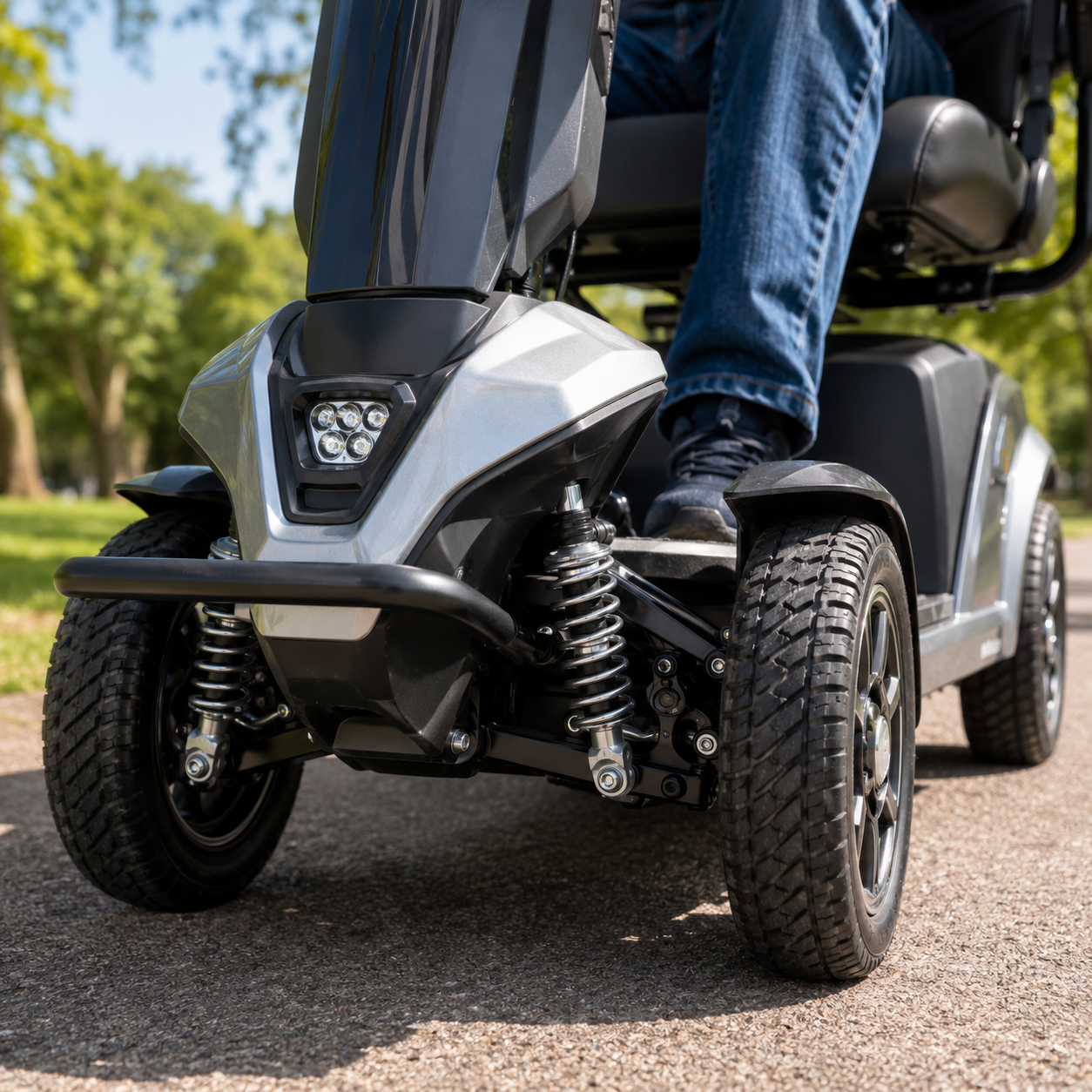
Mobility Scooter Suspension Explained: Benefits, Types and When You Need It
Suspension can reduce the jolts and vibration transferred through a mobility scooter when it crosses paving joints, dropped kerbs and uneven surfaces. But not every scooter needs full suspension, and suspension alone does not determine comfort, stability or terrain capability.
It gives the wheels room to react before the rest of the scooter has to.
Without suspension, much of the movement created by a bump passes directly through the wheels, chassis, seat and user.
A suspension system introduces controlled movement between the wheels and frame. This can soften abrupt impacts and create a calmer, less jarring ride.
Even a well-maintained pavement contains joints, shallow dips, patched tarmac and changes in level. A mobility scooter without suspension transfers more of this movement through its wheels and frame.
On a short journey across a smooth shopping centre, that may not be a significant problem. Over longer journeys, repeatedly crossing dropped kerbs and uneven residential pavements can make the ride tiring or uncomfortable.
Suspension is therefore most useful when it matches the journeys being completed. It should not be treated as a feature that every scooter must have or as proof that a scooter can safely tackle rough terrain.
Comfort and control are also influenced by the tyres, wheel size, seat, wheelbase, speed, ground clearance, weight distribution and the way the scooter has been adjusted for its user.
How Does Mobility Scooter Suspension Work?
Suspension creates controlled movement between the wheels and the scooter’s main frame. Most systems use springs, dampers or a combination of components that compress when a wheel encounters a raised or uneven surface.
The system then returns towards its normal position rather than allowing the complete scooter to follow every movement of the wheel at the same intensity.
The wheel meets a bump
A paving joint, kerb edge or uneven patch pushes the wheel upwards.
The suspension compresses
The spring or suspension linkage allows controlled movement around the wheel.
Less movement reaches the frame
Part of the sudden impact is absorbed before it travels through the chassis.
The scooter settles again
The suspension returns towards its normal position after the obstacle has been crossed.
It cannot remove every jolt or make an unsuitable route safe. Large potholes, steep kerbs, deep gravel and severe side slopes should still be avoided.
What Are the Benefits of Suspension on a Mobility Scooter?
A smoother ride over everyday imperfections
Suspension can soften the movement created by paving joints, patched tarmac, shallow dips and low dropped kerbs.
Less repeated movement through the seat
Reducing repeated jolts can make longer journeys feel less tiring, particularly for users who are sensitive to vibration or abrupt movement.
More consistent wheel contact
On minor surface variations, controlled wheel movement can help the scooter feel calmer and more predictable than a completely rigid frame.
Greater comfort over longer distances
The difference becomes more noticeable when a journey contains repeated changes in surface rather than one isolated bump.
It can reduce some of the movement transmitted through the frame, but servicing, user weight, terrain, tyre condition, storage and driving style still affect wear.
Front, Rear and Full Mobility Scooter Suspension
The word “suspension” can describe several different systems. Two scooters that both list suspension may provide noticeably different ride quality.
Front suspension
Front suspension acts around the front wheels, where the scooter first meets kerbs, joints and surface changes.
It can make a noticeable difference on local pavements without adding the weight and complexity of a complete front-and-rear system.
Rear suspension
Rear suspension acts close to the seat and drive wheels. It can reduce the movement reaching the user after the rear wheels cross an obstacle.
Some systems allow the rear suspension firmness or preload to be adjusted for different user weights.
Full or all-round suspension
Full suspension provides movement at both ends of the scooter and is most common on larger pavement, road-legal and outdoor models.
It is particularly useful for longer journeys where both wheels repeatedly encounter changing surfaces.
Independent suspension
Independent systems allow one wheel to move with less direct effect on the wheel at the opposite side.
This is usually found on higher-specification scooters designed for mixed terrain and extended outdoor use.
Seat-post suspension
Seat-post systems introduce movement directly beneath the seat. They can reduce some of the vibration reaching the user.
They do not provide the same wheel control or chassis isolation as suspension positioned around the wheels.
Pneumatic tyres without suspension
Air-filled tyres compress slightly as they cross a surface variation, providing useful cushioning on lighter scooters.
This is not a true suspension system, but it may be sufficient for shorter journeys over relatively smooth surfaces.
Suspension that is too soft may compress excessively, while a setting that is too firm can reduce the benefit. Use the manufacturer’s instructions or ask an experienced mobility technician to adjust it.
Where Does Mobility Scooter Suspension Make the Most Difference?
The benefit generally increases as journeys become longer and surfaces become more varied. The graphic below is a practical guide rather than a product rating.
* Suspension does not make every scooter suitable for gravel or rough paths. The tyres, motor, wheel size, ground clearance and complete scooter design must also be appropriate.
Suspension is likely to matter more when:
- You regularly travel over older or patched pavements.
- Your route contains frequent dropped kerbs.
- You use the scooter for longer journeys.
- You travel on roads using a suitable Class 3 scooter.
- You experience discomfort from repeated jolting.
- You frequently cross between tarmac, paving and park paths.
Does Suspension Make a Mobility Scooter Safer or More Stable?
Suspension can help the scooter feel more settled as its wheels cross minor surface changes. It may also support more consistent wheel contact on suitable terrain.
It should not, however, be described as a system that automatically prevents tipping or guarantees safe handling.
Suspension can help with
- Reducing abrupt vertical movement.
- Softening repeated small impacts.
- Helping the scooter feel calmer on broken surfaces.
- Supporting comfort over longer journeys.
- Reducing the amount of movement reaching the seat.
Stability still depends on
- Wheelbase and overall width.
- Centre of gravity and weight distribution.
- User position and carried luggage.
- Wheel and tyre size.
- Speed, gradient and turning technique.
- The condition of the route.
Suspension cannot compensate for entering a corner too quickly, crossing a steep side slope or attempting an obstacle beyond the scooter’s stated limits.
Suspension vs Pneumatic Tyres: What Is the Difference?
Suspension and tyres can both reduce the movement reaching the user, but they achieve this in different ways.
| Feature | Dedicated suspension | Pneumatic tyres | Solid tyres |
|---|---|---|---|
| How cushioning is created | Springs, dampers or suspension linkages allow movement between wheels and frame | Air inside the tyre compresses as the wheel crosses a surface change | Limited compression through the tyre material |
| Ride comfort | Can provide substantial benefit on varied surfaces | Usually softer than a comparable solid tyre | Often firmer, particularly on small wheels |
| Maintenance | Components should be inspected during routine servicing | Requires pressure checks and can puncture | Cannot suffer a conventional air-pressure puncture |
| Commonly found on | Mid-size, road-legal and outdoor scooters | Pavement, road and outdoor scooters | Folding, portable and low-maintenance models |
A scooter combining suitable suspension, larger wheels, pneumatic tyres and supportive seating will normally provide a different ride from a compact scooter relying on small solid tyres.
Which Mobility Scooters Usually Have Suspension?
| Scooter category | Typical suspension setup | Why it may or may not be included |
|---|---|---|
| Folding mobility scooter | Often none, although selected premium models include compact suspension | Low weight and folded dimensions are normally prioritised |
| Car-boot scooter | None, front suspension or compact full suspension depending on the model | Components must remain manageable for lifting and dismantling |
| Pavement scooter | Front, rear or all-round suspension on mid-range and premium models | Designed for repeated everyday use on local pavements |
| Road-legal scooter | Front-and-rear or independent suspension is common | Longer journeys and higher road speeds make ride quality more important |
| All-terrain scooter | Substantial full or independent suspension | Designed around larger surface changes and outdoor routes |
| Canopy scooter | Usually full suspension on larger models | Additional bodywork and year-round use favour a more substantial chassis |
Swipe horizontally across the table to see the complete comparison.
Prioritising portability?
Explore compact models where folded size, total weight and ease of lifting matter more than substantial suspension.
Prioritising longer journeys?
Larger pavement and road scooters are more likely to combine suspension with supportive seating, large wheels and greater battery range.
Are There Any Disadvantages to Mobility Scooter Suspension?
Suspension can improve ride quality, but every design choice involves a compromise.
Reasons to choose it
- More comfortable on broken pavements.
- Better suited to longer journeys.
- Reduces repeated movement through the seat.
- Useful on routes with frequent dropped kerbs.
- Often combined with larger outdoor wheels.
Points to consider
- Suspension adds components, weight and cost.
- It may increase the scooter’s overall size.
- Springs, dampers and linkages require inspection.
- Incorrect adjustment can affect ride quality.
- A heavier scooter may be harder to transport.
- It cannot compensate for unsuitable tyres or low ground clearance.
Do You Need Suspension on Your Mobility Scooter?
Start with the surfaces and distances you actually travel. A heavier full-suspension scooter is not automatically a better purchase when most journeys begin after unloading a lightweight scooter from a car.
Suspension should be high on your list when:
You regularly cover longer distances, use uneven pavements, cross many dropped kerbs, travel on roads or find repeated vibration uncomfortable.
It may be less important when:
You mainly use the scooter indoors, in shopping centres or on short, smooth routes and need the lightest possible model for car transport.
Compare the complete comfort package
Look at suspension together with seat support, tyre type, wheel size, legroom, tiller position and the scooter’s overall dimensions.
Test it on a realistic surface
A smooth showroom floor reveals very little about suspension. Include paving joints and a suitable low dropped kerb during the demonstration where possible.
Mobility Scooter Suspension Checklist
- Identify the surfaces on your normal routes.
- Consider the length of a typical return journey.
- Check whether the scooter has front, rear or full suspension.
- Ask whether each wheel moves independently.
- Check whether the suspension can be adjusted.
- Confirm that the settings suit the user’s weight.
- Compare pneumatic and solid tyre options.
- Check wheel size and ground clearance.
- Try the seat and tiller over more than a few minutes.
- Test the scooter over representative paving joints.
- Listen for knocking, rattling or excessive movement.
- Check the total scooter weight and dimensions.
- Make sure it will fit in the intended storage area.
- Consider whether it must be lifted into a car.
- Ask how the suspension should be inspected and serviced.
- Confirm parts and aftercare availability.
Signs Mobility Scooter Suspension May Need Attention
Suspension components can wear, loosen or move out of adjustment over time. Arrange an inspection when the scooter begins to feel or sound different.
New knocking or rattling sounds
A noise over bumps can indicate a loose fixing, worn bush, damaged linkage or another component requiring inspection.
One side appears lower than the other
Uneven ride height may indicate incorrect adjustment, a weakened spring or a problem elsewhere in the chassis.
The scooter repeatedly bottoms out
A hard impact at the end of the suspension movement may mean the system is too soft, overloaded or worn.
The ride becomes unusually bouncy
Repeated movement after a bump can indicate reduced damping or another suspension issue.
Steering or handling feels different
Stop using the scooter and request an inspection where the steering, stability or braking response changes unexpectedly.
Avoid cutting springs, adding unapproved spacers or altering mounting points. Use the manufacturer’s approved adjustment procedure or a qualified mobility engineer.
Mobility Connect’s Aftercare service can assist with routine inspections, servicing, faults and repairs.
Mobility Scooter Suspension FAQs
Do all mobility scooters have suspension?
No. Many lightweight folding and car-boot scooters use a rigid frame and rely on tyre and seat cushioning. Front, rear and full suspension are more common on larger pavement, road-legal and outdoor scooters.
Is full suspension worth having on a mobility scooter?
Full suspension can be worthwhile for longer journeys, uneven pavements, repeated dropped kerbs and mixed surfaces. It may be unnecessary when low weight and car transport are the main priorities.
What is the difference between front and full suspension?
Front suspension reduces movement around the front wheels as they first encounter a surface change. Full suspension provides controlled movement at both the front and rear, which can create a smoother overall ride.
Does suspension make a mobility scooter safer?
Suspension can make the scooter feel calmer and more predictable over minor uneven surfaces, but it does not automatically prevent tipping. Stability also depends on speed, wheelbase, centre of gravity, tyres, gradients and the way the scooter is driven.
Does suspension help with back or joint discomfort?
Reducing repeated jolts and vibration may make journeys feel more comfortable for someone who is sensitive to movement. Anyone with significant pain or complex seating needs should also seek appropriate healthcare or seating advice.
Are pneumatic tyres the same as suspension?
No. Pneumatic tyres provide cushioning through compressed air inside the tyre. Suspension uses springs, dampers or linkages that allow movement between the wheels and frame. The two features can work together.
Can a folding mobility scooter have suspension?
Yes. Selected folding and portable scooters now include compact suspension systems. It remains less common because suspension adds weight, components and folded bulk.
Does suspension make a mobility scooter all-terrain?
No. All-terrain suitability also depends on the motor, tyres, wheel size, ground clearance, battery capacity, chassis and stated gradient limits.
Can mobility scooter suspension be adjusted?
Some scooters allow spring firmness or preload adjustment. Other systems are fixed. Adjustments should follow the manufacturer’s instructions and account for the user and carried load.
Can mobility scooter suspension wear out?
Yes. Springs, bushes, dampers, mounting points and linkages can wear or loosen. New noise, uneven ride height, excessive bouncing or changed handling should be investigated.
Is a larger scooter always more comfortable?
Not automatically. Larger scooters often include more substantial suspension, wheels and seating, but comfort also depends on correct adjustment and how well the product suits the individual user.
Find a Mobility Scooter Suited to Your Routes
Speak with Mobility Connect about the pavements, roads, dropped kerbs and outdoor surfaces you use. The team can help you compare suspension, tyres, seating and portability before choosing.