


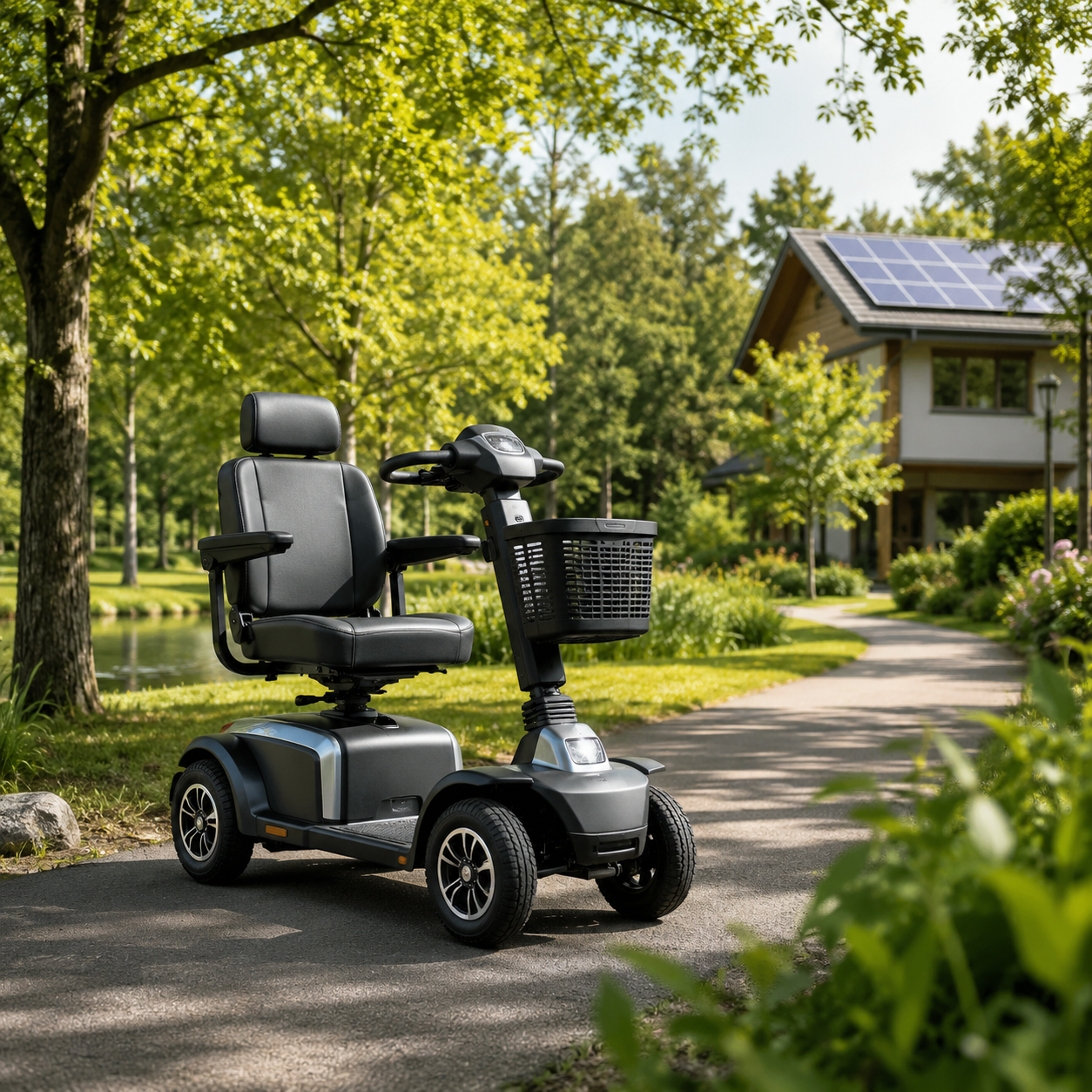
Are Mobility Scooters Environmentally Friendly?
A balanced look at electricity use, batteries, manufacturing, recycling and how to reduce the environmental impact of your mobility scooter.
Mobility scooters offer a convenient, low-emission way to get around locally, making it easier to visit family, reach local shops and continue enjoying everyday life.
Because they are powered by rechargeable batteries, mobility scooters produce no exhaust fumes or tailpipe emissions while being driven. However, that does not mean they have no environmental impact at all.
Manufacturing the scooter, producing its battery, generating the electricity used for charging and disposing of components at the end of their life all use energy and resources.
The balanced answer: Mobility scooters can be a relatively efficient form of personal transport, particularly when they replace suitable short car journeys. Their overall environmental impact depends on the model chosen, how it is used, how long it lasts and whether its batteries and electrical components are recycled responsibly.
Mobility Scooters and the Environment at a Glance
Four important points to understand when considering the environmental impact of an electric mobility scooter.
Are Mobility Scooters Environmentally Friendly?
Mobility scooters have several environmental advantages, but it is more accurate to describe them as low-emission during use rather than completely impact-free.
Do mobility scooters produce emissions?
A mobility scooter does not have a petrol or diesel engine, so it produces no exhaust gases or tailpipe emissions while being driven.
There can still be indirect emissions associated with generating the electricity used to charge it. The level of these emissions depends partly on the source of the electricity.
There are also emissions associated with manufacturing and transporting the scooter and its battery. This is why the complete lifetime of the product should be considered rather than only what happens while it is being driven.
Are mobility scooters better for the environment than cars?
A mobility scooter is much smaller and has a substantially smaller battery than a typical electric car. It also does not consume petrol or diesel during use.
When a suitable mobility scooter journey replaces a short car journey, it may reduce the energy and road space needed to transport one person.
However, mobility scooters and cars have different purposes and capabilities. A scooter will not replace every car journey, and safety, comfort, range and the rider’s requirements must always come first.
Does using a mobility scooter help reduce congestion?
Mobility scooters occupy considerably less space than cars and may provide a practical alternative for some shorter local journeys.
Their primary purpose is accessibility and independence, rather than traffic reduction. Nevertheless, enabling someone to reach nearby shops or services without a car can provide an additional environmental benefit.
Accessibility comes first: Environmental considerations should never lead someone to choose a scooter that is too small, lacks sufficient range or is unsuitable for their individual requirements. The most sustainable scooter is still one that can be used safely and confidently.
Potential Environmental Benefits of Mobility Scooters
Electric mobility scooters can offer several advantages compared with larger petrol or diesel vehicles used for short personal journeys.
No Tailpipe Pollution
Electric mobility scooters do not release exhaust gases at street level, helping to avoid additional roadside air pollution during use.
Quiet Operation
Electric motors operate much more quietly than petrol or diesel engines, helping to limit additional noise in residential and pedestrian areas.
Smaller Vehicle Size
Mobility scooters generally require fewer materials and less road and storage space than full-sized motor vehicles.
Efficient Local Travel
A scooter can be an efficient way for one person to complete suitable local journeys without moving a much larger vehicle.
Rechargeable Energy
Mobility scooter batteries can be recharged many times before they reach the end of their useful service life.
Repairable Components
Tyres, batteries, controls, seats and other parts can often be repaired or replaced without discarding the complete scooter.
Where Does the Environmental Impact Come From?
The environmental footprint of a mobility scooter is spread across its complete life cycle.
| Stage | Potential environmental impact | How the impact may be reduced |
|---|---|---|
| Raw materials | Metals, plastics, rubber and battery materials must be extracted and processed. | Choose an appropriate scooter that is built to remain useful for several years. |
| Manufacturing | Producing the frame, motor, electronics and battery requires energy. | Avoid replacing a serviceable scooter unnecessarily and repair suitable components. |
| Transport and delivery | Scooters and components may travel through several stages of the supply chain. | Consolidated delivery, good preparation and choosing the correct model first time can help avoid unnecessary returns or exchanges. |
| Charging | Electricity generation can produce emissions, depending on the energy source. | Follow correct charging guidance, maintain the battery and use a renewable electricity tariff where practical. |
| Maintenance | Replacement tyres, batteries and components require additional resources. | Regular servicing can identify smaller issues before they cause greater damage. |
| End of life | Batteries and electrical equipment can create environmental and fire risks when discarded incorrectly. | Use an approved battery, electrical or specialist recycling service. |
Mobility Scooter Batteries and the Environment
The battery is one of the most important parts of a mobility scooter and one of the main areas to consider when assessing its environmental impact.
| Battery type | Common characteristics | Environmental considerations |
|---|---|---|
| AGM or sealed lead-acid | Established technology, commonly used in larger mobility scooters and generally less expensive to replace. | Heavier than lithium batteries and contains lead, but established specialist recycling routes can recover valuable materials. |
| Gel | A sealed lead-acid battery designed for repeated cycling and commonly found in medium and larger scooters. | Still contains lead and must be handled and recycled through an appropriate collection route. |
| Lithium-ion | Lighter, more energy-dense and increasingly common in folding, portable and lightweight scooters. | Uses mined battery materials and requires specialist handling. Damaged or discarded lithium batteries can also create a serious fire risk. |
Are lithium mobility scooter batteries better for the environment?
Lithium batteries are much lighter than equivalent lead-acid batteries and can store more energy for their size. This can make the scooter easier to transport and may reduce the weight carried during journeys.
However, lithium battery production requires energy and the extraction of valuable minerals. They also need a suitable specialist recycling route at the end of their life.
A lithium battery is therefore not automatically the most environmentally responsible option in every situation. Suitability, expected lifespan, scooter weight and responsible recycling should all be considered.
Are lead-acid mobility scooter batteries recyclable?
Lead-acid mobility scooter batteries can be recycled through appropriate specialist routes. Recyclers may recover lead, plastic and other materials for further use.
These batteries are larger than ordinary household batteries and should not be placed in domestic waste or normal supermarket battery containers without confirming that the facility accepts them.
Which mobility scooter battery lasts the longest?
Battery lifespan depends on the specific battery, its quality, charging habits, storage conditions, frequency of use and how deeply it is discharged.
Lithium batteries can offer a long cycle life, while high-quality gel and AGM batteries can also provide dependable service when charged and maintained correctly.
The longest-lasting option is normally the battery type approved for the scooter and suited to the user’s regular journeys.
How to Reduce the Environmental Impact of Your Mobility Scooter
The way a scooter is selected, charged and maintained can make a meaningful difference over its lifetime.
Choose a scooter that matches your journeys
A large road-legal scooter may be ideal for long, regular outdoor journeys, but it could be unnecessary for someone who mainly travels around shops or needs a scooter that fits inside a car.
Choosing the correct size and specification can reduce unnecessary materials, weight and battery capacity while also making the scooter easier to live with.
Browse the complete range of Mobility Connect mobility scooters or request a demonstration before deciding.
Look after the battery correctly
Recharge the battery in accordance with the manufacturer’s instructions and use only the approved charger.
Avoid repeatedly leaving a battery completely depleted. If the scooter will not be used for an extended period, follow the storage-charging schedule specified for that battery.
Correct charging can help the battery remain useful for longer, reducing the need for early replacement.
Keep tyres and moving parts maintained
Underinflated pneumatic tyres increase rolling resistance, making the scooter work harder and potentially reducing the distance available from a charge.
Regularly inspect tyres, wheels, brakes, controls and visible fixings. A professional service can also identify worn components before they cause more extensive damage.
Learn about Mobility Connect aftercare for additional servicing, repair and breakdown support.
Use it for suitable local journeys
Where routes and conditions are safe, using a mobility scooter for nearby shops, appointments or visits may avoid the need to use a larger vehicle.
Plan the complete return journey, allow a reasonable battery reserve and never compromise safety simply to avoid using another form of transport.
How to Recycle a Mobility Scooter Battery
Mobility scooter batteries must be disposed of through a suitable recycling or collection service.
Never place a mobility scooter battery in a household bin or general recycling bin. Batteries can contain hazardous materials and may create a serious fire risk if crushed, damaged or handled incorrectly.
Ask Your Mobility Dealer
A mobility dealer or battery supplier may be able to advise on a suitable collection or take-back route when your battery is replaced.
Check Your Local Council
Local recycling arrangements differ. Contact your council or recycling centre before travelling to confirm that it accepts your battery type.
Use a Specialist Recycler
Larger lead-acid and lithium mobility batteries may need to be handled by a specialist battery or electrical waste service.
What should I do with a damaged mobility scooter battery?
Stop using or charging a battery if it is swollen, cracked, leaking, excessively hot, producing an unusual smell or has suffered significant impact damage.
Keep it away from heat and combustible materials, do not attempt to open or repair it and contact a qualified mobility engineer, battery supplier or specialist recycling service for instructions.
Do not post or transport a visibly damaged lithium battery without professional guidance.
Can I put a mobility scooter battery in a supermarket recycling bin?
Ordinary supermarket battery bins are generally intended for smaller portable household batteries. A mobility scooter battery may be too large or may fall into a different category.
Check with the retailer before taking it there. Your local authority, mobility dealer or a specialist battery recycler may provide a more suitable option.
Choosing a Mobility Scooter That Will Last
Buying the correct scooter first time can be better for the user and help avoid unnecessary replacement, transport and manufacturing.
Avoid choosing on weight alone. A very lightweight scooter can be easier to transport, but it must still provide the range, comfort, stability and capacity required for everyday use.
Environmental FAQs About Mobility Scooters
Answers to common questions about electricity use, charging, batteries and sustainable scooter ownership.
Do mobility scooters use a lot of electricity?
Mobility scooter batteries are much smaller than electric-car batteries, but the amount of electricity used varies between models and battery capacities.
Larger road scooters with high-capacity batteries generally require more energy for a full charge than compact folding or car boot scooters.
Follow the manufacturer’s instructions and use the approved charger to charge the battery efficiently and safely.
Is it environmentally friendly to charge a mobility scooter overnight?
Charging overnight is commonly recommended for many mobility scooters, but you should always follow the instructions supplied with your particular scooter and charger.
Modern compatible chargers normally manage the charging process automatically. A faulty, damaged or incorrect charger should never be used.
Does a solar-powered home make scooter charging greener?
Using electricity generated by household solar panels may reduce the amount of grid electricity required to charge the scooter, depending on when it is charged and how the solar system is configured.
A renewable electricity tariff may also support electricity generated from renewable sources, although the exact environmental benefit depends on the tariff and supplier.
Is buying a second-hand mobility scooter more sustainable?
Continuing to use a safe, serviceable scooter can extend the life of the materials already used to manufacture it.
A used scooter should be professionally checked for battery condition, structural damage, tyre wear, braking performance and electrical safety. It must also be suitable for the new user rather than being chosen solely because it is available.
Should I replace my mobility scooter with a newer, more efficient model?
Replacing a working scooter is not automatically the most sustainable choice because manufacturing a replacement uses additional materials and energy.
Replacement may be appropriate when the existing scooter no longer meets your requirements, has become unreliable, cannot be repaired economically or lacks the range and safety required for your journeys.
What is the most eco-friendly mobility scooter?
There is no single scooter that is automatically the most environmentally friendly for every user.
A good environmental choice is usually a reliable model that is correctly sized, provides enough range without unnecessary excess, can be serviced and repaired and is likely to remain suitable for several years.
Choose a Mobility Scooter That Suits Your Life
Mobility Connect can help you find a scooter that provides the comfort, range and performance you require without paying for features you do not need. Your scooter is delivered built and ready to drive, with a full demonstration to help you use it confidently.
Environmental impact varies according to scooter design, manufacturing, battery type, electricity source, usage, maintenance and end-of-life disposal. Always follow the manufacturer’s safety, charging and recycling guidance.