


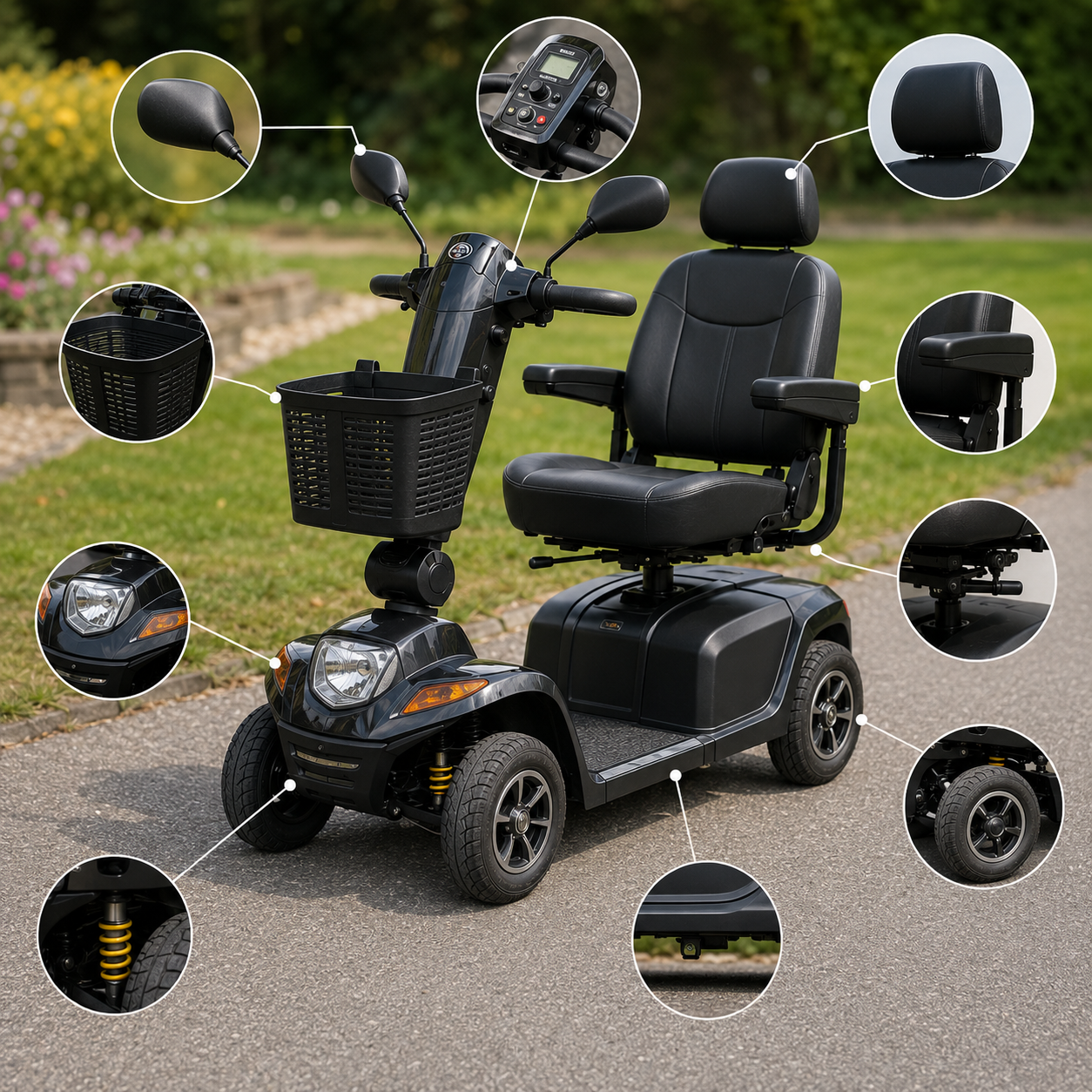
Mobility Scooter Features Explained: What They Mean and Why They Matter
Battery range, suspension, ground clearance, tyre type and turning circle can all affect how a mobility scooter performs. This guide explains the most important mobility scooter features so you can compare models with greater confidence.
Match features to your journeys
A feature is only useful when it suits where you will travel, how far you will go and the surfaces you regularly encounter.
Look beyond headline range
Battery range is important, but comfort, stability, controls, storage and realistic charging arrangements can matter just as much.
Try the scooter where possible
A specification cannot tell you how comfortable the seat feels or how confidently you can operate the controls and steering.
Mobility scooter specifications can initially feel overwhelming. Product pages may mention amp-hour batteries, electromagnetic brakes, turning circles, ground clearance, pneumatic tyres and maximum gradients without explaining what those figures mean in everyday use.
The right combination of features depends on the individual user. A lightweight folding scooter designed for holidays will prioritise portability, while a road-legal scooter may focus on range, suspension, visibility and long-distance comfort.
Choosing the model with the largest battery or highest maximum user weight does not automatically make it the best scooter. Larger components usually add weight, size and cost, which may make the scooter harder to store or transport.
Think about your usual journeys, local terrain, storage, charging and transportation before comparing individual features.
Mobility Scooter Features at a Glance
Different scooter types place greater importance on different features. This table provides a useful starting point when comparing models.
| Scooter type | Features normally prioritised | Typical compromises |
|---|---|---|
| Folding scooter | Low weight, compact folded size and removable lithium battery | Simpler seating, smaller wheels and more limited suspension |
| Car-boot scooter | Dismantling design, manageable individual sections and easy storage | Shorter range and reduced ground clearance |
| Pavement scooter | Manoeuvrability, comfort and practical local range | Not designed for normal road travel |
| Road-legal scooter | Longer range, road lighting, suspension, mirrors and supportive seating | Larger dimensions, higher weight and more storage space required |
| All-terrain scooter | Large wheels, powerful motor, substantial suspension and increased ground clearance | Heavy, wide and difficult to transport |
| Canopy scooter | Integrated weather protection, windscreen and year-round comfort | Increased height, width, weight and wind sensitivity |
Swipe horizontally across the table to see the complete feature comparison.
Mobility Scooter Tiller and Driving Controls
The tiller is the steering column positioned in front of the seat. It normally contains the handlebars, drive controls, speed adjustment, battery display and horn.
Larger road scooters may also include switches for lights, indicators and hazard warning lights.
Wig-wag controls
Many scooters use levers that are pulled with the fingers or pushed with the thumbs to move forwards and backwards.
Speed dial
The speed control limits how quickly the scooter accelerates when the drive lever is fully operated.
Delta tiller
A wraparound or delta-shaped tiller can provide more hand positions and may be easier for some users to grip.
Adjustable tiller
Tiller-angle adjustment helps position the controls closer to or further away from the user.
What to check during a demonstration
- Can you reach the controls without leaning forwards?
- Can you steer fully in both directions?
- Can you repeatedly operate the drive lever comfortably?
- Are the horn and speed control easy to locate?
- Can you read the battery display clearly?
- Does the tiller lock securely after adjustment?
A control that feels manageable for a few seconds may become uncomfortable during a longer journey. Consider hand strength, shoulder movement and fatigue.
Maximum Speed and Mobility Scooter Classification
A scooter’s maximum speed affects where it can legally be used as well as the equipment it requires.
| Classification | Maximum speed | Typical use |
|---|---|---|
| Class 2 | Up to 4mph | Pavements, pedestrian areas and separated cycle tracks |
| Class 3 | Up to 8mph, limited to no more than 4mph on pavements | Pavements, pedestrian areas, separated cycle tracks and roads |
Class 3 mobility scooters must be registered with the DVLA. They also need the equipment required for road use, including effective brakes, lights, reflectors, indicators, a mirror and a horn.
Read the current GOV.UK mobility scooter classification guidance .
Reduce your speed for narrow pavements, crowds, corners, uneven surfaces and poor weather. A slower speed usually gives you more time to react.
Mobility Scooter Batteries and Travelling Range
Battery range is one of the most frequently compared specifications. It indicates how far the scooter may travel under the conditions used for testing.
The published figure should be treated as a comparison guide, not a guaranteed distance for every journey.
Factors that can reduce real-world range
- Hills and repeated inclines.
- Cold temperatures.
- Grass, gravel and soft ground.
- Low tyre pressure.
- Additional user or luggage weight.
- Frequent acceleration and stopping.
- Use of lights, heated features or powered accessories.
- The age and condition of the batteries.
Sealed lead-acid batteries
Commonly used in larger scooters. They can provide dependable performance but are generally heavier than lithium batteries.
Lithium-ion batteries
Often used in folding and lightweight scooters because they can provide useful capacity at a lower weight.
Removable battery packs
A removable battery may be charged indoors without bringing the complete scooter close to a socket.
Off-board charging
Some batteries can be charged away from the scooter using a compatible charging dock or direct charging port.
Select a scooter with more range than your normal return journey requires. Avoid routinely planning to use the complete advertised range.
Motor Power, Hill Climbing and Maximum Gradients
The motor converts battery power into movement. Larger scooters generally use more substantial motors to support heavier loads, larger wheels and steeper routes.
Motor wattage alone does not tell you exactly how a scooter will perform. Controller programming, gearing, battery voltage, weight and tyre size also influence acceleration and hill climbing.
Understanding maximum gradient figures
A manufacturer may state a maximum gradient as degrees or a percentage. This normally represents a controlled testing limit rather than a recommended slope for regular use.
- Approach slopes straight rather than diagonally.
- Avoid turning across a steep slope.
- Reduce speed before descending.
- Be cautious on wet leaves, gravel, ice and loose ground.
- Do not exceed the gradient stated in the product manual.
- Remember that kerbs and sudden level changes are different from gradual slopes.
A scooter may technically climb a slope while feeling uncomfortable or unstable. Test the routes you use regularly where possible.
Mobility Scooter Tyre Types and Wheel Size
Tyres influence comfort, grip, puncture risk and the surfaces a scooter can handle.
| Tyre type | Advantages | Points to consider |
|---|---|---|
| Solid tyres | Cannot lose air through a conventional puncture and require little maintenance | Can provide a firmer ride over uneven ground |
| Pneumatic tyres | Air cushioning can provide greater comfort and grip | Require pressure checks and can puncture |
| Foam-filled tyres | Designed to provide puncture resistance with some additional cushioning | Often heavier and may still feel firmer than air-filled tyres |
| Low-profile road tyres | Can provide efficient performance on firm, smooth surfaces | May offer less cushioning on broken paths |
| Chunky all-terrain tyres | Improved traction on grass, gravel and uneven outdoor surfaces | Add size, weight and rolling resistance |
Larger wheels generally cross small obstacles and uneven surfaces more easily than small travel-scooter wheels. However, they also increase the scooter’s size and weight.
What to check
- Whether the tyres are solid or air-filled.
- How often tyre pressure must be checked.
- Whether replacement tyres are readily available.
- Whether the wheels are suitable for your usual terrain.
- Whether mudguards provide sufficient protection.
Suspension and Ground Clearance
Suspension helps absorb movement caused by uneven surfaces. It can improve comfort and help the wheels maintain contact with the ground.
Front suspension
Helps absorb impacts reaching the front wheels, steering and tiller.
Rear suspension
Can reduce the movement transferred through the rear wheels and seat.
All-round suspension
Uses suspension at both ends and is common on larger scooters intended for longer outdoor journeys.
Seat-post suspension
Adds cushioning beneath the seat but does not provide the same wheel control as full suspension.
What is ground clearance?
Ground clearance is the distance between the lowest part of the scooter and the surface beneath it. More clearance can help on uneven paths, grass and raised transitions.
Low-clearance folding scooters can be suitable for smooth pavements and indoor areas but may catch on steep ramps, raised thresholds or uneven ground.
Wheel size, ground clearance, motor performance, tyres and overall stability must also suit the intended surface.
Mobility Scooter Braking and Freewheel Mode
Many mobility scooters use electromagnetic braking. The scooter slows and stops when the drive control is released, while the brake helps prevent it from rolling when parked.
Stopping distance still varies with speed, gradient, surface conditions, load and the condition of the scooter.
Freewheel mode
A freewheel lever allows the scooter to be pushed manually when the motor drive is disengaged. This may be useful for loading, workshop movement or recovering a scooter with a flat battery.
Never leave the scooter unattended on a slope while it is in freewheel mode. Return the lever to drive mode before attempting to operate the scooter.
Other stability and braking features
- Anti-tip wheels at the rear.
- Automatic parking brake.
- Manual emergency brake on certain models.
- Cornering-speed reduction on selected scooters.
- Regenerative motor control on certain systems.
Anti-tip wheels provide additional protection but do not make it safe to exceed the scooter’s slope, kerb or turning limits.
Mobility Scooter Seats and Adjustment Features
Seat design can affect transfers, posture and comfort, especially when the scooter is used for long periods.
Swivel seat
Allows the seat to rotate sideways, which can make getting on and off easier.
Sliding seat
Moves forwards or backwards to adjust legroom and the distance from the tiller.
Adjustable armrests
May move in width, angle or height and can normally be lifted for transfers.
Captain’s seat
A larger padded seat with a supportive backrest, commonly found on road and all-terrain scooters.
Reclining backrest
Allows the backrest angle to be altered on selected models.
Headrest
May provide additional comfort, although it should not be relied upon as specialist postural support.
Check your seating position
- Your back should feel supported.
- Your feet should remain stable on the platform.
- Your knees should not press against the tiller.
- You should reach every control without leaning.
- The armrests should support your arms comfortably.
- The swivel mechanism must lock before driving.
Request professional advice where you have significant postural, pressure-care or seating-support requirements.
Scooter Dimensions, Turning Circle and Manoeuvrability
Overall length and width affect storage, transport and the spaces in which the scooter can turn.
The turning circle or turning radius indicates the amount of space required to complete a turn. Manufacturers may measure this in different ways, so use it as a comparison guide.
Three-wheel scooters
Often have a tighter turning circle and increased space around the user’s feet.
Stability still depends on design, speed, terrain and the way the scooter is driven.
Four-wheel scooters
Commonly selected for outdoor stability and use over less even surfaces.
They may require more space to turn than a comparable three-wheel scooter.
Measure the complete route
- Home entrance and narrowest doorway.
- Hallways and corners.
- Lift dimensions and weight limit.
- Storage position.
- Garden gates and pathways.
- Vehicle boot opening.
- Space needed to swivel the seat and transfer.
A scooter may fit through a doorway but still be unable to turn immediately afterwards.
Maximum User Weight and Scooter Load Limits
Maximum user weight is the highest stated weight that the scooter has been designed to carry under the manufacturer’s conditions.
Check whether the figure includes luggage, shopping, oxygen cylinders, walking aids and other accessories. Added weight can affect range, braking and hill-climbing performance.
Why additional capacity can be helpful
- It provides an appropriate margin rather than operating continually at the maximum limit.
- It allows for normal clothing and carried items.
- Higher-capacity models may offer wider and more supportive seating.
- Stronger frames and motors may be better suited to regular heavy use.
Overloading may affect stability, steering, range, braking and component life. It could also affect warranty or insurance arrangements.
Lights, Indicators, Mirrors and Safety Features
Equipment varies considerably between compact travel scooters and road-going Class 3 models.
Headlights
Improve visibility ahead and help other people notice the scooter in poor light.
Rear lights and reflectors
Make the scooter easier to see from behind.
Indicators
Communicate intended changes in direction on appropriately equipped scooters.
Hazard warning lights
Allow all direction indicators to flash together when the scooter presents a temporary hazard.
Rear-view mirrors
Help the user check behind before changing direction or moving away.
Horn
Provides an audible warning where another road or pavement user has not noticed the scooter.
Road-going Class 3 scooters need specific equipment to meet legal requirements. Do not cover or remove required lights, reflectors, indicators or mirrors when fitting accessories.
Read the current GOV.UK requirements for road-going mobility scooters .
Folding, Dismantling and Portable Scooter Features
Portability can be achieved through folding the complete scooter or separating it into smaller sections.
| Design | How it works | What to check |
|---|---|---|
| Manual folding | The scooter folds through a manual mechanism | Force, balance and hand movement required to fold it |
| Automatic folding | Powered mechanism folds the scooter using a switch or remote | Whether it can still be folded if the battery or remote fails |
| Dismantling scooter | Separates into the seat, battery, frame and other sections | The weight of the heaviest individual part |
| Fixed-frame scooter | Remains assembled and is transported with a ramp, hoist or accessible vehicle | Total size, weight and securing points |
Always check the exact total weight, battery weight and heaviest lifting section. Consider the height of the car boot and the person performing the lift.
Folding scooters
Designed to reduce storage size while keeping the main frame together.
Car-boot scooters
Designed to separate into sections that can be loaded individually.
Displays and Electronic Mobility Scooter Features
Modern scooters can include additional electronic features that provide information or improve comfort.
Battery display
Shows an estimate of the remaining battery charge. Displays may use coloured lights, bars or a digital percentage.
Speedometer
Displays the scooter’s current travelling speed on selected models.
Odometer or trip display
Records the distance travelled and may help with journey planning or servicing.
USB charging
Allows compatible mobile devices to be charged from a built-in connection.
Automatic lighting
Switches selected lights on according to light levels or scooter operation.
Bluetooth connectivity
Selected scooters may connect to a phone or audio system, although features vary considerably.
Heated seat
Integrated heating can improve comfort during cold weather on selected premium scooters.
Heated handlebars
Provide warmth around the main hand-contact areas during winter journeys.
Lighting, heating and device charging may reduce the distance available from a battery charge. Factor this into longer or colder journeys.
Scooter Storage and Accessory Features
Practical storage can make shopping and everyday errands easier, but added weight and dimensions must be considered.
Front basket
Keeps shopping and personal items within sight and easy reach.
Rear basket or box
Offers greater capacity but adds length and may make reversing more difficult.
Under-seat storage
Provides concealed storage on certain compact scooters without adding external width.
Walking-stick holder
Secures a stick or crutch so it is not placed across the foot platform or tiller.
Cup holder
Carries a closed bottle or suitable drinks container without occupying the main basket.
Phone holder
Keeps a phone visible for navigation, provided it does not obstruct controls or distract the user.
Use compatible accessories and remain within the stated basket, accessory and scooter weight limits.
Read the Mobility Connect guide to mobility scooter accessories for more information.
Mobility Scooter Charging Features
Scooters can use an on-board charging socket, a removable battery pack or a separate charging dock. Check which method will work best in your home.
Charging features to compare
- Position of the charging socket.
- Whether the battery can be removed.
- Weight of the removable battery.
- Whether off-board charging is supported.
- Charger size and cable length.
- Charging-status lights.
- Expected charging time.
- Instructions for longer-term storage.
A charger that physically connects is not necessarily compatible. Follow the manufacturer’s instructions and do not charge a damaged, swollen or leaking battery.
- Charge in a suitable, dry and ventilated location.
- Do not cover the battery or charger during charging.
- Keep charging equipment away from combustible materials.
- Do not create trailing cables across a doorway.
- Do not store or charge the scooter where it blocks an escape route.
- Obtain permission before charging in a shared or communal area.
Mobility Scooter Feature Checklist
- Decide where the scooter will be used most often.
- Confirm whether you need Class 2 or Class 3.
- Calculate the distance of your normal return journey.
- Allow an appropriate battery-range reserve.
- Check hills, kerbs and uneven surfaces on your route.
- Decide whether solid or pneumatic tyres are preferable.
- Consider whether suspension is needed.
- Confirm the ground clearance.
- Try the tiller, controls and braking response.
- Check seat width, depth and adjustment.
- Confirm the maximum user and accessory weight.
- Measure your doorway, storage area and vehicle boot.
- Check the scooter’s total width and length.
- Compare the turning circle with your available space.
- Check total weight and the heaviest lifting section.
- Confirm how the battery will be charged.
- Check whether replacement batteries and tyres are readily available.
- Ask about warranty, servicing and aftercare.
- Request a full demonstration before relying on it independently.
Mobility Scooter Feature FAQs
What are the most important mobility scooter features?
The most important features depend on how the scooter will be used. Controls, seat comfort, battery range, dimensions, turning circle, weight, tyre type and storage arrangements are important for most users.
How much mobility scooter range do I need?
Choose more range than your normal return journey requires. Real-world range can be reduced by hills, cold weather, soft ground, low tyre pressure, additional weight and battery age.
Are lithium mobility scooter batteries better?
Lithium batteries are generally lighter and are useful in folding and portable scooters. Sealed lead-acid batteries remain common in larger models. The better option depends on weight, capacity, cost and the scooter’s approved design.
Are solid or pneumatic mobility scooter tyres better?
Solid tyres avoid conventional punctures and need little maintenance. Pneumatic tyres can provide a softer ride but require pressure checks and can puncture. Your regular terrain and comfort needs should guide the choice.
Does suspension make a mobility scooter safer?
Suspension can improve comfort and wheel contact over uneven surfaces. Safe performance also depends on tyre type, wheel size, ground clearance, speed and how the scooter is driven.
What is a good turning circle for a mobility scooter?
There is no single ideal figure. The scooter needs enough room to turn within the environments where you will use it. Measure hallways, corners, lifts and storage areas before comparing models.
What is electromagnetic braking?
Many scooters use an electromagnetic brake that helps slow and hold the scooter when the drive lever is released. Stopping distance still varies with speed, gradients, surfaces and load.
What does freewheel mode do?
Freewheel mode disengages the motor drive so the scooter can be pushed manually. It can also disengage normal automatic braking, so it should only be used according to the product manual and never on an unattended slope.
Is a three-wheel or four-wheel scooter better?
Three-wheel scooters often provide a tighter turning circle, while four-wheel scooters are commonly chosen for outdoor stability. The overall design, user, speed and intended terrain matter more than wheel count alone.
What does maximum user weight include?
Check the manufacturer’s instructions to confirm whether the limit includes luggage, accessories and other equipment. Never exceed the stated maximum load.
Is an automatic folding scooter better than a manual one?
Automatic folding can reduce the physical effort needed to fold the scooter. Manual models may be simpler and lighter. Check the total weight, folded dimensions and what happens if the powered mechanism or remote cannot be used.
Can I use a different mobility scooter charger?
Only use the charger supplied or approved for the scooter and battery. A matching plug does not confirm that the charger has the correct voltage, current or charging profile.
Find the Features That Fit Your Everyday Life
Speak with Mobility Connect about your usual journeys, comfort, storage, transport and charging needs before deciding which mobility scooter features matter most.