


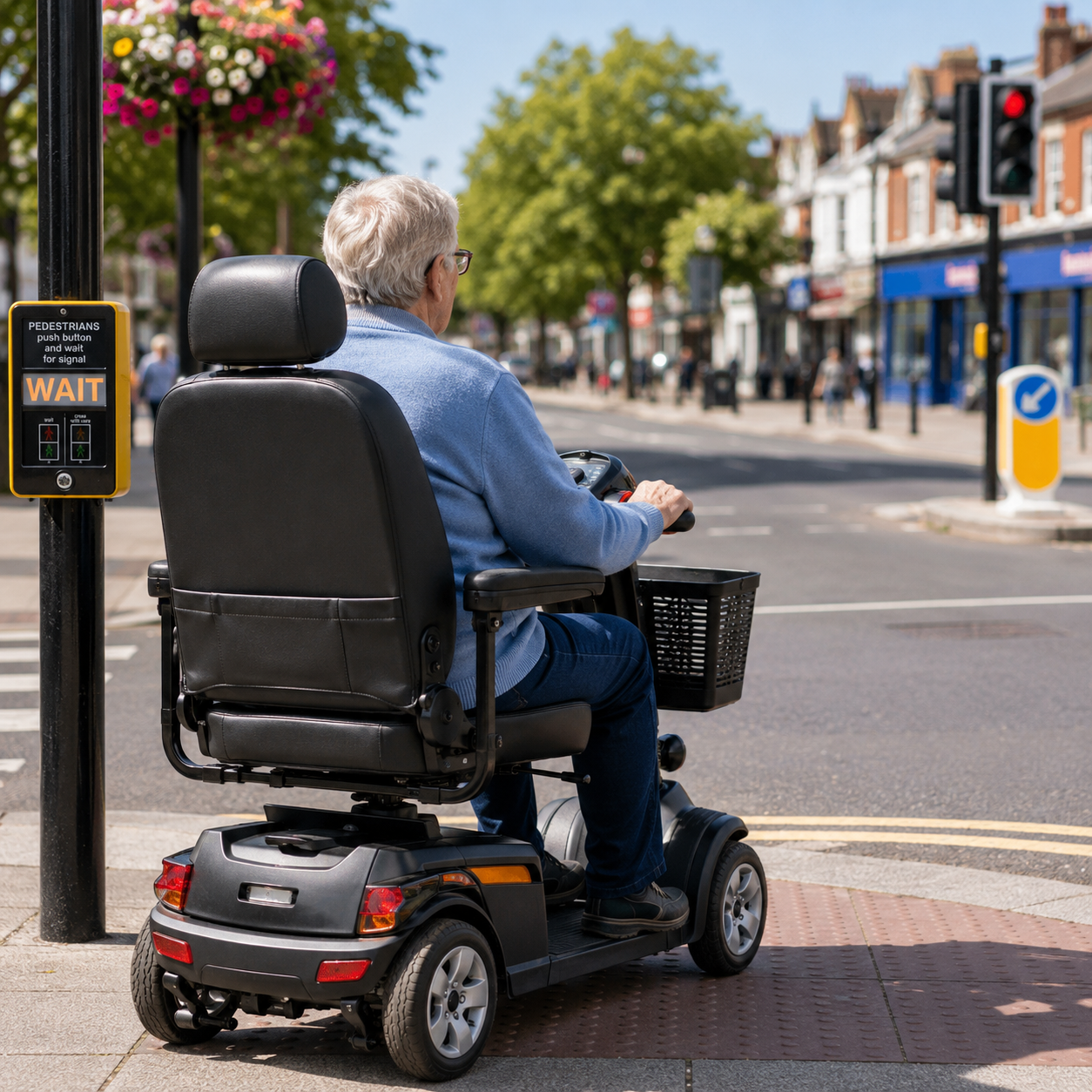
Where Can You Drive a Mobility Scooter? Complete UK Guide
Mobility scooters can be used on pavements, pedestrian areas, selected roads and many public paths, but the rules depend on whether the scooter is Class 2, Class 3 or outside the standard classifications. This guide explains where you can travel, the speed limits and the places to avoid.
Can you use a mobility scooter here?
These quick answers apply to standard Class 2 and Class 3 mobility scooters. The detailed rules, speed limits and exceptions are explained throughout the guide.
Pavements
Class 2 and Class 3 scooters can use pavements at no more than 4mph.
Roads
Class 3 scooters can use roads when registered, equipped and driven in accordance with the Highway Code.
Pedestrian areas
Scooters can use pedestrianised streets, but pedestrians have priority and speeds should remain low.
Cycle routes
Separated cycle tracks may be used. Painted cycle lanes running within a road cannot.
Public paths
Public footpaths, bridleways and restricted byways can generally be used by mobility scooters.
Shops and attractions
Many welcome mobility scooters, but entrances, lifts, turning space and local safety rules vary.
Bus lanes
Mobility scooters must not be driven within designated bus lanes.
Motorways
Mobility scooters and powered wheelchairs must never be used on motorways.
Mobility scooters give users greater freedom to complete everyday journeys, but they do not all have the same legal capabilities.
A compact 4mph folding scooter is generally a Class 2 product designed mainly for pavements. A larger 8mph scooter will usually be Class 3 and can be used on roads when it has the correct equipment and DVLA registration.
The scooter’s appearance does not confirm its legal class. Check the product documentation or ask the manufacturer or retailer.
Unusually fast, wide or heavy mobility vehicles can fall outside these classes and are subject to different rules. Do not assume that a modified or unusually large vehicle can use pavements.
Check Whether Your Mobility Scooter Is Class 2 or Class 3
The scooter’s class determines where it may be driven and whether registration is required.
Pavement mobility scooter
Class 2 scooters have a maximum powered speed of 4mph or less and are designed primarily for pedestrian environments.
- Pavements and pedestrian areas.
- Footpaths and bridleways.
- Separated cycle tracks.
- No DVLA registration normally required.
- Not designed for routine road travel.
Road-legal mobility scooter
Class 3 scooters can travel at up to 8mph on roads but must be limited to no more than 4mph on pavements.
- All standard pedestrian areas.
- Separated cycle tracks.
- Roads, subject to the rules.
- DVLA registration required.
- User must be at least 14 years old.
An unusually large or fast vehicle
A product may be outside the standard classes when it exceeds the legal speed, width or weight thresholds.
- Can only be used on roads.
- Cannot use pavements or cycle tracks.
- Driving licence required.
- DVLA registration required.
- Insurance may also be required.
Insurance is not legally compulsory for a standard Class 2 or Class 3 scooter, but it can provide valuable cover for theft, accidental damage and liability involving other people or property.
Mobility Scooter Location Rules at a Glance
| Location | Class 2 | Class 3 | Main rule |
|---|---|---|---|
| Pavements | Yes | Yes | Maximum 4mph and pedestrians have priority |
| Pedestrianised streets | Yes | Yes | Travel slowly and consider other users |
| Roads | Not for routine use | Yes | Class 3 must be registered and road equipped |
| Separated cycle tracks | Yes | Yes | Share considerately with cyclists and pedestrians |
| Painted cycle lanes | No | No | Mobility scooters cannot use road cycle lanes |
| Footpaths and bridleways | Yes | Yes | Route may not be physically accessible |
| Bus lanes | No | No | Use the permitted pavement or main road route as appropriate |
| Motorways | No | No | Mobility scooters are prohibited |
| Dual carriageways | No routine use | Legally possible in limited circumstances | Avoid where possible; amber beacon rules apply |
| Shops and attractions | Venue policy | Venue policy | Check access, size limits and local rules |
Can You Drive a Mobility Scooter on the Pavement?
Class 2 and Class 3 mobility scooters can be used on pavements. The maximum permitted speed is 4mph, although that does not mean 4mph is appropriate in every situation.
Reduce your speed around pedestrians, shop entrances, crossings, narrow paths, children, animals and people who may have difficulty seeing or hearing the scooter.
Pedestrians always have priority
A scooter user should make way for other pavement users and avoid expecting pedestrians to step into the road or onto an unsafe surface.
Use the horn only when it is genuinely necessary to warn someone of your presence. It should not be used to demand that pedestrians move.
Good pavement practice
- Keep to an appropriate speed below the 4mph maximum.
- Give pedestrians enough room to pass.
- Approach blind corners slowly.
- Watch for shop doors opening onto the pavement.
- Avoid driving close behind pedestrians.
- Do not block the pavement when stopping.
- Use dropped kerbs wherever possible.
- Avoid steep side slopes and damaged pavement edges.
Pedestrianised Streets, Shopping Areas and Promenades
Class 2 and Class 3 mobility scooters can be used in pedestrian areas at no more than 4mph.
Pedestrianised town centres, seafront promenades and shared public spaces can become extremely busy. A lower speed may be needed even where there is plenty of physical room.
Pedestrianised streets
Travel slowly, give way and watch for outdoor seating, displays, bollards and people changing direction unexpectedly.
Promenades and public paths
Share the route considerately with pedestrians, runners, cyclists, children and dogs.
Can You Drive a Mobility Scooter on the Road?
A properly equipped and registered Class 3 mobility scooter can be used on roads. Its maximum road speed is 8mph.
A Class 3 scooter used on the road needs an effective braking system, front and rear lights and reflectors, indicators, a rear-view mirror and an audible horn.
Class 2 scooters are designed for pavements rather than routine road travel. They may need to enter the road to cross it or where no pavement is available, but users should take extreme care and return to a suitable pavement as soon as possible.
Plan the road
Prefer quieter roads and avoid complicated junctions, fast traffic and major roundabouts.
Make yourself visible
Use working lights when required and consider reflective clothing during poor visibility.
Follow traffic direction
Travel in the direction of traffic and use indicators before changing direction.
Use the safer option
Where a junction feels unsafe, use a suitable pedestrian crossing or choose another route.
A Class 3 scooter travels much more slowly than normal traffic. Avoid fast, narrow or complex roads where there is a safer pavement or alternative route.
Read the current GOV.UK rules for using mobility scooters on roads .
Can Mobility Scooters Use Cycle Lanes and Cycle Tracks?
The answer depends on whether the route is a cycle lane or a separated cycle track. The two terms are not interchangeable.
Separated cycle track
Class 2 and Class 3 mobility scooters can use cycle tracks that are physically separated from ordinary road traffic by distance, a verge or a barrier.
Painted road cycle lane
Mobility scooters cannot use a cycle lane marked within the road alongside normal vehicle traffic.
Shared routes can change design along their length. Watch for signs, road markings, barriers and points where a separated track rejoins the road.
Footpaths, Bridleways and Countryside Routes
Mobility scooters and powered wheelchairs may use several types of public right of way, including footpaths, bridleways and restricted byways.
Having a legal right to use a path does not mean that the complete route will be physically accessible.
Public footpaths
Mobility scooters can use public footpaths, but narrow gates, steps, mud, roots and steep gradients may prevent practical access.
Bridleways
These routes may also contain horses and bicycles. Approach slowly, communicate clearly and leave plenty of space.
Restricted byways
Mobility scooters may generally use these routes, although the surfaces are often unsurfaced and can become difficult after poor weather.
Open-access land
Access rights and physical accessibility vary. Remain on suitable established routes and check local restrictions and terrain before travelling.
Check the route before setting off
- Look at recent route photographs where available.
- Check gradients and path surfaces.
- Look for gates, barriers and narrow bridges.
- Avoid deep mud, water and unstable ground.
- Check whether livestock may be present.
- Confirm that the complete return route is accessible.
- Allow additional battery range for grass and gravel.
- Tell someone your route on more isolated journeys.
You can check current information about using public rights of way .
Shops, Supermarkets, Shopping Centres and Attractions
Many shops and attractions welcome mobility scooter users, but private premises can have their own access and safety arrangements.
Compact Class 2 scooters are generally easier to use indoors than large road or canopy scooters. The building may also contain narrow aisles, small lifts, tight corners or fragile displays.
Supermarkets
Travel slowly around aisle ends, checkouts and displays. Avoid blocking access while stopping to browse.
Shopping centres
Check lift dimensions, upper-floor access and whether large Class 3 scooters are permitted in every area.
Garden centres
Watch for wet floors, gravel, narrow displays and changes between indoor and outdoor surfaces.
Museums and attractions
Ask about historic entrances, narrow galleries, scooter size limits and accessible routes.
Parks and nature reserves
Confirm whether routes are surfaced, whether gates are accessible and whether facilities remain open.
Restaurants and cafés
Ask where the scooter can be positioned without blocking tables, aisles, exits or emergency routes.
Give the venue the approximate width, length and turning requirements of your scooter. Asking whether the venue is “accessible” may not confirm that a large scooter will fit.
Where Can You Park a Mobility Scooter?
Normal parking restrictions should be followed. A mobility scooter should not be left where it blocks pedestrians, pushchairs, doorways, crossings, ramps or emergency exits.
Avoid parking:
- Across a pavement or dropped kerb.
- In front of an accessible entrance.
- Inside a fire exit or escape route.
- Where it prevents another wheelchair from passing.
- On tactile paving at a crossing.
- Where it obscures drivers’ or pedestrians’ visibility.
- In a cycle track or bus stop area.
- Where local signs prohibit waiting or parking.
Remove the key and use a suitable lock where the scooter will be left unattended. Do not attach a lock to wiring, controls or removable body panels.
Places Mobility Scooters Must Not Use
Some routes are prohibited regardless of whether the scooter is Class 2 or Class 3. Others are legally possible but should normally be avoided because of the level of risk.
Motorways
Mobility scooters and powered wheelchairs must not be driven on motorways.
Bus lanes
Mobility scooters cannot use a designated bus lane, even when other types of vehicle are permitted.
Painted cycle lanes
A cycle lane forming part of the road cannot be used by a mobility scooter.
Fast dual carriageways
Avoid dual carriageways, particularly where the speed limit exceeds 50mph. Amber beacon requirements apply where they are used.
Flooded routes
Standing water can hide potholes, kerbs and damaged surfaces and may damage electrical components.
Unsafe terrain
Do not attempt slopes, mud, loose surfaces or obstacles beyond the scooter manufacturer’s limits.
Can a Mobility Scooter Use a Dual Carriageway?
A road-capable Class 3 scooter may legally use certain dual carriageways, but this is generally an unsuitable and high-risk choice because the scooter travels much more slowly than surrounding traffic.
- Avoid dual carriageways wherever another route exists.
- Avoid unrestricted dual carriageways with speed limits above 50mph.
- An amber flashing beacon must be used when travelling on a dual carriageway with a speed limit above 50mph.
- An amber flashing beacon should be used on other dual carriageways.
- Ensure lights, reflectors and indicators are working.
- Do not enter through a motorway slip road accidentally.
A legal route is not necessarily a sensible route. Pavements, pedestrian crossings and quieter local roads are normally safer than a dual carriageway.
Crossing Roads and Moving Between Pavement and Road
Take particular care when leaving a pavement, crossing a road or joining traffic. A scooter sits lower than many vehicles and may be difficult for drivers to see around parked cars.
Safer crossing practice
- Use a pedestrian crossing where practical.
- Use dropped kerbs even when reaching one requires a slightly longer route.
- Stop and check in every direction before entering the road.
- Make sure drivers have noticed you.
- Cross directly rather than diagonally.
- Approach a small permitted kerb at a right angle.
- Never attempt a kerb higher than the scooter’s stated limit.
- Avoid crossing between vehicles that block visibility.
- Use the pavement method for a difficult right turn where it is safer.
Consider travelling along the pavement and using controlled crossings, or plan a route that avoids a multi-lane roundabout altogether.
Using a Mobility Scooter at Night or in Poor Visibility
Road-going scooters must use their lights at night. Good visibility is also important during rain, fog, dusk and dull winter conditions.
Working lights
Check front and rear lights before travelling and keep lenses clean and unobstructed.
Reflective material
Reflective clothing or suitable scooter markings can make the user easier for other road users to notice.
Avoid relying on street lighting alone. Batteries, bulbs, connections and reflectors should be checked as part of routine servicing.
Build a Route Around the Scooter You Actually Own
A suitable route for a large Class 3 scooter may not suit a lightweight folding scooter, and a path shown on a map may contain inaccessible barriers or surfaces.
Confirm the legal route
Check whether each section is pavement, road, cycle track, cycle lane or private land.
Check the physical route
Look for gradients, kerbs, barriers, narrow paths and difficult surfaces.
Calculate the return distance
Allow for diversions, hills, weather and a sensible battery reserve.
Create a backup plan
Carry a phone, breakdown details and the contact information of someone who can assist.
Mobility Scooter Route Checklist
- Confirm whether the scooter is Class 2 or Class 3.
- Check whether a Class 3 scooter is registered.
- Test lights, indicators, horn and mirrors.
- Check the battery charge.
- Calculate the complete return distance.
- Check the weather forecast.
- Identify pavements and dropped kerbs.
- Avoid bus lanes, motorways and painted cycle lanes.
- Plan around difficult junctions and roundabouts.
- Check path surfaces and barriers.
- Confirm that the destination accepts the scooter.
- Check lift and doorway dimensions.
- Identify accessible toilets and shelter.
- Carry a charged phone.
- Carry breakdown and emergency details.
- Tell someone the route on an unfamiliar journey.
- Carry a suitable lock.
- Leave sufficient battery power for unexpected diversions.
Where Can You Drive a Mobility Scooter? FAQs
Can mobility scooters be driven on pavements?
Class 2 and Class 3 mobility scooters can be used on pavements. The maximum permitted speed is 4mph, although users should travel more slowly around pedestrians and in narrow or crowded areas.
Can a Class 2 mobility scooter be used on the road?
Class 2 scooters are designed primarily for pavements and should not be used for routine road travel. It may be necessary to enter the road to cross it or where no pavement is available. Use extreme caution and return to a suitable pavement as soon as possible.
Can a Class 3 mobility scooter be driven on the road?
Yes. A Class 3 scooter can travel at up to 8mph on roads. It must be registered with the DVLA and have the required brakes, lighting, reflectors, indicators, mirror and horn.
Can mobility scooters use pedestrianised streets?
Class 2 and Class 3 scooters can use pedestrian areas at no more than 4mph. Travel more slowly where the area is crowded and give pedestrians priority.
Can mobility scooters use cycle paths?
Class 2 and Class 3 scooters can use cycle tracks that are separated from the main road by distance or a barrier. They cannot use a painted cycle lane that forms part of the road.
Can mobility scooters use public footpaths?
Mobility scooters may use public footpaths, bridleways and restricted byways. Check whether the surface, gates, gradients and width make the route suitable for your particular scooter.
Can mobility scooters go into shops?
Many shops permit mobility scooters, but private premises can have local access and safety arrangements. Large scooters may not fit through entrances, aisles or lifts, so contact the venue before making a special journey.
Can you drive a mobility scooter in a bus lane?
No. Mobility scooters and powered wheelchairs cannot be driven within designated bus lanes.
Can mobility scooters go on motorways?
No. Mobility scooters and powered wheelchairs must not be used on motorways.
Can a mobility scooter use a dual carriageway?
A road-capable Class 3 scooter may use certain dual carriageways, but they should generally be avoided. An amber flashing beacon is compulsory when using a dual carriageway with a speed limit above 50mph and is recommended on other dual carriageways.
What is the mobility scooter speed limit on pavements?
The maximum is 4mph. This is a maximum rather than a target, and a much lower speed may be required in crowded, narrow or shared spaces.
Do you need a driving licence for a mobility scooter?
You do not normally need a driving licence for a standard Class 2 or Class 3 mobility scooter. Different rules apply to vehicles outside the standard classifications.
Does a Class 3 mobility scooter need to be registered?
Yes. Class 3 mobility scooters and powered wheelchairs must be registered with the DVLA, although no vehicle-tax payment is required when they are correctly registered as mobility vehicles.
Is mobility scooter insurance compulsory?
Insurance is not compulsory for a standard Class 2 or Class 3 mobility scooter, but it is recommended. It may cover theft, accidental damage and third-party liability.
Can you park a mobility scooter on the pavement?
Normal parking restrictions apply. Do not leave the scooter where it blocks pedestrians, pushchairs, crossings, doorways, ramps or emergency routes.
Find a Mobility Scooter Suited to Where You Travel
Mobility Connect can help you compare folding, pavement, road-legal and all-terrain scooters based on your usual routes, comfort, range, storage and transport requirements.