


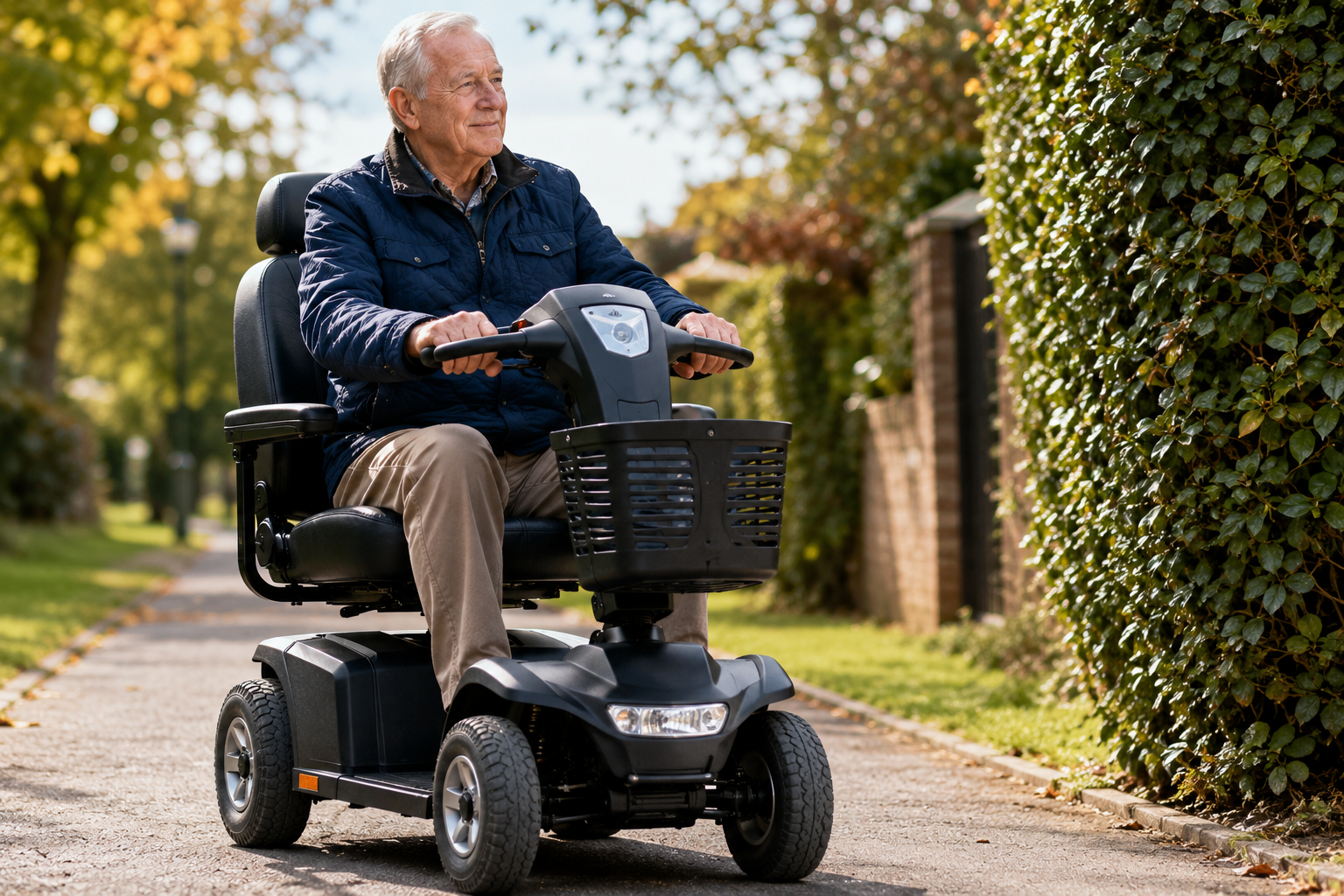
How Long Do Mobility Scooters Last? Lifespan, Maintenance and Replacement Guide
A good-quality mobility scooter can provide many years of reliable use, but there is no single expiry date. The frame, motor, batteries, tyres, charger, controls and seating all wear at different rates. This guide explains what normally lasts longest, what may need replacing first and how to decide whether an older scooter remains worth repairing.
Around five to ten years is a useful guide, not a fixed expiry date
Some mobility scooters need major repairs within only a few years. Others remain dependable well beyond ten years because they have been correctly charged, stored, serviced and used within their design limits.
Age should therefore be considered alongside condition, safety, reliability, parts availability and whether the scooter still meets the user’s needs.
They are consumable components and normally wear out before the scooter’s main frame or motor.
Hills, grass, heavy loads and rough paths create more wear than short journeys on smooth indoor floors.
Follow the manufacturer’s schedule and arrange an inspection sooner when performance changes.
A well-kept older scooter may be more dependable than a newer product that has been neglected.
A mobility scooter is made from a collection of structural, mechanical, electrical and consumable parts. These components do not all reach the end of their useful life at the same time.
Batteries and tyres may be replaced several times while the frame, motor and controller continue to operate normally. Upholstery may look worn even though the scooter remains mechanically sound. Alternatively, a scooter may appear clean while developing electrical, braking or steering faults.
The more useful question is therefore not simply, “How old is the scooter?” It is:
A professional inspection can identify whether reduced performance is being caused by a normal replacement item or a more serious problem affecting the complete product.
What Is the Average Lifespan of a Mobility Scooter?
A quality mobility scooter that is used appropriately and maintained well may provide around five to ten years of dependable service. Some continue operating for considerably longer, while others require replacement earlier.
The estimate should not be interpreted as a warranty or a promise that every scooter will reach a particular age. Products experience different levels of use, terrain, weather exposure, storage and maintenance.
| Use and care | Possible outcome | Typical characteristics |
|---|---|---|
| Light use with excellent care | May remain reliable for ten years or longer | Dry storage, regular charging, smooth routes and prompt servicing |
| Regular everyday use | Around five to ten years can be a useful planning guide | Normal local journeys, routine maintenance and periodic replacement parts |
| Heavy or demanding use | Major repairs may be needed earlier | High mileage, hills, outdoor terrain, heavy loads and year-round exposure |
| Poor care or unsuitable storage | Reliability can decline within only a few years | Flat batteries, water exposure, corrosion, incorrect charging and ignored faults |
Mobility scooters do not normally have the same documented mileage and service history as a car. The type of mileage can matter as much as the total distance.
One Scooter, Several Different Lifespans
The ranges below are broad planning guides. Actual life depends on the scooter, component quality, usage, maintenance and manufacturer’s instructions.
Mobility scooter batteries
Batteries are consumable and commonly become the first major component requiring replacement. Charging, discharge depth, temperature and storage have a substantial effect.
Tyres and inner tubes
Tyres should be replaced according to tread, cracking, damage, pressure loss and grip rather than waiting for a particular birthday.
Battery charger
A correctly used charger may last for many years. Damage to the plug, cable, casing or charging electronics can require earlier replacement.
Seat, armrests and upholstery
Padding, coverings and armrest components may show cosmetic wear before the mechanical scooter reaches the end of its useful life.
Motor, gearbox and brake
These may operate for much of the scooter’s life, but overloading, demanding terrain, water ingress and ignored noises can accelerate wear.
Controller and electrical system
Controllers, wiring, switches and displays can last for years but may be affected by moisture, heat, impact, damaged connectors or electrical faults.
Frame and main chassis
The frame is usually one of the longest-lasting elements. Corrosion, cracks, collision damage and repeated overloading can make it unsafe.
A battery is a normal wear item. When the frame, electronics and drive system remain sound, fitting compatible new batteries can restore dependable range.
How Long Do Mobility Scooter Batteries Last?
Battery lifespan depends heavily on chemistry, frequency of use, charging routine, temperature, depth of discharge and storage.
| Battery type | Broad planning range | What affects it most |
|---|---|---|
| AGM or sealed lead-acid | Often around one to three years | Deep discharge, storage while flat, charging routine and frequency of use |
| Gel | Often around two to four years | Charge cycles, correct charger, workload and storage |
| Lithium | Often around three to five years or longer | Battery quality, charging, heat, cycle count and battery-management system |
These ranges are not guarantees. A heavily used battery can wear sooner, while a correctly maintained battery used less frequently may last longer.
Signs that the batteries may be weakening
- The scooter travels less distance after a complete charge.
- The battery display falls rapidly on hills.
- Power reduces when accelerating.
- The scooter cuts out under load.
- Charging appears to finish unusually quickly.
- The scooter needs charging more frequently.
- Performance changes significantly in ordinary conditions.
A battery test can help distinguish worn batteries from a faulty charger, loose connection, low tyre pressure or another electrical issue.
Read the complete mobility scooter battery-care guide .
What Affects How Long a Mobility Scooter Lasts?
Frequency of use
A scooter used throughout every day completes more charge cycles and experiences more tyre, motor, bearing and control wear.
Terrain
Hills, grass, gravel, broken pavements and rough tracks place greater loads on batteries, motors, suspension and tyres.
User and luggage weight
Regularly operating near the maximum capacity increases demand on the motor, batteries, brakes, tyres and suspension.
Water and weather
Prolonged rain, standing water and damp storage can contribute to corrosion and electrical problems.
Charging routine
Incorrect charging, prolonged discharge and an incompatible charger can shorten battery life and reduce reliability.
Storage
Dry, secure storage protects the scooter from moisture, frost, excessive heat, theft and accidental impact.
Driving style
Repeated hard acceleration, abrupt changes of direction and impacts with kerbs create avoidable strain.
Build quality
Frame design, component quality, weather protection and engineering all influence durability.
Maintenance
Early attention to loose fittings, damaged tyres, unusual noises and electrical faults can prevent additional damage.
Do Larger Mobility Scooters Last Longer?
Larger scooters often use more substantial frames, motors, wheels, seats and suspension. That does not automatically mean they will outlast every lightweight scooter.
| Scooter type | Potential longevity advantage | Main source of wear |
|---|---|---|
| Folding scooter | Lower mileage and indoor-focused use can reduce mechanical wear | Folding joints, light wheels, lifting damage and compact batteries |
| Dismantling car-boot scooter | Individual components may be replaceable and easy to inspect | Repeated dismantling, connectors and loading into vehicles |
| Pavement scooter | Designed for regular local journeys and generally more substantial than travel models | Kerbs, uneven pavements, outdoor storage and daily mileage |
| Road-legal scooter | Larger motors, batteries, tyres and suspension support longer journeys | Higher mileage, road vibration, weather and heavier loads |
| All-terrain scooter | Strong chassis and outdoor components | Mud, gravel, gradients, water and demanding terrain |
A lightweight folding scooter used repeatedly on rough rural paths may wear more quickly than a larger scooter built for those conditions.
A Maintenance Routine That Can Extend Scooter Life
Before regular journeys
Check the charge level, tyres, controls, seat lock, lights and route conditions.
Every few weeks
Inspect the charger, cables, wheels, mirrors, accessories and accessible fixings.
Seasonally
Review battery performance, tyre condition, storage, corrosion and winter or wet-weather exposure.
Professional servicing
Follow the manual’s schedule and arrange an earlier inspection when performance or handling changes.
Items that should be checked regularly
- Battery performance and charging behaviour.
- Charger, plug, cable and socket condition.
- Pneumatic tyre pressure where applicable.
- Tyre tread, cracking and damage.
- Wheel movement and unusual noise.
- Steering movement and tiller security.
- Drive control and braking response.
- Seat, armrests and seat-lock mechanism.
- Lights, indicators, horn and reflectors.
- Folding or dismantling mechanisms.
- Suspension and ground clearance.
- Loose, cracked or damaged body panels.
- Signs of rust, corrosion or water exposure.
A small change in noise, steering, charging or braking may be easier and less expensive to address before it causes additional wear.
Mobility Connect’s Aftercare service can assist with routine servicing, batteries, tyres, repairs and product support.
How to Judge the Condition of an Older Mobility Scooter
A scooter should not be judged by appearance alone. Assess the complete product and obtain professional advice when safety-critical components are involved.
Cosmetic marks may have little effect on reliability. Loose steering, cracked frames, unreliable braking and electrical faults require much greater attention.
Signs an Older Mobility Scooter Needs Attention
Changes to monitor
- Gradually reduced battery range.
- Tyres losing pressure more often.
- New squeaks, rattles or vibration.
- Worn seat padding or armrests.
- Slow or inconsistent charging.
- Loose baskets, mirrors or body panels.
- Increasingly frequent minor repairs.
Potential safety concerns
- Steering suddenly feels loose or unpredictable.
- The scooter does not stop normally.
- Power cuts out while moving.
- The frame or seat mounting is cracked.
- Wiring is exposed, damaged or overheating.
- A battery is swollen, leaking or unusually hot.
- Wheels wobble or appear insecure.
Stop using the scooter and contact an experienced mobility technician when steering, braking, structural or electrical safety is uncertain.
Is It Better to Repair or Replace an Older Mobility Scooter?
Compare the repair cost with the scooter’s condition, reliability, suitability and expected future maintenance. The cheapest immediate option is not always the best long-term decision.
Keep the current scooter when:
- The fault is limited to batteries, tyres, charger or another replaceable component.
- The frame, steering and brakes remain sound.
- Replacement parts remain readily available.
- The scooter still suits the user and their journeys.
- It has otherwise been dependable.
- The repair cost is reasonable compared with replacement.
Consider a new scooter when:
- Several major components require attention.
- Faults repeatedly leave the user without transport.
- Structural corrosion or damage is present.
- Parts are discontinued or difficult to obtain.
- The user’s mobility or seating needs have changed.
- The scooter no longer provides sufficient range, comfort or stability.
- Repair costs approach the value of a more suitable replacement.
Compare the Complete Cost, Not Just One Repair
A replacement battery or tyre may return an otherwise healthy scooter to service for several more years. A large repair can be less attractive when additional components are also nearing the end of their useful life.
Ask for a written assessment covering:
- The exact fault.
- Parts and labour required.
- Whether parts are original, compatible or refurbished.
- The condition of the batteries and charger.
- Tyre and wheel condition.
- Steering and braking condition.
- Evidence of corrosion or water damage.
- Any additional maintenance likely to be required soon.
- The warranty provided with the repair.
- The likely availability of future replacement parts.
A scooter can continue operating long after its warranty expires. Equally, remaining warranty cover does not remove the need for correct maintenance and safe use.
How Old Is Too Old for a Second-Hand Mobility Scooter?
There is no universal maximum age. Service history, condition, parts availability and suitability matter more than the year of manufacture alone.
- Confirm the make, model and approximate age.
- Ask for service and repair records.
- Check the age and type of the batteries.
- Test the scooter after a complete charge.
- Check whether the charger is original and compatible.
- Inspect tyres for wear, cracking and damage.
- Test steering, acceleration, reverse and stopping.
- Check the seat and tiller locking mechanisms.
- Look underneath for corrosion or impact damage.
- Confirm that lights, indicators and horn work.
- Check folding or dismantling mechanisms.
- Confirm replacement parts remain available.
- Check that the scooter has not been modified unsafely.
- Confirm its legal class and maximum speed.
- Make sure it suits the user’s weight and seating needs.
- Ask an experienced mobility technician to inspect it.
The motor, controller, wiring, tyres, brakes, bearings, steering and frame must also be considered.
How to Make a Mobility Scooter Last Longer
- Use the scooter within its stated weight limit.
- Choose a product designed for your usual terrain.
- Use only the approved charger.
- Follow the battery-charging instructions.
- Avoid leaving batteries fully discharged.
- Store the scooter somewhere secure and dry.
- Protect it from prolonged rain and standing water.
- Maintain pneumatic tyres at the specified pressure.
- Slow down before kerbs, bumps and changes in surface.
- Avoid deep mud, flood water and unsuitable terrain.
- Keep the scooter clean without soaking electrical components.
- Deal with loose fixings and unusual noises promptly.
- Arrange servicing according to the manual.
- Use compatible replacement parts.
- Do not modify the frame, speed or electrical system.
- Keep service and repair records.
- Review whether the scooter still suits the user.
A robust outdoor scooter used regularly on suitable terrain may age better than a lightweight travel scooter repeatedly pushed beyond its intended limits.
How Storage Affects Mobility Scooter Lifespan
A scooter may spend more time in storage than it does being driven. The storage environment can therefore have a major effect on its condition.
| Storage condition | Possible effect | Better approach |
|---|---|---|
| Damp shed or exposed cover | Corrosion, mould, electrical problems and upholstery damage | Use dry, ventilated and weather-protected storage |
| Unheated freezing environment | Reduced battery performance and possible damage when charging incorrectly | Follow the battery’s temperature and storage instructions |
| Hot conservatory or vehicle | Battery ageing, heat damage and deterioration of plastics or upholstery | Avoid prolonged extreme heat and direct sunlight |
| Communal escape route | Obstruction, impact and fire-safety concerns | Use an approved dedicated storage and charging location |
| Long storage without battery checks | Deep discharge and possible battery failure | Follow the manual’s storage-charging routine |
Mobility Scooter Lifespan FAQs
How many years should a mobility scooter last?
Around five to ten years is a useful broad guide for a good-quality scooter that receives appropriate care. Some last longer, while heavy use, demanding terrain, poor storage or neglected maintenance can shorten their life.
Can a mobility scooter last more than ten years?
Yes. Some older scooters remain dependable when they have been maintained correctly and replacement parts remain available. Age alone does not confirm safety or reliability, so an older product should be inspected regularly.
What normally wears out first on a mobility scooter?
Batteries are commonly among the first major components to require replacement. Tyres, upholstery, armrests and chargers can also wear before the main frame or drive system.
How long do mobility scooter batteries last?
AGM and sealed lead-acid batteries often last around one to three years, gel batteries may last around two to four years and lithium batteries may last around three to five years or longer. Actual life varies according to use, charging, temperature, storage and battery quality.
Does replacing the batteries extend the scooter’s life?
It can. Where the scooter’s motor, controller, frame, steering and brakes remain in good condition, fitting compatible new batteries can restore useful range and reliability.
How often should a mobility scooter be serviced?
Follow the schedule in the product manual. An annual professional inspection is a sensible approach for many regularly used scooters, while some manufacturers or products recommend checks every six to twelve months. Arrange help sooner when performance changes.
Does a road-legal scooter wear out faster?
Not automatically. Road scooters are normally built for greater mileage and outdoor use, but frequent journeys, weather exposure, road vibration and heavier loads can create more wear.
Do folding mobility scooters last as long as larger scooters?
They can provide many years of service when used on suitable routes. Repeated lifting, folding, dismantling and use on rough terrain can place additional stress on compact components and joints.
Is a ten-year-old mobility scooter safe?
Its age does not provide enough information. Safety depends on the frame, steering, braking, tyres, electrical system, seat mounting and maintenance history. Arrange a professional inspection before relying on an older scooter.
Is it worth repairing an old mobility scooter?
Repair may be worthwhile where the fault is a replaceable battery, tyre, charger or other available component and the rest of the scooter remains sound. Replacement may be more sensible where several major faults, structural damage or unavailable parts are involved.
What makes a mobility scooter wear out faster?
Common factors include deep battery discharge, incorrect charging, damp storage, excessive weight, rough terrain, repeated kerb impacts, low tyre pressure, water exposure and delayed repairs.
Can rain shorten the life of a mobility scooter?
Prolonged heavy rain, standing water and damp storage can contribute to corrosion and electrical faults. Mobility scooters are intended for outdoor use but should not be treated as completely waterproof.
Should I buy an older second-hand mobility scooter?
It may be suitable when its condition, service history, battery performance, parts availability and specification have been checked carefully. Arrange an independent inspection rather than relying on appearance or the seller’s description.
When should I stop using my mobility scooter?
Stop using it when steering, braking, structural integrity or electrical safety is uncertain. Sudden power loss, wheel movement, cracked components, exposed wiring or an overheating battery require professional attention.
Does Your Mobility Scooter Need Servicing or Replacing?
Mobility Connect can help assess battery performance, tyres, controls, charging problems and other faults, or help you compare a more suitable replacement scooter when repairs no longer provide good value.