



Mobility Scooters with the Best Turning Circles: 5 Models Compared
A tight turning circle can make a significant difference when using a mobility scooter inside shops, around the home, on narrow pavements or in busy pedestrian areas. This guide compares five compact, folding and road-legal scooters from the Mobility Connect range.
Manoeuvrability matters as much as speed and range
The scooter with the smallest turning measurement will generally require less space to change direction. However, width, overall length, steering position and the user’s confidence also affect how easy a scooter feels in confined spaces.
Mobility scooter specifications frequently use the term turning radius, while customers often search for the turning circle. The two terms are sometimes used interchangeably by retailers, even though a radius and a full circle are technically different measurements.
To avoid creating misleading comparisons, this guide uses the measurement currently published on each Mobility Connect product page. Each is labelled as the scooter’s published turning radius.
A compact folding scooter may be easier to turn inside a shop, while a larger road-legal scooter may provide more comfort, range, suspension and user-weight capacity. Consider where the scooter will be used most often.
Turning measurements should be used as a guide rather than a guarantee that a scooter will fit a particular room, lift or doorway. Arrange a demonstration and test the scooter in a realistic space wherever possible.
What Is a Mobility Scooter Turning Circle?
A turning measurement indicates approximately how much room a scooter needs to change direction. A smaller figure usually means the scooter can complete a tighter turn.
Turning measurement
This indicates the space required by the scooter as it steers through a tight turn.
Overall width
A narrow scooter can pass through smaller gaps, but width alone does not determine how tightly it turns.
Overall length
Longer scooters need more room for the rear and front of the scooter to sweep through a turn.
Why a tight turning circle can help
- Turning around in shop aisles.
- Entering and leaving lifts.
- Moving through narrow hallways.
- Positioning beside tables and counters.
- Navigating cafés and restaurants.
- Manoeuvring around displays and furniture.
- Reversing from restricted parking spaces.
- Changing direction on narrower pavements.
Mobility Scooter Turning Radius Comparison
| Mobility scooter | Published turning radius | Width | Top speed | Maximum range | Maximum user weight |
|---|---|---|---|---|---|
| Drive Auto Fold | 1200mm | 420mm | 4mph | 9 miles | 18 stone / 115kg |
| Scooterpac Atom N Fold | 1400mm | 520mm | 4mph | 9 miles | 19.6 stone / 125kg |
| Komfi Rider Phoenix | 1490mm | 630mm | 8mph | 25 miles | 21 stone / 136kg |
| Kymco Agility | 1560mm | 575mm | 8mph | 25 miles | 26 stone / 165kg |
| Drive Sport Rider | 1650mm | 780mm | 8mph | Up to 31 miles | 28 stone / 180kg |
The Auto Fold and Atom N Fold prioritise portability. The Phoenix and Agility combine road-legal performance with relatively compact dimensions. The Sport Rider is a much larger scooter designed around road presence, comfort and longer journeys.
Which Scooter Stands Out?
Drive Auto Fold
Its 1200mm published turning radius and narrow 420mm width make it the most compact option in this comparison.
Scooterpac Atom N Fold
At approximately 15kg, it combines a compact 1400mm turning measurement with easier lifting and transport.
Komfi Rider Phoenix
It combines a 1490mm turning radius with 8mph performance and a maximum range of 25 miles.
Five Mobility Scooters with Tight Turning Circles

Drive Auto Fold
The Drive Auto Fold is the most compact scooter in this comparison. Its narrow body and automatic folding system make it particularly well suited to shopping trips, travel and locations where storage space is limited.
It folds and unfolds by remote control, helping users who want a portable scooter without needing to operate a manual folding mechanism.

Scooterpac Atom N Fold
Weighing approximately 15kg, the Atom N Fold is designed for users who need a scooter that is easier to lift, transport and store.
Its central folding mechanism and integrated lifting handle make it practical for car journeys, family visits and days out, while the compact dimensions help in busier indoor environments.

Komfi Rider Phoenix
The Komfi Rider Phoenix is a road-legal 8mph scooter that maintains relatively compact proportions for its class.
It provides front and rear suspension, LED lighting and a travel range of up to 25 miles, making it suitable for users who need more outdoor capability without moving to one of the largest road scooters.
Kymco Agility
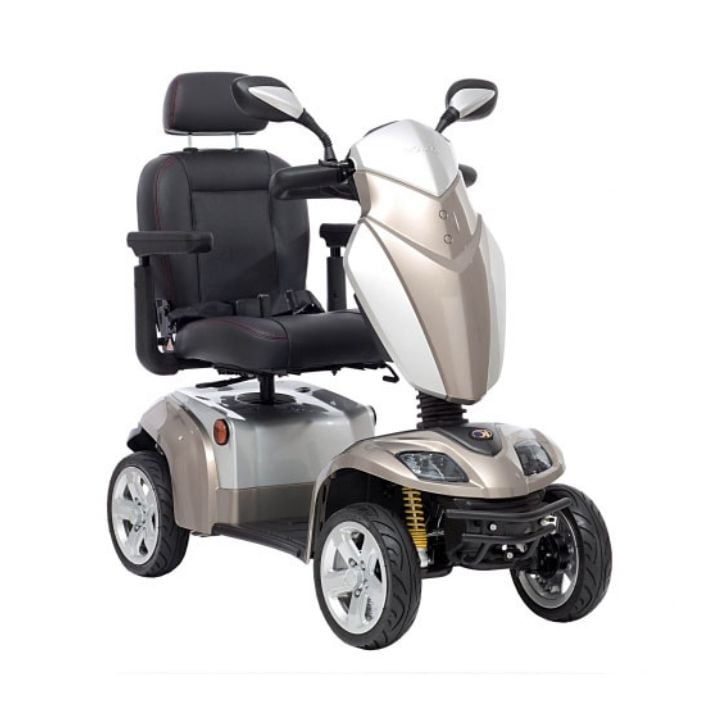
The Kymco Agility combines an 8mph maximum speed, 25-mile travel range and substantial 26-stone user capacity within a relatively narrow 575mm body.
All-round suspension, pneumatic tyres and full LED lighting help make it suitable for regular outdoor journeys, while its dimensions remain manageable for many urban routes.

Drive Sport Rider
The Sport Rider is considerably larger than the folding models in this guide, but it offers a different balance of comfort, outdoor stability, road presence and long-distance performance.
Its motorcycle-inspired steering, substantial seating, telescopic suspension and optional higher-capacity batteries make it suitable for users prioritising outdoor travel over indoor compactness.
How to Choose a Manoeuvrable Mobility Scooter
A tight turning measurement is only one part of choosing a suitable scooter. Think about the complete environment and how the scooter will be transported, stored and used.
| Your main requirement | Features to prioritise | Potential scooter choice |
|---|---|---|
| Using the scooter in shops | Tight turning measurement, narrow width and controlled low-speed operation | Drive Auto Fold |
| Lifting into a car | Low scooter weight, folding design and lifting handle | Scooterpac Atom N Fold |
| Pavement and road journeys | Compact Class 3 design, lighting, suspension and useful range | Komfi Rider Phoenix |
| Higher user-weight capacity | Strong frame, comfortable seating and sufficient carrying capacity | Kymco Agility |
| Longer outdoor journeys | Large batteries, supportive seating, suspension and road stability | Drive Sport Rider |
Other specifications to compare
- Overall scooter width.
- Overall scooter length.
- Seat height and width.
- Maximum user-weight capacity.
- Footwell and legroom.
- Control and tiller position.
- Maximum travel range.
- Suspension and tyre type.
- Ground clearance.
- Folding or dismantling process.
- Weight of the heaviest component.
- Storage and charging space.
Read our guide to the different types of mobility scooter for a wider comparison of folding, portable, pavement, road-legal and all-terrain models.
Measure the Places Where You Will Use It
Record the narrowest entrance, hallway, lift and storage area. Allow additional clearance rather than choosing a scooter that only just fits the published measurements.
A scooter may pass through a doorway but still be unable to approach it at the necessary angle. Measure the hallway, landing or room on both sides of the entrance.
What to Check During a Mobility Scooter Demonstration
- Sit in your normal driving position.
- Adjust the seat and tiller before testing.
- Practise a complete turn at low speed.
- Turn in both directions.
- Check how far the front wheels sweep outward.
- Check the rear of the scooter during the turn.
- Practise approaching a doorway.
- Practise reversing through a controlled space.
- Check control at very low speed.
- Try positioning beside a table or counter.
- Check that your knees and feet remain comfortable.
- Confirm that mirrors and accessories do not add excessive width.
- Ask how the scooter behaves on slopes.
- Confirm the scooter’s complete dimensions.
- Check that the scooter fits the intended storage area.
- Test folding or dismantling where applicable.
Turning around a clear showroom is easier than navigating a furnished room or busy shop. Explain where you intend to use the scooter so the demonstration can include similar manoeuvres.
Mobility Scooter Turning Circle FAQs
Which mobility scooter has the best turning circle?
Of the five scooters compared in this guide, the Drive Auto Fold has the smallest currently published turning radius at 1200mm. The best scooter for an individual user will also depend on comfort, weight capacity, range and intended terrain.
Is a smaller turning radius better?
A smaller measurement normally means the scooter can turn within less space. This is particularly useful indoors and in shops, but it should be considered alongside stability, comfort and outdoor capability.
What is the difference between turning radius and turning circle?
Technically, the radius is measured from the centre of a circle to its outer edge, while the turning circle describes the complete diameter. Product listings do not always use the terms consistently, so compare published specifications carefully.
Are three-wheel mobility scooters easier to turn?
Three-wheel scooters often have a tighter turning radius because they use a single front wheel. Four-wheel scooters may offer greater stability, particularly outdoors. Actual performance depends on the individual design.
Can a mobility scooter be used inside the home?
Some compact mobility scooters can be used inside suitable homes, but doorways, flooring, corners and furniture must provide sufficient clearance. Powerchairs often offer tighter indoor manoeuvrability than tiller-controlled scooters.
Which mobility scooter is best for shopping?
A compact Class 2 scooter with a controlled low speed, narrow width and tight turning measurement is often suitable. The Drive Auto Fold and Scooterpac Atom N Fold are the smallest options in this comparison.
Does scooter width affect the turning circle?
Width affects the gaps a scooter can pass through, but the complete turning measurement also depends on wheelbase, steering angle, overall length and wheel arrangement.
Can a road-legal scooter have a tight turning circle?
Yes. Compact road-legal models such as the Komfi Rider Phoenix and Kymco Agility provide smaller published turning measurements than many larger Class 3 scooters while still offering 8mph performance.
Will a folding scooter be easier to manoeuvre?
Folding scooters are often compact and narrow, which can make them easier to use in confined spaces. However, the exact turning measurement, steering design and control at low speed should still be checked.
How can I tell whether a scooter will fit in my lift?
Measure the clear lift-door opening and internal floor space. Consider whether the scooter must enter straight, turn inside or reverse out, and allow extra clearance for mirrors, baskets and controls.
Should I test drive a mobility scooter before choosing one?
Yes. A demonstration helps you assess steering, low-speed control, visibility, comfort and how the scooter behaves during complete turns and reversing manoeuvres.
Need a Scooter That Is Easier to Manoeuvre?
Mobility Connect can help you compare scooter width, turning measurements, comfort, user-weight capacity and travel range before arranging a free demonstration.