


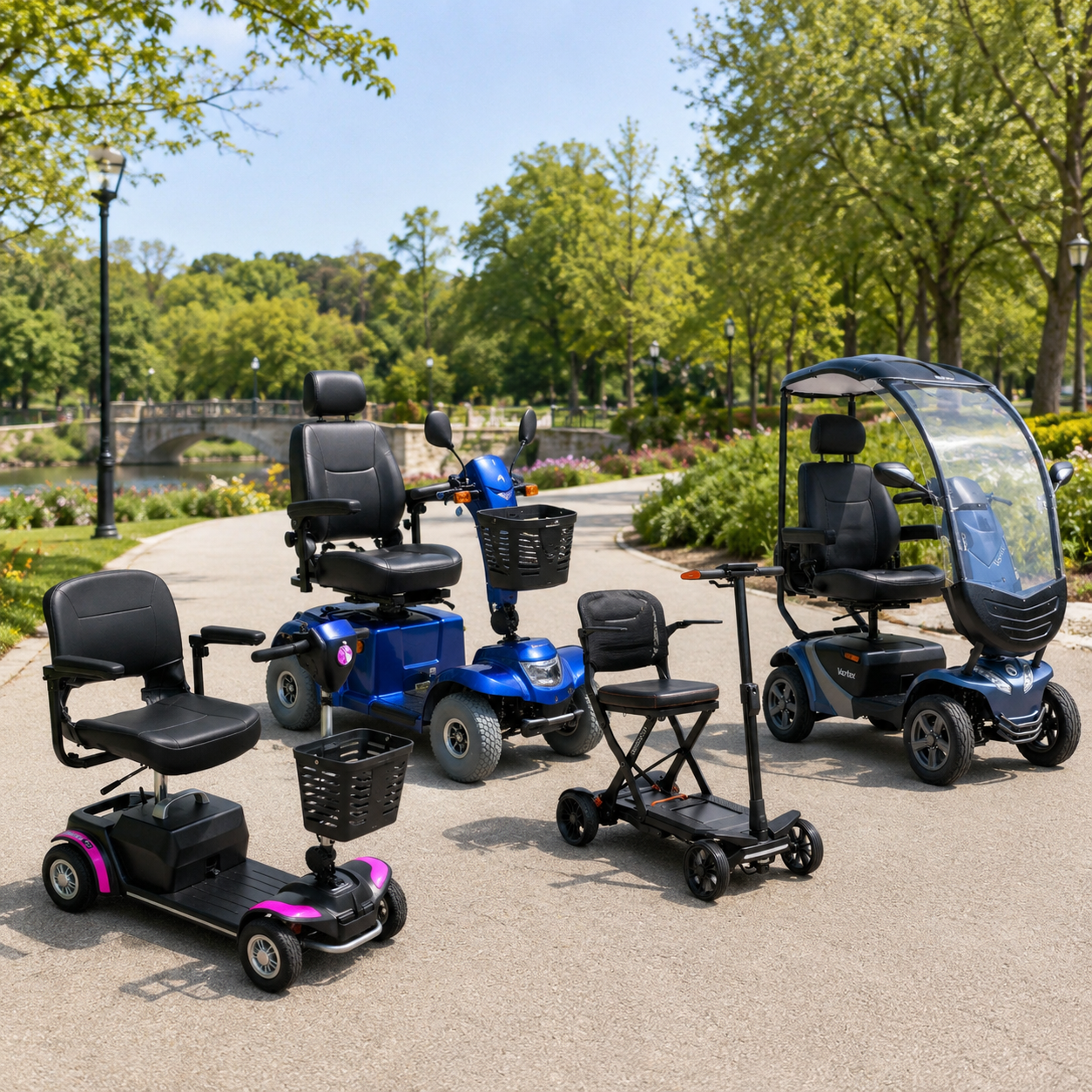
Types of Mobility Scooters Explained: Which One Is Right for You?
From lightweight folding scooters to road-legal, all-terrain and weather-protected models, there is no single mobility scooter that suits every person. This guide explains the main scooter types, UK legal classes and the practical differences that matter when choosing.
Where will your mobility scooter take you?
The best scooter type is determined less by its name and more by where it will be used, how it will be stored and whether it needs to travel in a car.
Car trips and holidays
Look first at folding, portable and dismantling car-boot scooters.
Shops and local pavements
Consider a compact portable model or a comfortable Class 2 pavement scooter.
Longer road journeys
A registered Class 3 road-legal scooter may provide the range, equipment and comfort required.
Grass and uneven outdoor routes
Look for an all-terrain scooter with suitable tyres, clearance, suspension and motor performance.
Mobility scooters are often divided into categories such as folding, pavement, road-legal and all-terrain. These labels help describe how a scooter has been designed, but they are not all legal classifications.
A single scooter can belong to several descriptions at the same time. For example, it could be:
This is why choosing by one feature alone can be misleading. A lithium battery may reduce weight, but it does not tell you whether the scooter is comfortable, road legal or suitable for grass.
Begin with your normal journeys, then compare the weight, dimensions, controls, range, comfort, terrain capability and storage requirements of the scooters designed for those journeys.
UK law mainly separates mobility scooters into Class 2 and Class 3. Retailers use additional categories to help customers compare design, portability and intended use.
Class 2 or Class 3
The legal class affects maximum speed, road use, vehicle equipment and whether DVLA registration is required.
A scooter’s legal class should be confirmed through its documentation rather than assumed from its size or appearance.
Folding, pavement, all-terrain and more
These terms describe features such as folding, transportability, wheel size, weather protection and the surfaces for which the scooter is designed.
Practical categories can overlap, and they do not replace the official Class 2 or Class 3 classification.
Class 2 and Class 3 Mobility Scooters Explained
Before comparing practical scooter types, it helps to understand the two main legal classes used in the UK.
| Feature | Class 2 mobility scooter | Class 3 mobility scooter |
|---|---|---|
| Maximum powered speed | 4mph or less | Up to 8mph |
| Pavement use | Yes, at an appropriate speed up to 4mph | Yes, but limited to no more than 4mph |
| Road use | Not intended for normal road travel | Permitted when the scooter meets the relevant requirements |
| DVLA registration | Not normally required | Required |
| Road equipment | Varies by model | Requires suitable brakes, lights, reflectors, indicators, mirror and horn |
| Typical designs | Folding, portable, car-boot and pavement scooters | Road-legal, long-range, all-terrain and canopy scooters |
| Typical storage requirement | Ranges from very compact to medium-sized | Usually requires a larger secure storage area |
A scooter capable of travelling faster than 4mph is not Class 2 under the current classification. Confirm the legal class, maximum speed and registration requirements for the specific model.
Check the latest GOV.UK mobility scooter class guidance before using a scooter on public roads or pavements.
The Main Types of Mobility Scooter at a Glance
The following categories describe the main ways mobility scooters are designed, transported and used.
Folding scooters
Fold into a smaller shape while keeping most or all of the scooter together as one unit.
Car-boot scooters
Fold or dismantle into sections intended for loading into a suitable vehicle.
Pavement scooters
Designed around everyday local journeys, pedestrian areas and pavement use.
Road-legal scooters
Class 3 scooters equipped and registered for road use, usually with greater range and comfort.
All-terrain scooters
Built for more demanding outdoor surfaces using larger wheels, clearance and stronger components.
Canopy scooters
Use an integrated roof, windscreen or enclosed body to provide increased weather protection.
High-capacity scooters
Designed with stronger frames, wider seating and increased maximum user-weight limits.
Lightweight scooters
Prioritise reduced lifting weight through compact designs, aluminium, carbon fibre or lithium batteries.
Three-wheel scooters
Use a single front wheel and can offer a tighter turning circle and more space around the feet.
From Portability to Outdoor Performance
Mobility scooter design usually involves compromise. As wheels, batteries, suspension and seating become more substantial, the scooter normally becomes heavier and more difficult to transport.
Some premium folding scooters now include longer-range batteries and suspension, while certain compact all-terrain models may be smaller than expected. Always compare the specific product.
Folding Mobility Scooters
Folding mobility scooters reduce their overall storage size without needing to be separated into several main frame sections.
Some fold manually using a release mechanism. Others use a powered automatic-folding system controlled by a button or remote.
Folding scooters are often best for:
- Holidays and days out.
- Smaller storage spaces.
- Customers who dislike dismantling several parts.
- Occasional car travel.
- Smooth pavements and indoor public spaces.
Points to consider:
- The complete folded unit may still be heavy.
- Smaller wheels can provide a firmer ride.
- Seating is often simpler than on larger scooters.
- Ground clearance may be limited.
- Automatic mechanisms add components and weight.
Manual folding versus automatic folding
| Feature | Manual folding scooter | Automatic folding scooter |
|---|---|---|
| How it folds | User operates the folding mechanism by hand | Powered mechanism folds using a control or remote |
| Physical effort | Requires some hand movement, bending or force | Reduces the effort required to initiate folding |
| Weight | Can be lighter because fewer powered components are required | Motor and folding equipment can add weight |
| Backup method | Folding does not depend on a powered motor | Check whether manual folding is possible if the battery or remote cannot be used |
Always check the scooter’s exact weight without relying on labels such as portable or travel friendly. Consider who will lift it and the height and shape of the vehicle boot.
Portable and Car-Boot Mobility Scooters
Portable scooter is a broad description covering compact scooters designed for easier storage or transport. Car-boot scooter describes a portable model intended specifically to be folded or dismantled for vehicle use.
Many traditional car-boot scooters separate into several components, commonly including the seat, battery box, rear drive section and front frame.
The most important transport specification
Do not compare total scooter weight alone. When a scooter dismantles, the weight of its heaviest individual section may be more important.
Dismantling design
Separating the scooter means each part can be loaded independently rather than lifting the complete product.
Battery box
A removable battery box may reduce the weight of the remaining frame and allow off-board charging.
Vehicle fit
Measure the boot opening, internal space and loading height rather than assuming every portable scooter will fit.
Portable scooters may suit you when:
- Car transport is a regular priority.
- You mainly use smooth pavements and indoor areas.
- You need the scooter after reaching a destination.
- Several smaller sections are easier than one complete lift.
They may be less suitable when:
- You need substantial suspension and ground clearance.
- You travel long distances directly from home.
- You cannot safely lift or dismantle the sections.
- You require a large and highly supportive seat.
Explore portable mobility scooters or browse car-boot mobility scooters .
Pavement Mobility Scooters
Pavement scooters are designed for everyday local travel, including shopping, appointments, family visits and journeys around pedestrian areas.
They are generally larger and more comfortable than folding or car-boot scooters but smaller and easier to store than full road-legal models.
Typical pavement-scooter features
Pavement scooters are often best for:
- Frequent local journeys.
- Shopping and appointments.
- Users wanting more comfort than a travel scooter.
- Homes with suitable ground-level storage.
- Pavements and pedestrian areas.
Points to consider:
- Many are too large for straightforward car-boot lifting.
- Storage and charging space are still required.
- Not every model has full suspension.
- They are not designed for normal road travel unless separately classified and equipped.
Always confirm the official legal class and maximum speed of the particular model. A conventional Class 2 scooter has a maximum powered speed of 4mph or less.
Road-Legal Class 3 Mobility Scooters
Road-legal mobility scooters are Class 3 products designed for longer journeys on pavements and roads.
They can travel at up to 8mph on roads but must be limited to no more than 4mph on pavements and in pedestrian areas. They must also be registered with the DVLA.
Common Class 3 equipment
Road controls
Speed selection, indicators and clear controls help the user operate the scooter in different environments.
Lights and reflectors
Front and rear lighting, reflectors and indicators make the scooter more visible to other road users.
Larger chassis
Bigger batteries, wider seating, larger wheels and suspension can support longer journeys.
Road-legal scooters may suit you when:
- The scooter will be a main form of local transport.
- You travel longer distances directly from home.
- Your routes include suitable roads.
- Comfort and suspension are important.
- You have secure ground-level storage.
Points to consider:
- They are usually heavy and difficult to transport.
- They require DVLA registration.
- They need a substantial secure storage area.
- Wider dimensions affect gates, paths and doorways.
- Greater range does not remove the need to plan journeys.
Read the GOV.UK road-use guidance before driving a Class 3 scooter on public roads.
All-Terrain and Off-Road Mobility Scooters
All-terrain scooters are designed for more demanding outdoor routes than a conventional folding or pavement scooter.
The term all terrain is not a legal class and does not mean the scooter can safely cross every surface. Suitability depends on the complete product and the limits stated by its manufacturer.
Features that support outdoor performance
All-terrain scooters may suit:
- Rural homes and country routes.
- Firm grass and suitable park paths.
- Gravel and uneven outdoor surfaces.
- Users needing more substantial suspension.
- Longer journeys over mixed terrain.
They still have limitations:
- Deep mud and loose ground can cause loss of traction.
- Steep side slopes can affect stability.
- Water can damage electrical components.
- Large scooters need considerable storage.
- High ground clearance does not remove gradient limits.
Avoid attempting deep water, unstable ground, severe slopes or obstacles beyond the scooter’s stated limits. Consider the route, weather and ground condition before every journey.
Canopy and Enclosed Mobility Scooters
Canopy scooters provide more weather protection than an open model. Designs range from a simple roof and windscreen to enclosed cabins with doors or side panels.
Solid roof
Provides overhead protection from direct rain and creates mounting points for windscreens or panels.
Windscreen and sides
Reduce exposure to wind and rain while retaining varying degrees of ventilation and access.
Enclosed cabin
Provides the greatest weather protection but also increases size, weight and storage requirements.
Canopy scooters may suit you when:
- You travel throughout the year.
- Longer journeys leave you exposed to the weather.
- You have suitable secure covered storage.
- You value integrated protection over portability.
Points to consider:
- Canopies increase overall height and width.
- Large bodywork can be affected by strong winds.
- Access and transfers may feel more restricted.
- Storage entrances must be tall and wide enough.
- Windscreens and panels require cleaning and care.
High-Capacity and Heavy-Duty Mobility Scooters
High-capacity scooters are designed for customers who need a greater maximum user weight, wider seating or a more substantial chassis.
Heavy duty is a product description rather than a separate legal class. A high-capacity scooter may be Class 2 or Class 3 depending on its maximum speed and construction.
Features to compare
- Maximum user weight.
- Seat width and depth.
- Armrest width and adjustment.
- Legroom and tiller position.
- Frame and suspension design.
- Tyre size and pressure requirements.
- Battery capacity and realistic range.
- Overall scooter width.
- Access through gates and storage entrances.
Check how the manufacturer defines the load limit and account for clothing, shopping, accessories, walking aids and other equipment. Never exceed the scooter’s stated maximum.
Three-Wheel vs Four-Wheel Mobility Scooters
Wheel configuration affects turning space, foot room and how the scooter feels during outdoor use, but wheel count alone does not determine whether a product is safe or suitable.
Three-wheel scooters
A single front wheel can help produce a tighter turning circle and create additional space around the user’s feet.
- Useful in tighter indoor and shopping spaces.
- Can feel easier to steer around narrow turns.
- May provide more leg and foot room.
- Requires appropriate speed and care on turns and uneven surfaces.
Four-wheel scooters
Two front wheels create a broader contact pattern and are widely used on pavement, road and outdoor scooters.
- Common choice for regular outdoor journeys.
- Available across folding, pavement and road categories.
- Often combined with larger wheels and suspension.
- Usually needs more room for a tight turn than a similar three-wheel model.
Stability and manoeuvrability also depend on wheelbase, width, centre of gravity, tyre type, user position, speed and the surface being crossed.
Are Lithium, Aluminium and Carbon Scooters Separate Types?
These descriptions refer to components or construction materials rather than the scooter’s legal class or complete intended use.
Lithium scooters
Use a lithium battery, which can reduce battery weight and support removable charging systems.
Aluminium scooters
Use an aluminium frame or structural sections to reduce weight compared with some traditional steel designs.
Carbon-fibre scooters
Use carbon-fibre components to combine low weight with structural strength, usually on premium portable models.
A lithium scooter may be folding, pavement or road-legal. An aluminium scooter may dismantle or fold. Compare the whole specification rather than choosing by material or battery alone.
Mobility Scooter Type Comparison
| Scooter type | Best suited to | Portability | Typical comfort | Storage needed | Main compromise |
|---|---|---|---|---|---|
| Folding | Holidays, days out and compact storage | High | Basic to moderate | Low | Complete folded unit may still be heavy |
| Car boot | Regular vehicle transport | High | Basic to moderate | Low | Requires dismantling and lifting |
| Pavement | Shopping and everyday local journeys | Moderate to low | Moderate to high | Moderate | Usually too large for simple car loading |
| Road legal | Longer pavement and road journeys | Low | High | High | Heavy and requires DVLA registration |
| All terrain | Rural routes and mixed outdoor surfaces | Very low | High | High | Large, heavy and not suitable for every surface |
| Canopy | Frequent year-round outdoor journeys | Very low | High | Very high | Height, weight and wind sensitivity |
| High capacity | Greater user-weight and seating requirements | Low | Moderate to high | High | Wider and heavier chassis |
Which Type of Mobility Scooter Is Right for You?
Begin with the journey you make most often. Choosing a scooter for an occasional unusual trip can leave you with a product that is inconvenient for everyday use.
“It needs to go in my car.”
Compare folding, portable and dismantling car-boot scooters. Focus on folded dimensions, total weight and the heaviest part.
“I mainly travel to local shops.”
A compact pavement scooter may provide a better balance of comfort, manoeuvrability, basket space and local range.
“I need to travel further from home.”
Consider a comfortable Class 3 road-legal scooter with suitable range, suspension, lighting and secure storage.
“My routes include grass and rough paths.”
Look for an all-terrain model with suitable ground clearance, tyres, motor, suspension and stated gradient capability.
“I want more weather protection.”
A canopy or enclosed scooter may suit regular year-round travel, provided its dimensions fit your storage and access route.
“I need the lightest practical scooter.”
Compare aluminium, carbon-fibre and lithium-powered folding scooters, but check comfort and lifting weight as carefully as frame material.
Mobility Scooter Buying Checklist
The NHS advises that mobility scooters may be useful for people who struggle to walk, need to travel longer distances and can get on and off the scooter safely. Individual suitability should always come before product category.
- Decide where the scooter will be used most often.
- Confirm whether the model is Class 2 or Class 3.
- Check whether normal journeys involve pavements, roads or rougher ground.
- Measure the complete distance of a typical return journey.
- Leave a sensible battery-range reserve.
- Check that you can transfer safely on and off.
- Try the steering, drive lever and braking response.
- Check seat width, depth and back support.
- Confirm the maximum user and luggage weight.
- Compare solid, pneumatic and puncture-resistant tyres.
- Decide whether suspension is important for your route.
- Check ground clearance and gradient limits.
- Measure gates, pathways, doors and storage entrances.
- Check the available turning space.
- Measure the vehicle boot and its opening.
- Check total weight and the heaviest lifting section.
- Decide where and how the battery will be charged.
- Check the warranty, servicing and breakdown support.
- Request a full demonstration.
- Test the scooter on a realistic surface where possible.
Read the NHS guidance on choosing and obtaining a mobility scooter .
When Might a Powerchair Be More Suitable?
A mobility scooter normally requires the user to transfer into the seat, sit upright and reach and operate a tiller. A powerchair uses joystick control and may provide a tighter turning circle or more adaptable seating.
Consider comparing powerchairs when:
- You need powered mobility inside your home.
- You find a scooter tiller difficult to reach or turn.
- You need a tighter indoor turning circle.
- You require more supportive foot or seating positions.
- Transferring between seats is difficult.
- You expect to remain seated for longer periods.
Read the guide to mobility scooters versus powerchairs or explore Mobility Connect powerchairs .
Types of Mobility Scooter FAQs
What are the main types of mobility scooter?
The main practical types include folding, portable, car-boot, pavement, road-legal, all-terrain, canopy and high-capacity scooters. Scooters can also be described by their wheel configuration, frame material or battery type.
What is the difference between Class 2 and Class 3 mobility scooters?
Class 2 mobility scooters have a maximum powered speed of 4mph or less and are designed primarily for pavements and pedestrian areas. Class 3 scooters can travel at up to 8mph, can be used on roads when requirements are met and must be registered with the DVLA.
Which type of mobility scooter fits in a car?
Folding and dismantling car-boot scooters are designed around vehicle transport. Check the folded dimensions, total weight, heaviest component and the size and height of the vehicle boot opening.
What is the difference between a folding scooter and a car-boot scooter?
A folding scooter reduces into a smaller shape while generally remaining one main unit. A traditional car-boot scooter often dismantles into several sections that can be lifted separately. Some folding scooters are also marketed as car-boot scooters.
Which mobility scooter is best for pavement use?
A compact Class 2 pavement scooter may provide a useful balance of manoeuvrability, comfort, basket space and range for regular local journeys. A lighter portable scooter may be preferable where transport is more important.
Which type can be driven on the road?
A suitably equipped Class 3 mobility scooter can be used on roads and must be registered with the DVLA. It can travel at up to 8mph on roads but must not exceed 4mph on pavements.
Are all large mobility scooters road legal?
No. Size alone does not determine legal class. Confirm the scooter’s official classification, maximum speed, equipment and registration documentation.
Does all terrain mean a scooter can go anywhere?
No. All-terrain scooters have limits for gradients, ground conditions, water exposure and obstacles. Suitability depends on tyres, ground clearance, suspension, motor performance and the route itself.
Is a three-wheel or four-wheel mobility scooter better?
Three-wheel scooters often provide a tighter turning circle and more foot room. Four-wheel models are widely chosen for outdoor journeys. Overall design, width, wheelbase, tyres and the intended route matter more than wheel count alone.
Are lithium mobility scooters better?
Lithium batteries can reduce weight and are useful on folding and portable scooters. The better scooter still depends on comfort, range, controls, storage, transport and the intended journeys.
Are canopy scooters completely waterproof?
No. A canopy or cabin provides increased weather protection but does not necessarily make every component completely waterproof. Follow the manufacturer’s guidance and avoid deep water, flooding and unsuitable weather.
What is the lightest type of mobility scooter?
Lightweight folding scooters using aluminium, carbon fibre and removable lithium batteries are commonly among the lightest options. Compare the exact lifting weight rather than relying on the word lightweight.
How much range should a mobility scooter have?
Choose more range than your normal return journey requires. Hills, cold temperatures, soft ground, tyre pressure, additional weight and battery age can reduce the distance achieved in everyday use.
Should I test a mobility scooter before choosing?
Yes. A demonstration allows you to check the controls, steering, seat, turning circle and braking response. It can also confirm whether the scooter is suitable for your access, storage and normal journeys.
Find the Right Mobility Scooter for Your Journeys
Mobility Connect can help you compare folding, portable, pavement, road-legal, all-terrain and canopy scooters based on your comfort, route, storage and transport requirements.