


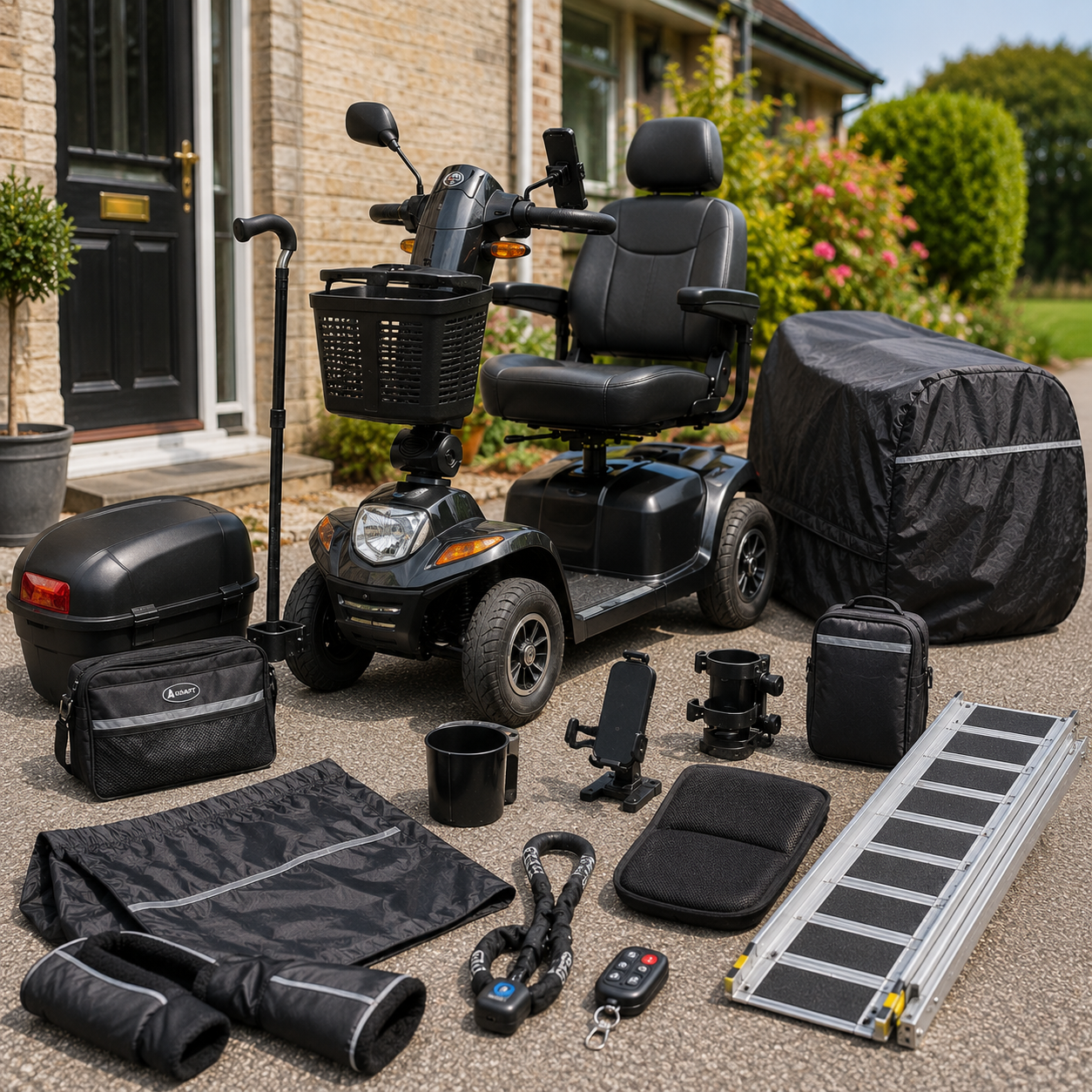
Best Mobility Scooter Accessories for Comfort, Safety and Everyday Convenience
The right accessories can make your mobility scooter easier to use, more comfortable in poor weather and better suited to shopping, days out and everyday journeys. This guide explains which accessories are most useful and what to check before attaching anything to your scooter.
Start with compatibility
Check that every accessory fits your scooter without interfering with its controls, lights, steering, folding mechanism or safe weight limits.
Prioritise practical accessories
Storage, mirrors, walking-stick holders and weather protection are often more useful than accessories chosen mainly for appearance.
Avoid unsafe modifications
Do not drill the frame, alter electrical wiring or fit heavy accessories without checking the scooter manufacturer’s guidance.
Mobility scooters are designed to provide greater freedom, but the standard scooter may not include every feature you need for your individual routine.
A front basket may make shopping easier. A rear walking-stick holder can help you carry another mobility aid. Mirrors, reflective accessories and weather protection can make longer outdoor journeys more comfortable and reassuring.
Accessories should enhance the scooter without making it difficult to control, unstable or too large for your home, car or storage area. A product described as universal may still require a specific bracket, fixing point or weight capacity.
Record the scooter’s make, model and year before ordering an accessory. Where possible, use accessories supplied or approved by the scooter manufacturer or fitted by an experienced mobility specialist.
How to Choose Compatible Mobility Scooter Accessories
An accessory must be suitable for the scooter as well as useful to the person driving it. Check the complete effect of the accessory rather than simply whether it can be physically attached.
| What to check | Why it matters |
|---|---|
| Make and model compatibility | Brackets, seat posts, armrests and attachment points differ between scooters. |
| Accessory weight | Added weight can affect handling, range, lifting and the scooter’s overall limits. |
| Position | The accessory must not obstruct controls, steering, lights, mirrors or the driver’s view. |
| Overall width and length | Rear bags, holders and baskets can make the scooter harder to use in doorways and lifts. |
| Folding or dismantling | Accessories may need to be removed before the scooter can fold or separate safely. |
| Maximum load | Baskets, holders and ramps all have their own safe working limits. |
| Warranty | Drilling, rewiring or using incompatible electrical equipment could affect warranty cover. |
| Storage and transport | The scooter must still fit in its usual storage area and intended vehicle. |
Test the scooter after fitting any new accessory. Check that you can turn fully in both directions and operate every control without reaching awkwardly.
Which Mobility Scooter Accessories Might You Need?
Start with the problem you want to solve rather than buying a collection of accessories that may rarely be used.
Shopping and errands
Consider a front basket, lockable rear box, armrest bag or secure shopping bag designed for the scooter.
Poor weather
Consider a scooter cover, waterproof control-panel cover, lap cover, canopy or warm hand protection.
Longer journeys
Mirrors, supportive seating, a cup holder and secure phone mounting can make longer journeys more practical.
Carrying walking aids
Use a properly fitted holder designed for a walking stick, crutch, rollator or other approved mobility aid.
Security
Consider a strong lock, alarm, secure storage point or professionally fitted tracking device.
Transporting the scooter
Suitable ramps, hoists, protective bags or battery cases may make car travel easier.
Mobility Scooter Baskets, Bags and Storage Accessories
Storage is one of the most practical accessory categories. The best option depends on what you carry and where you need to reach it.
Front basket
Front baskets keep shopping and personal items where they can be seen and reached easily.
Check that the basket does not obstruct the headlight, steering or access to the tiller.
Rear basket
Rear baskets can provide more capacity but add length to the scooter and may make reversing or entering a lift more difficult.
Lockable rear box
A hard storage box can provide better weather protection and help keep personal items out of sight.
Armrest bag
A compact armrest bag is useful for keys, glasses, a purse, medication or a mobile phone.
It should not interfere with transfers or armrest movement.
Seat-back bag
A seat-back bag provides additional storage without placing weight on the steering tiller.
Insulated bag
An insulated bag may help when carrying chilled shopping, drinks or temperature-sensitive personal items.
Weight attached to the tiller can affect steering and stability. Use the scooter’s approved basket or storage system and remain within its stated load limit.
Distribute weight evenly and keep heavy objects low where possible. Loose items should be secured so they cannot fall into the wheels or move unexpectedly during a turn.
Walking-Stick, Crutch and Mobility-Aid Holders
Many scooter users can walk short distances after parking. A suitable holder allows a walking stick or crutch to travel securely without being balanced across the footplate or handlebars.
Available holders may include:
- Single walking-stick holders.
- Double holders for two sticks or crutches.
- Folding-crutch holders.
- Rollator or walking-frame carriers.
- Holders designed for certain oxygen cylinders or medical equipment.
Rear-mounted holders add to the scooter’s overall length. Check that the item cannot move into the wheels, obscure lights or strike someone while turning.
A walking stick or rollator may extend beyond the rear of the scooter. Allow extra clearance around doors, furniture, parked vehicles and pedestrians.
Mobility Scooter Covers and Weather Accessories
Mobility scooters are designed for outdoor use, but they are not completely waterproof. Weather accessories can protect the user and help reduce unnecessary exposure of the scooter to rain and moisture.
Storage cover
A fitted cover protects a parked scooter from dust, light rain and dirt. Choose a breathable cover that fits without dragging on the ground.
Control-panel cover
A transparent tiller cover can provide additional protection while allowing the controls and display to remain visible.
Waterproof seat cover
A seat cover helps keep upholstery dry while the scooter is parked or during changeable weather.
Lap and leg cover
A waterproof lap cover can provide warmth and rain protection without the bulk of a full canopy.
Scooter canopy
A properly fitted canopy can provide overhead protection, although it may increase the scooter’s height, width and sensitivity to strong winds.
Windscreen and side panels
Compatible windscreens and panels provide greater protection on certain larger scooters and canopy-ready models.
Remove a full storage cover before charging unless the scooter manufacturer expressly permits another arrangement. Chargers and batteries need appropriate ventilation and should not be covered or thermally insulated during use.
Canopies, umbrellas and large covers can catch the wind and affect stability. Never attach a household umbrella or improvised weather shield to the scooter.
Frequent all-weather users may prefer a scooter designed around integrated weather protection rather than adding a large aftermarket canopy.
Comfort and Seating Accessories
Small comfort accessories can make a noticeable difference, especially when the scooter is used for longer journeys. They must not compromise posture, transfers or control.
Seat cushion
A suitable cushion may improve comfort, but it also raises the seating position and changes the relationship between the user, tiller and armrests.
Lumbar support
A correctly positioned support may help some users maintain a comfortable upright position.
Armrest pads
Padded armrest covers can improve comfort where the original armrests feel firm or become cold in winter.
Cup or bottle holder
A secure holder makes carrying a closed drink easier without occupying the basket or footplate.
Heated accessories
Some scooters offer manufacturer-approved heated seats or handlebars. Avoid adding unapproved electrical heating equipment.
Hand muffs or warm covers
Weather-resistant hand protection can provide warmth while leaving the controls accessible.
People with a history of pressure damage, reduced sensation, significant postural needs or long periods of continuous sitting should request appropriate clinical seating advice.
Mirrors, Lights and Visibility Accessories
Visibility accessories can help the scooter user see other road users and make the scooter easier for other people to notice.
Rear-view mirror
A mirror can help with checking behind before changing direction. It must be positioned without obstructing controls or making the scooter too wide.
Reflective strips
High-quality reflective strips can improve visibility in low light without drawing power from the battery.
High-visibility cover or clothing
Reflective clothing can make the user more noticeable during daytime, dusk and poor weather.
Additional lighting
Any extra light should be compatible, securely fitted and positioned so it does not confuse or dazzle other road users.
Safety flag
A visible flag may help in certain pedestrian or outdoor settings, provided it remains secure and does not create a snagging hazard.
Amber beacon
A suitable amber flashing beacon is required when a mobility scooter is used on certain dual carriageways.
Class 3 mobility scooters need suitable road equipment, including lights, reflectors, indicators, a mirror and a horn. Do not remove, cover or replace required equipment with an unsuitable accessory.
Read the current GOV.UK road-use guidance .
Phone Holders, USB Charging and Navigation Accessories
A mobile phone can be useful for navigation, contacting family or requesting assistance. It should be mounted where it can be seen without blocking the scooter controls or the route ahead.
Consider the following:
- Use a secure holder designed for the phone’s size and weight.
- Check that the mount remains stable over uneven ground.
- Keep the phone away from the steering and drive levers.
- Set the route or destination before moving.
- Stop somewhere safe before typing or changing settings.
- Use only built-in or approved USB power connections.
- Avoid trailing charging cables around the tiller.
Stop the scooter safely before making calls, reading messages or entering navigation instructions. Keep your attention on pedestrians, traffic and the route ahead.
Mobility Scooter Locks, Alarms and Security Accessories
Removing the key is important, but additional security may be helpful where the scooter is regularly left outside a shop, in a communal store or in an accessible parking area.
Cable or chain lock
A lock can secure the scooter to an appropriate fixed point. Avoid attaching it to electrical wiring, removable trim or steering components.
Disc or wheel lock
Certain scooters may accept a wheel lock, although it must be removed before driving and should not damage the tyre or braking system.
Movement alarm
An alarm can draw attention if the scooter is moved while unattended.
Tracking device
A discreet tracker may assist in locating a stolen scooter. Check battery life, mobile coverage and ongoing subscription costs.
Lockable storage box
A secure box can help keep smaller personal items hidden while the scooter is parked.
Ground anchor
A professionally fitted anchor may improve security in a garage, shed or dedicated scooter store.
Check your insurance terms before choosing a lock or storage location. The policy may require specific precautions when the scooter is left unattended.
Mobility Scooter Ramps and Transport Accessories
Loading a scooter into a vehicle can require more planning than driving it. The correct accessory depends on the scooter’s weight, dimensions and whether it folds or dismantles.
Portable loading ramp
A loading ramp must be long enough, wide enough and rated for the weight of the scooter and the method of loading.
Vehicle hoist
A professionally installed hoist can reduce manual lifting but must be compatible with the car and scooter.
Protective transport bag
Bags may protect removable batteries, cushions or dismantled scooter sections during transport.
Boot liner
A durable liner helps protect the car from mud, moisture and damage when loading scooter sections.
Tie-down equipment
Use only suitable securing points and equipment. Avoid attaching straps to removable bodywork, controls or wiring.
Folding access ramp
A small threshold or access ramp can make entering a home or storage area easier when its gradient and weight capacity are suitable.
Some ramps are intended for an unoccupied scooter to be pushed or winched. Follow the instructions for the ramp, scooter and vehicle loading system.
Measure the boot opening as well as the available space inside the car. A scooter may technically fit in the boot but be impossible to lift through the opening safely.
Charging and Battery Accessories
Charging equipment is safety-critical. Use the charger supplied or approved for the specific scooter and battery.
Approved charger
A replacement charger must be compatible with the battery chemistry, voltage and charging system.
Off-board charging dock
Certain removable batteries can be charged away from the scooter using a manufacturer-approved dock.
Spare battery
Some travel scooters support a compatible spare battery, providing an alternative for longer days or holidays.
Charger bag
A protective bag can keep the charger organised during travel, provided it is removed from the bag before use.
Charging safety reminders
- Follow the scooter and battery manuals.
- Inspect cables and plugs for damage.
- Charge on a stable surface with suitable ventilation.
- Keep the charging area clear of combustible materials.
- Do not cover the charger or battery while charging.
- Do not charge a swollen, damaged or leaking battery.
- Keep cables away from doorways and walking routes.
- Obtain permission before charging in a communal area.
A plug that physically fits does not confirm electrical compatibility. An unsuitable charger could damage the battery, create a fire risk or affect warranty cover.
Medical and Personal Accessories
Some users need to carry medical equipment or important personal items. These accessories require particularly secure fitting.
Examples may include:
- Approved oxygen-cylinder holders.
- Medication bags.
- Emergency-information pouches.
- Hearing-aid or glasses cases.
- Personal alarm holders.
- Catheter-bag covers and suitable securing systems.
- Holders for approved mobility or communication equipment.
Medical accessories should not interfere with transfers, tubing, circulation, posture or access to emergency equipment.
Speak to the relevant healthcare professional before carrying oxygen, specialist medical equipment or equipment that must remain in a particular position.
Unsafe Accessories and Modifications to Avoid
An accessory should never compromise the scooter’s structure, electrical system or handling.
- Do not drill the frame without manufacturer approval.
- Do not splice into scooter wiring to power lights, heaters or electronic accessories.
- Do not use an incompatible charger or battery.
- Do not attach heavy bags to the tiller or handlebars.
- Do not fit accessories that cover lights, reflectors, indicators or mirrors.
- Do not add an umbrella or large improvised canopy.
- Do not exceed the accessory or scooter weight limit.
- Do not place loose objects on the footplate.
- Do not fit accessories that prevent the seat or tiller from locking.
- Do not rely on cable ties as a permanent structural fixing.
- Do not attach anything that can move into the wheels.
- Do not make speed, controller or motor modifications.
Stop using an accessory if it becomes loose, changes the steering, produces unusual noise or causes the scooter to behave differently.
Which Accessories Should You Buy First?
The following table provides a practical starting point. Your own priorities may differ according to your scooter, environment and mobility needs.
| Accessory | Most useful for | Priority |
|---|---|---|
| Compatible storage basket | Shopping and everyday essentials | High for most users |
| Rear-view mirror | Outdoor journeys and checking behind | High for regular outdoor users |
| Walking-stick holder | Users who walk after parking | High when required |
| Storage cover | Garages, sheds and sheltered outdoor storage | High where the scooter is exposed |
| Lap cover | Cold and wet-weather journeys | Seasonal |
| Phone holder | Navigation and emergency contact | Useful |
| Security lock or alarm | Parking away from home | High where theft is a concern |
| Cup holder | Longer days out | Optional |
| Canopy | Frequent year-round outdoor travel | Depends on scooter compatibility |
| Loading ramp or hoist | Regular car transport | Essential where manually loading is unsafe |
Mobility Scooter Accessory Checklist
- Record the scooter’s manufacturer, model and year.
- Confirm that the accessory is specifically compatible.
- Check the accessory’s weight and load capacity.
- Check the scooter’s maximum weight and storage limits.
- Measure the attachment point before ordering.
- Check whether an additional bracket is required.
- Confirm that controls and steering remain accessible.
- Ensure lights, mirrors and reflectors remain visible.
- Check the effect on total width and length.
- Confirm that the scooter can still fold or dismantle.
- Check that it still fits in the storage area and car.
- Ask whether professional fitting is recommended.
- Confirm whether the accessory affects the warranty.
- Test the scooter at low speed after installation.
- Recheck fixings regularly for movement or wear.
Mobility Scooter Accessory FAQs
What are the most useful mobility scooter accessories?
The most useful accessories commonly include a suitable basket or storage bag, rear-view mirror, walking-stick holder, weather protection and security lock. The best combination depends on your normal journeys and scooter model.
Are mobility scooter accessories universal?
No. Seat posts, armrests, tillers, brackets and fixing points vary between manufacturers and models. Even an accessory sold as universal should be checked carefully before fitting.
Can I fit a basket to any mobility scooter?
Many scooters support a front or rear basket, but the correct bracket and safe weight limit vary. The basket must not interfere with steering, lights, folding or access to the seat.
Can I add a canopy to my mobility scooter?
A canopy should only be fitted where the scooter and canopy are compatible. It can increase the scooter’s height, width and sensitivity to wind. Some users may be better served by choosing a purpose-designed canopy scooter.
Can I use a normal phone holder on a mobility scooter?
A suitably strong holder may be used when it fits securely and does not obstruct the controls, steering or view ahead. Stop the scooter safely before operating the phone.
Can I use a different charger for my mobility scooter?
Only use a charger supplied or approved for the scooter and battery. Matching the plug or voltage alone does not confirm that a charger is safe or compatible.
Can accessories reduce mobility scooter range?
Additional weight and electrical accessories can reduce available range. Canopies may also create additional wind resistance. The effect depends on the scooter, journey and accessory.
How should I secure shopping on a mobility scooter?
Use an approved basket, bag or storage box and remain within its weight limit. Avoid placing loose items on the footplate or hanging heavy bags from the tiller.
Do I need a mirror on my mobility scooter?
A rear-view mirror is required equipment for a Class 3 road-going mobility scooter. A mirror can also be useful on a Class 2 scooter, even where it is not a legal requirement.
Can fitting an accessory affect my warranty?
Unapproved electrical changes, drilling or structural modifications may affect warranty cover. Check the warranty and manufacturer’s instructions before making permanent changes.
Need Help Choosing Compatible Accessories?
Speak with Mobility Connect before adding an accessory that could affect your scooter’s controls, weight, storage, transport or warranty.