


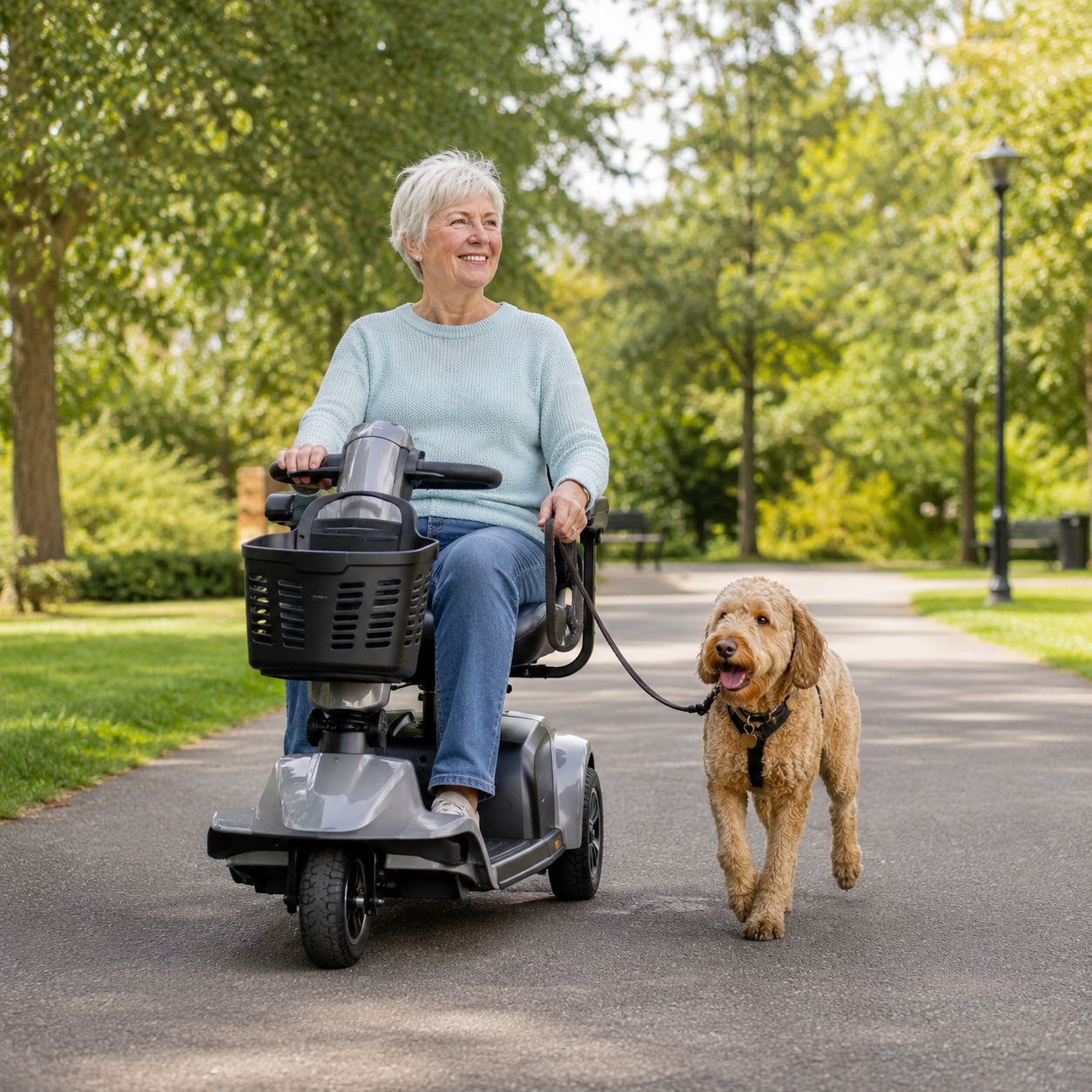
Walking Your Dog with a Mobility Scooter: Benefits, Training and Safety
A mobility scooter can make it easier for some dog owners to enjoy regular outdoor time with their pet. The experience should never begin by simply attaching a lead and setting off, however. Your dog must first become comfortable around the scooter, learn where to walk and respond reliably to changes in speed and direction.
Dogs benefit from regular exercise, opportunities to sniff and explore, mental stimulation and time spent with their owners. When walking has become tiring, a mobility scooter may make some of these outings more manageable.
The benefit depends on the individual dog. A calm adult dog that already walks comfortably on a loose lead may adapt quickly. A dog that pulls, lunges towards other animals, crosses repeatedly in front of its owner or feels nervous around moving equipment will require considerably more preparation.
A mobility scooter should also be selected because it meets the user’s mobility, comfort, access and journey requirements. Its usefulness for dog walking should be an additional consideration rather than the sole reason for choosing one.
Your dog may benefit when a mobility scooter allows you to provide more consistent, enjoyable and appropriately paced outdoor time. It will only be beneficial when the dog is comfortable, safely trained and still receives the type and amount of exercise it needs.
In the UK, rules apply to who can use a mobility scooter and where. Check the current gov.uk rules before you ride.
Check the current GOV.UK mobility scooter rules .
Potential benefits · Dog suitability · Choosing a scooter · Training steps · Lead safety · Route planning · Weather safety · Different dogs · Checklist · FAQs
How Could a Mobility Scooter Benefit Your Dog?
A suitable mobility scooter may remove some of the physical barriers that make regular dog walks difficult. It can allow the owner and dog to travel together without requiring the owner to walk the complete distance.
Potential benefits include:
- More consistent opportunities to go outside.
- Greater variety in the routes and places the dog visits.
- Opportunities to sniff, explore and experience different surroundings.
- More time spent together away from the home.
- Easier access to nearby parks and suitable green spaces.
- A more sustainable routine for an owner who finds walking tiring.
- Greater independence when family members are not available to help.
- Opportunities for gentle outdoor activity with an older or slower dog.
A scooter walk should not simply transport the dog from one place to another as quickly as possible. Allow safe opportunities to stop, sniff and investigate the environment.
Exercise also supports a dog’s fitness, weight and mental stimulation. The amount required varies according to breed, age, personality and fitness.
Read the PDSA guidance on dog exercise for more information.
Is Your Dog Suitable for Walking Beside a Mobility Scooter?
Most dogs can become familiar with mobility equipment, but that does not mean every dog is immediately safe to walk beside a moving scooter.
| Dog behaviour or circumstance | What it means | Recommended approach |
|---|---|---|
| Calm and comfortable on a loose lead | Usually provides the best starting point | Introduce the scooter gradually and practise in a quiet area |
| Regularly pulls on the lead | Sudden pulling could affect control and positioning | Complete loose-lead training before attempting independent scooter walks |
| Crosses repeatedly in front | The dog could enter the path of the front wheels | Teach a consistent walking side and position |
| Lunges at dogs, wildlife or vehicles | Creates a significant risk of loss of control | Seek help from a qualified trainer or behaviourist |
| Nervous around wheels or motor sounds | The scooter may cause fear or avoidance | Desensitise slowly without forcing the dog closer |
| Young puppy | May lack training, concentration and physical maturity | Ask your vet about appropriate exercise and keep sessions short |
| Senior dog or dog with limited stamina | May tire easily or experience joint, heart or breathing difficulties | Ask your vet to recommend an appropriate pace and distance |
| Small dog | May be difficult to see close to the scooter and wheels | Maintain a clearly visible and consistent position |
| Very energetic working or sporting dog | A slow scooter walk may not provide sufficient exercise | Combine walks with other suitable activity, training or professional dog walking |
The dog should learn to remain beside the scooter on a loose lead. Increasing speed or using the scooter’s weight to resist pulling does not teach safe walking behaviour.
Choosing a Mobility Scooter for a Dog Owner
The correct scooter depends primarily on the user’s requirements. Dog walking may then influence which features are particularly useful.
| Scooter feature | Why it may help | What to check |
|---|---|---|
| Smooth low-speed control | Makes it easier to match the dog’s natural walking pace | Test acceleration, stopping and slow-speed manoeuvring |
| Stable four-wheel layout | Can provide a reassuring platform on regular outdoor routes | Width, turning circle and storage space |
| Suitable suspension | Improves comfort over uneven pavements and dropped kerbs | Whether it suits the actual route and terrain |
| Appropriate tyres | Support grip and comfort on the intended surfaces | Puncture risk, pressure checks and terrain suitability |
| Useful travel range | Allows for the complete return journey and occasional diversions | Hills, cold weather, weight and battery condition can reduce range |
| Clear all-round visibility | Helps the user monitor the dog, pedestrians and surrounding traffic | Mirrors, seating position and blind spots |
| Storage basket | Provides space for water, waste bags and weather clothing | Weight limit and whether it obstructs the dog’s position |
| Lights and reflectors | Improve visibility in dull conditions or during an unexpectedly late return | Check that every light operates correctly |
Read our guide to the different types of mobility scooter before comparing products.
A large road scooter may provide excellent comfort and range but be difficult to manoeuvre on narrow local paths. A portable model may fit in the car but provide less ground clearance or outdoor comfort.
How to Train a Dog to Walk Beside a Mobility Scooter
Training should take place gradually. Move to the next stage only when the dog appears relaxed and confident at the current stage.
Step 1: Introduce the stationary scooter
Leave the switched-off scooter somewhere the dog can observe it without being forced to approach. Reward calm behaviour and allow the dog to investigate at its own pace.
Step 2: Sit on the scooter without moving
Sit in the normal driving position while another person remains with the dog. Reward the dog for settling nearby and maintaining a comfortable distance from the wheels.
Step 3: Introduce the sounds and controls
Switch the scooter on without driving away. Introduce any beeps, indicators, lights and motor sounds gradually.
Stop when the dog appears worried. Do not restrain a frightened dog beside the scooter until it “gets used to it”.
Step 4: Use a second person to hold the lead
Ask a trusted helper to walk the dog beside the scooter while you travel very slowly in a straight line. The helper can control the dog while both of you identify the safest walking position.
PDSA recommends this assisted approach when first teaching a dog to walk beside a wheelchair or mobility scooter.
Step 5: Practise starting and stopping
Teach the dog that the scooter moving means walking and the scooter stopping means waiting beside it. Use consistent verbal cues and reward calm responses.
Step 6: Add wide turns
Practise gentle turns in both directions. Make sure the dog does not cut across the front of the scooter or move close to the rear wheels.
Step 7: Add useful commands
Depending on your normal training vocabulary, useful cues may include:
- Walk or move on.
- Slow.
- Stop or wait.
- This side.
- Leave.
- Watch me.
- Come closer.
Step 8: Move to a quiet outdoor space
Begin outside in a familiar, open area with few pedestrians, dogs or vehicles. Keep the first sessions short and return home while the dog is still calm.
Step 9: Introduce everyday distractions gradually
Add passing pedestrians, other dogs, driveways, dropped kerbs and road crossings one at a time rather than taking the dog immediately into a busy town centre.
Step 10: Build distance slowly
Increase time and distance according to the dog’s fitness, confidence and comfort. Watch for fatigue and do not expect the dog to maintain the scooter’s maximum speed.
Reward the behaviour you want, including remaining beside the scooter, leaving distractions and stopping calmly. Short, regular sessions are usually more productive than one long and frustrating session.
Read the PDSA guidance on exercising your dog .
Lead Positioning and Equipment Safety
The lead must remain clear of the scooter’s wheels, steering, controls and moving components throughout the journey.
Safer lead-management principles
- Teach the dog to remain on one consistent side.
- Position the dog away from moving traffic where the route allows.
- Keep the dog far enough from the wheels to avoid contact.
- Use a lead that remains visible and does not trail on the ground.
- Maintain enough slack for comfortable walking without allowing the dog to cross the scooter’s path.
- Shorten the lead before road crossings, narrow gaps and busy areas.
- Check that the dog’s collar or harness fits correctly.
- Carry treats and waste bags somewhere that does not interfere with the controls.
A sudden pull could affect steering, create a tangle or prevent you from releasing the dog safely. Do not use an attachment unless it has been specifically designed for the scooter and assessed as suitable by the manufacturer and an experienced dog trainer.
Are retractable leads suitable?
A long retractable line can be difficult to see, may wrap around the scooter and allows the dog to change position suddenly. A conventional lead that provides predictable control will generally be easier to manage during training and on shared routes.
Before scooter training begins, the dog should already be able to walk without persistent pulling. The RSPCA recommends rewarding a dog for remaining close on a loose lead and stopping whenever pulling begins.
Read the RSPCA loose-lead training guide .
How Fast Should You Travel with a Dog?
Mobility scooters must not exceed 4mph on pavements, footpaths and pedestrian areas. When walking a dog, the appropriate speed will often be considerably lower.
Travel at the dog’s natural walking pace rather than asking it to trot continuously beside the scooter. Reduce speed further around:
- Pedestrians and other dogs.
- Children and pushchairs.
- Narrow pavements.
- Blind corners and shop entrances.
- Driveways and road crossings.
- Uneven surfaces and dropped kerbs.
- Wet leaves, mud and standing water.
- Busy parks and promenades.
Sustained running beside a powered vehicle can cause a dog to overheat or become exhausted before the rider notices. Pace the journey around the dog rather than the scooter’s capability.
Check the current rules for mobility scooters on pavements and footpaths .
Planning a Safe Dog-Walking Route
A route that is manageable on foot may feel very different when using a mobility scooter with a dog beside it.
Check the following before setting off:
- The complete return distance.
- The scooter’s available battery range.
- Pavement and path width.
- Availability of dropped kerbs.
- Road crossings and complicated junctions.
- Steep gradients and side slopes.
- Grass, gravel, mud and uneven surfaces.
- Gates, barriers and narrow entrances.
- Busy areas containing children or other dogs.
- Places where the dog can stop and sniff safely.
- Shade and access to water.
- A suitable shorter route if the dog becomes tired.
- Somewhere to stop without blocking the path.
- Mobile phone signal and emergency contacts.
Travel around a new route alone or with another adult before attempting it with the dog. This allows you to identify narrow sections, steep kerbs and difficult crossings without also managing a lead.
Read our guide explaining where you can drive a mobility scooter .
Weather Safety When Walking a Dog from a Mobility Scooter
Hot weather
Dogs can overheat during exercise, particularly when asked to move continuously beside a scooter. Flat-faced dogs, older dogs, puppies, overweight dogs and dogs that struggle in warm weather may be at greater risk.
- Walk during the cooler morning or evening.
- Avoid sustained exercise during the hottest part of the day.
- Test hot pavement with the back of your hand.
- Choose shaded routes and cooler surfaces where possible.
- Carry water and offer regular breaks.
- Turn back before the dog becomes exhausted.
- Never leave the dog or scooter user waiting in a hot vehicle.
Heavy panting, excessive drooling, weakness, confusion, vomiting or collapse may indicate heatstroke. Stop exercising the dog, begin cooling it and contact a veterinary practice urgently.
Read the RSPCA hot-weather dog guidance .
Cold and wet weather
Cold, wind and rain can be uncomfortable for both the rider and dog. Smaller, short-coated, older and unwell dogs may become cold more quickly.
- Keep the journey shorter during severe weather.
- Use suitable dog clothing where recommended.
- Avoid ice, deep water and flooded paths.
- Wipe mud, grit and road salt from paws after the walk.
- Dry the dog and scooter before settling indoors.
- Use working scooter lights during dark or dull conditions.
Adapting Scooter Walks for Different Dogs
| Dog | Main consideration | How to adapt the outing |
|---|---|---|
| Puppy | Growing joints, limited concentration and incomplete training | Use very short sessions and ask the vet about suitable exercise |
| Senior dog | Stiffness, reduced stamina, hearing or vision changes | Choose familiar level routes with frequent breaks |
| Small dog | Close proximity to wheels and reduced visibility | Keep the dog in a consistent position that remains clearly visible |
| Large active dog | Strength and greater exercise requirements | Complete loose-lead training and provide additional suitable exercise |
| Flat-faced dog | Increased difficulty breathing and regulating temperature | Use short, gentle outings in cool conditions and follow veterinary advice |
| Reactive dog | Lunging or sudden changes of direction | Seek professional help and avoid crowded routes until behaviour is manageable |
| Nervous dog | Fear of movement, sound or being close to the scooter | Use gradual desensitisation and never force the dog beside the vehicle |
| Dog with stiffness or limited stamina | Older dogs: shorter routes and more rest stops | Ask the vet to recommend the appropriate duration, surface and pace |
Ask your vet about your dog's exercise needs before changing their routine.
Can a Dog Ride on a Mobility Scooter?
Do not place a dog loosely on the foot platform, seat, handlebars or inside a standard shopping basket. The dog could obstruct the controls, jump out or alter the scooter’s balance.
A carrier should only be considered when:
- It is specifically designed for transporting a dog.
- It is compatible with the scooter.
- The scooter manufacturer permits its use.
- The carrier and dog remain within all weight limits.
- Steering, visibility and controls remain unobstructed.
- The dog is secured appropriately within the carrier.
- The scooter remains stable during turns and stopping.
A standard shopping basket is not designed to restrain a dog or protect it during sudden braking.
When Should You Avoid a Scooter Dog Walk?
Delay the walk or use another form of exercise when:
- The dog is frightened by the scooter.
- The dog cannot remain safely clear of the wheels.
- Pulling or lunging cannot be controlled reliably.
- The dog is unwell, injured or recovering.
- The weather is too hot, icy, stormy or windy.
- The planned route is flooded or badly obstructed.
- The pavement is too narrow for the scooter, dog and other users.
- The scooter has a tyre, steering, braking or battery problem.
- The rider cannot manage the controls and lead independently.
- The battery does not have enough range for the return journey.
Other Ways to Keep Your Dog Active
A mobility scooter can support a dog’s routine, but it does not need to provide every part of the dog’s exercise and enrichment.
Other suitable activities may include:
- Help from a family member or friend.
- A reputable professional dog walker.
- Reward-based training sessions at home.
- Scent-search games.
- Food puzzles and enrichment toys.
- Gentle play in a secure garden.
- Fetch or retrieve games adapted to the dog’s fitness.
- Accessible dog-training classes.
- Secure enclosed exercise areas.
Training, sniffing and problem-solving can help occupy a dog when weather or accessibility makes a full walk impractical.
Mobility Scooter Dog-Walking Checklist
- Confirm that the dog is comfortable around the scooter.
- Make sure the dog can walk on a loose lead.
- Use a secure, correctly fitted collar or harness.
- Keep the lead away from the wheels and controls.
- Do not attach the lead to the tiller.
- Check the scooter battery.
- Check tyres, steering and stopping response.
- Test lights, indicators, horn and mirrors.
- Check the weather for the complete journey.
- Avoid hot pavement and extreme temperatures.
- Plan a route with suitable pavement width.
- Check for dropped kerbs and safe crossings.
- Avoid surfaces beyond the scooter’s capability.
- Carry dog waste bags.
- Carry water on longer journeys.
- Carry a charged mobile phone.
- Allow the dog time to stop and sniff.
- Keep below 4mph on pavements.
- Travel more slowly around other people and animals.
- Watch continuously for tiredness or distress.
- Leave enough battery range to return safely.
Walking a Dog with a Mobility Scooter FAQs
Can you walk a dog from a mobility scooter?
Yes, provided the dog is comfortable around the scooter, walks safely on a loose lead and remains clear of the wheels and controls. Introduce the scooter gradually and begin with help from another person.
Will a mobility scooter help me exercise my dog?
It may make regular outings easier when walking is difficult for the owner. The dog may still need additional exercise, play or enrichment depending on its breed, age and energy level.
How do I introduce my dog to a mobility scooter?
Begin with the scooter switched off and stationary. Reward calm behaviour, then introduce the controls and movement gradually. Initially ask another person to hold the lead while the dog walks alongside.
Which side should the dog walk on?
Use a consistent side that keeps the dog visible and away from the wheels. Where practical, keep the dog on the side furthest from moving traffic. The safest position may vary according to the scooter and route.
Can I attach my dog’s lead to the mobility scooter?
Do not improvise by attaching a lead to the handlebars, tiller or controls. A sudden pull could affect steering or cause a tangle. Only use an attachment specifically approved for the scooter after taking appropriate professional advice.
Is a retractable lead suitable beside a scooter?
A retractable line can be difficult to see and may reach the wheels or allow sudden changes of position. A conventional lead usually provides more predictable control while the dog is being trained.
How fast should the mobility scooter travel?
Mobility scooters must not exceed 4mph on pavements, but a slower speed is usually more appropriate when walking a dog. Match the dog’s comfortable walking pace and slow down further in busy or narrow areas.
Can my dog run beside the scooter?
Do not use the scooter to make the dog run for a prolonged period. The dog may overheat or become exhausted. Any higher-intensity exercise should be appropriate for the dog and discussed with a vet where necessary.
What is the best mobility scooter for a dog owner?
The best scooter depends on the user’s mobility, comfort, storage and normal journeys. Smooth low-speed control, good visibility, suitable range, appropriate tyres and a stable design may be particularly useful for dog walking.
Can a puppy walk beside a mobility scooter?
Puppies may lack the training, concentration and physical maturity required for longer scooter walks. Introduce the stationary scooter gradually and ask your vet how much exercise is appropriate.
Can an older dog walk beside a mobility scooter?
Gentle scooter outings may suit some older dogs, but pace and distance should reflect mobility, stamina and fitness. Choose level routes and ask your vet for advice where the dog has stiffness or another condition.
Can a reactive dog be walked from a mobility scooter?
A dog that lunges towards people, animals or vehicles can create a serious risk. Seek help from a qualified reward-based trainer or behaviourist before attempting independent scooter walks.
Can a dog sit in the scooter basket?
A standard shopping basket is not a safe dog carrier. Only use a purpose-designed carrier that is compatible with the scooter, remains within weight limits and does not obstruct the controls or visibility.
What should I take on a scooter dog walk?
Take a charged phone, waste bags, water where appropriate, weather protection and any required emergency information. Make sure everything is stored without interfering with steering or the lead.
Find a Mobility Scooter Suited to Your Everyday Journeys
Mobility Connect can help you compare mobility scooters based on comfort, low-speed control, range, storage, route conditions and the journeys you would like to enjoy with your dog.