


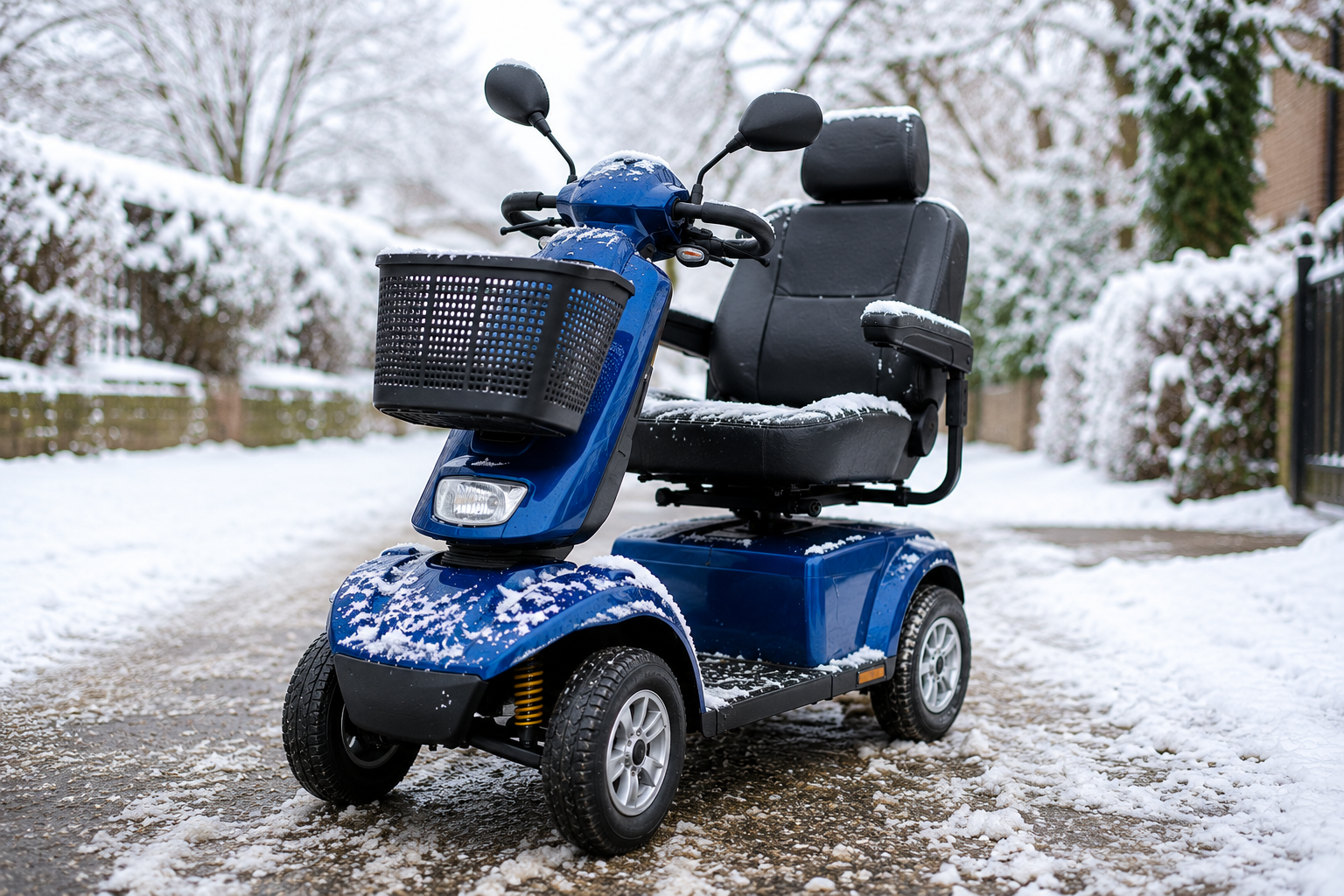
Mobility Scooter Winter Maintenance: Battery, Storage and Safety Guide
Cold temperatures, rain, road salt, darker days and slippery surfaces can all affect a mobility scooter during winter. This guide explains how to check the battery, tyres, brakes, controls and storage area, as well as how to prepare for safer journeys in cold and changeable weather.
Winter reliability begins before the first cold journey
A mobility scooter that performs normally during mild weather may provide less range or require more careful handling when temperatures fall and surfaces become wet.
Checking the scooter before winter makes it easier to address worn tyres, weak batteries, damaged lights or storage problems before they interrupt an important journey.
Winter does not automatically mean that a mobility scooter must be put away until spring. Many users continue making everyday journeys throughout the colder months.
Preparation becomes more important, however. Cold temperatures can temporarily reduce the power available from a battery, while rain and damp can affect electrical components if the scooter is not cleaned, dried and stored correctly.
Tyre pressure may also fall as temperatures change. Low pressure can affect handling, comfort and the distance available from a charge.
Charging, storage, cleaning, tyre pressure and maintenance instructions vary between products. The manufacturer’s instructions take priority over general guidance.
Even large wheels, suspension and all-terrain styling cannot guarantee grip on ice. Snow can also hide kerbs, potholes and uneven surfaces.
Complete a Mobility Scooter Check Before Winter
Begin before the coldest weather arrives. This gives you time to arrange replacement parts or professional help rather than discovering a problem immediately before an important journey.
Battery and charger
Check that the battery charges normally and inspect the charger, cable, plug and charging socket for damage.
Tyres and wheels
Inspect tread, pressure, cracking, punctures, flat spots and anything trapped in the tyres.
Steering and brakes
Check that steering feels secure and that the scooter slows and stops normally when the drive control is released.
Lights and visibility
Test the headlight, rear lights, indicators, hazards, horn, mirrors and reflectors where fitted.
Frame and seat
Look for cracks, corrosion, loose body panels and problems with the seat, armrests or tiller lock.
Storage area
Check for leaks, condensation, frost, damaged sockets and anything that could obstruct safe charging.
Some bearings, motors and transaxle assemblies are sealed and pre-lubricated. Apply lubricant only where the manufacturer’s instructions specifically require it.
Look After the Mobility Scooter Battery in Cold Weather
The battery deserves particular attention during winter. Cold conditions can temporarily reduce the power and range available, even when the battery normally performs well.
Winter battery-care checklist
- Use only the charger supplied or approved for the scooter and battery.
- Charge in a dry and suitably ventilated location.
- Follow the charging time and indicator sequence in the product manual.
- Keep the charger and battery away from rain and condensation.
- Avoid allowing the battery to remain completely discharged.
- Check that the charging cable and connector remain undamaged.
- Allow more range than usual for the return journey.
- Expect hills, soft ground, low tyre pressure and extra weight to reduce the available distance further.
- Arrange a battery test when the range falls unexpectedly or power reduces sharply on inclines.
Move the scooter or removable battery to a suitable environment and follow the manufacturer’s instructions. Do not attempt to warm a battery rapidly using a heater, radiator or other improvised method.
Sealed lead-acid, gel and lithium batteries do not always have the same charging or long-term storage requirements. Check the instructions supplied with the exact battery.
Read the complete guide to preserving a mobility scooter battery .
Check Mobility Scooter Tyres and Wheels Regularly
Tyres influence steering, comfort, grip and available range. They should be checked more frequently when the scooter is being used on wet, dirty or damaged winter surfaces.
| Component | What to inspect | Why it matters |
|---|---|---|
| Pneumatic tyres | Pressure, tread, cracking, cuts, punctures and embedded objects | Incorrect pressure can affect handling, comfort and battery range |
| Solid tyres | Splitting, flat spots, heavy wear and missing sections | Damage may reduce grip or cause vibration |
| Wheels | Unusual movement, noise, looseness or resistance | May indicate a bearing, fixing or wheel problem |
| Wheel arches | Packed mud, leaves, road grit and other debris | Build-up can restrict movement and trap moisture |
| Castors or anti-tip wheels | Damage, obstruction and secure attachment | These contribute to stability on compatible models |
Do not copy a pressure from another product. Check the tyre, manual or manufacturer’s instructions.
Mobility scooter tyre sizes and wheel assemblies vary significantly. Only use tyres approved for the exact scooter and fitted correctly by a suitable technician.
Test the Brakes, Controls and Lights
Reduced daylight and wet surfaces make predictable controls and good visibility particularly important.
Test in a safe, level and open area
- Check forward and reverse movement at low speed.
- Confirm that acceleration remains smooth.
- Release the drive control and check that the scooter slows and stops normally.
- Turn in both directions and check for stiffness or unusual movement.
- Confirm that the freewheel lever is correctly returned to drive mode.
- Test the horn.
- Test front and rear lights.
- Test indicators and hazard lights where fitted.
- Clean mirrors and reflectors.
- Check that the control display is clear and undamaged.
Pulling to one side, delayed stopping, unexpected power loss, loose steering or repeated fault codes should be investigated before another journey.
Clean and Dry the Scooter Before Storing It
Road grit, salt, wet leaves and mud can collect around the tyres, floorboard and lower frame. Remove them without soaking the scooter or spraying electrical components.
Park somewhere dry
Switch off the scooter, remove the key and disconnect the charger before cleaning.
Remove loose debris
Brush away mud, leaves, grit and stones before using a damp cloth.
Wipe rather than rinse
Clean the bodywork, floorboard and tyres without directing water towards electrical components.
Dry thoroughly
Pay particular attention to the controls, charging area, seat, frame and wheels.
Water can enter controls, connectors, wheel hubs, bearings and the motor. Apply mild cleaner to a cloth rather than spraying it directly onto the scooter.
Follow the full guide explaining how to clean a mobility scooter safely .
Store the Mobility Scooter Somewhere Dry and Protected
Storage protects more than the battery. Prolonged exposure to moisture, frost and temperature extremes can affect the controls, wiring, upholstery, bodywork and metal components.
| Storage location | Main consideration | Recommended action |
|---|---|---|
| Inside the home | Charging, ventilation, access and fire escape routes | Use an approved location that does not block doors, hallways or emergency exits |
| Garage | Cold temperatures, damp floors and condensation | Keep the scooter dry, ventilated and protected from freezing conditions |
| Shed | Leaks, security, ventilation and electrical safety | Check the roof, floor, charging socket and temperature before relying on it |
| Outdoor storage | Rain, frost, wind and trapped condensation | Use a secure purpose-designed shelter where possible rather than only a loose cover |
| Vehicle | Extreme cold, condensation and theft | Avoid using a vehicle as routine long-term storage |
For prolonged periods without use
- Fully charge the battery as directed by the manual.
- Follow the manufacturer’s maintenance-charging routine.
- Disconnect or remove the battery only when the product instructions recommend it.
- Keep removable batteries in an approved temperature range.
- Do not leave the battery completely discharged.
- Check pneumatic tyre pressure periodically.
- Protect tyres from prolonged pressure in one position where the manual recommends it.
- Check regularly for damp, corrosion, pests or damage.
- Do not cover the scooter while it is wet.
A cover may keep direct rain off the scooter while still trapping condensation underneath. Use a breathable, correctly fitted product and check beneath it regularly.
Decide Whether the Conditions Are Safe Before Travelling
Consider the complete route and the return journey, not only the weather outside when you leave.
Proceed with normal care
Paths are clear, visibility is good and the scooter has sufficient battery range.
Continue to allow for changing weather and an earlier sunset.
Shorten or adjust the journey
Rain, cold temperatures, strong wind or poor visibility is expected.
Choose a familiar route, travel slowly and allow additional battery reserve.
Choose another time
Ice, unsafe snow, flooding, severe wind or very poor visibility is present.
No scooter feature or accessory can make these conditions reliably safe.
Shaded pavements, bridges, untreated side roads, sloping driveways and areas near standing water may remain icy after other routes have cleared.
Plan Winter Mobility Scooter Journeys Carefully
- Check the latest local weather forecast.
- Confirm that the battery is fully charged.
- Allow for reduced cold-weather range.
- Calculate the complete return distance.
- Choose pavements and paths likely to be cleared.
- Avoid steep hills and severe side slopes.
- Check for roadworks, flooding and path closures.
- Avoid routes containing untreated ice or snow.
- Identify places where you can shelter.
- Plan to return before darkness where practical.
- Test the lights before leaving.
- Carry a charged mobile phone.
- Carry breakdown and emergency contact details.
- Tell someone your route on an unfamiliar journey.
- Wear suitable warm and waterproof clothing.
- Leave room to operate the controls comfortably.
- Carry required medication.
- Turn back before the battery or weather becomes a concern.
Check where different scooter classes can travel in the guide to UK mobility scooter routes and rules .
Stay Warm Without Restricting Scooter Control
Cold conditions can affect the user’s comfort, concentration and ability to operate small switches and levers.
Helpful winter preparations may include:
- Several warm layers rather than one restrictive garment.
- Waterproof outer clothing.
- Gloves that still allow full use of the controls.
- Warm footwear with sufficient grip.
- Reflective or high-visibility clothing.
- A correctly fitted control-panel cover.
- A lap cover kept securely away from the wheels.
- A manufacturer-approved canopy or weather protection system.
- An integrated heated seat where it is supplied or approved for the scooter.
Long scarves, blankets, straps and loose bags can become caught in moving components or interfere with steering.
Accessories drawing power from an unsuitable socket can damage the scooter or reduce the available battery range. Use only approved equipment.
Compare useful products in the guide to mobility scooter accessories .
Winter Mobility Scooter Maintenance Schedule
| Frequency | Checks to complete | Arrange help when |
|---|---|---|
| Before each longer journey | Battery charge, tyres, controls, brakes, lights, mirrors and weather | Performance differs from normal or a warning indicator appears |
| After wet or muddy journeys | Remove dirt, wipe surfaces and dry the controls, frame and wheels | Water has entered the display or electrical components |
| Weekly during regular use | Tyre condition, tyre pressure, charger cable, lights, reflectors and loose accessories | Tyres repeatedly lose pressure or a component becomes loose |
| Monthly | Frame, corrosion, wiring, charging socket, storage area and battery performance | Corrosion, exposed wiring or reduced range is found |
| Professional servicing | Follow the manufacturer’s service schedule and aftercare recommendations | Braking, steering, electrical or structural safety is uncertain |
Mobility Connect’s Aftercare service can assist with servicing, batteries, tyres, charging problems and repairs.
Winter Warning Signs That Need Attention
Stop and arrange professional advice when you notice:
- A major or sudden reduction in battery range.
- Power cutting out while moving.
- A charger or battery becoming unusually hot.
- A swollen, damaged or leaking battery.
- Loose or unpredictable steering.
- Changed stopping behaviour.
- Repeated tyre-pressure loss.
- Cracked, split or heavily worn tyres.
- Water inside the control display.
- Exposed or damaged wiring.
- Strong burning or electrical smells.
- Significant corrosion.
- Cracks in the frame or seat mounting.
- Repeated fault codes or circuit-breaker activation.
Repeatedly driving a scooter with a steering, braking, electrical or structural problem can cause additional damage or leave the user stranded.
Is Your Mobility Scooter Suitable for Your Winter Journeys?
Maintenance cannot turn a lightweight travel scooter into an all-weather road scooter. Consider whether the scooter’s range, tyres, wheel size, ground clearance, suspension and weather protection suit the routes you need to use.
| Scooter feature | Possible winter benefit | Important limitation |
|---|---|---|
| Larger wheels | Can handle minor surface changes more easily | Do not provide safe grip on ice |
| Suspension | Improves comfort over uneven winter-damaged pavements | Does not make flooded or frozen routes safe |
| Pneumatic tyres | May provide cushioning and suitable outdoor grip | Require pressure checks and can puncture |
| Canopy | Provides increased protection from wind and rain | Adds height and can increase sensitivity to strong winds |
| Larger battery | Provides more flexibility for longer journeys | Cold, hills and soft ground can still reduce range |
| Lighting | Improves visibility during dark or dull conditions | Lights must remain clean and operational |
Read the guide to mobility scooters suited to winter journeys .
Complete Winter Mobility Scooter Checklist
- Read the product manual.
- Check that the battery charges normally.
- Never charge a frozen battery.
- Use only the approved charger.
- Allow extra battery range in cold weather.
- Check tyre pressure where applicable.
- Inspect tyres for damage and wear.
- Test steering and stopping.
- Check the freewheel lever is in drive mode.
- Test lights, indicators and horn.
- Clean mirrors and reflectors.
- Check the frame, seat and tiller.
- Store the scooter somewhere dry.
- Do not trap dampness beneath a cover.
- Wipe the scooter after wet or muddy journeys.
- Avoid hoses and pressure washers.
- Remove road grit and salt promptly.
- Do not use unapproved lubricants.
- Check the forecast before travelling.
- Avoid ice, unsafe snow and flooding.
- Carry a charged mobile phone.
- Wear warm clothing that does not restrict controls.
- Allow sufficient range for the return journey.
- Arrange servicing when performance changes.
Mobility Scooter Winter Maintenance FAQs
Can you use a mobility scooter during winter?
Yes, many mobility scooters can be used during ordinary winter conditions. Check the weather, route, battery, tyres, controls and lighting before travelling. Avoid ice, unsafe snow, flooding and conditions beyond the scooter’s capabilities.
Does cold weather affect mobility scooter batteries?
Cold conditions can temporarily reduce battery performance and available range. Keep the battery charged, protect it from extreme temperatures and allow additional capacity for the return journey.
Can I charge a mobility scooter in a cold garage?
Check the battery and charger instructions for the permitted charging-temperature range. Never charge a frozen battery, and make sure the location is dry, ventilated and electrically suitable.
Can a mobility scooter be stored outside during winter?
Indoor or properly enclosed storage is generally preferable. When outdoor storage cannot be avoided, use a secure purpose-designed shelter and protect the scooter from rain, frost and trapped condensation.
Should I keep my mobility scooter battery fully charged?
Follow the charging routine specified for the battery and charger. Avoid leaving the battery completely discharged and follow the manufacturer’s maintenance-charging instructions during long periods without use.
Can you drive a mobility scooter on snow?
Snow can reduce grip and hide kerbs, potholes and other hazards. Avoid snow-covered routes unless conditions are clearly safe and the product manufacturer permits that type of use. Never use a scooter on ice.
Can mobility scooters be used in rain?
Mobility scooters are designed for outdoor use, but they should not be treated as completely waterproof. Avoid prolonged heavy rain, standing water and flooded routes. Dry the controls, charging area and frame afterwards.
Should I fit winter tyres to my mobility scooter?
Do not fit tyres unless they are approved for the exact scooter and wheel assembly. Most users should concentrate on maintaining the correct pressure and replacing worn or damaged tyres with compatible parts.
How often should I check tyre pressure in winter?
Follow the schedule in the scooter manual and check more frequently when temperatures change or the scooter is used regularly outdoors. Repeated pressure loss may indicate a puncture or valve problem.
Should I lubricate my mobility scooter before winter?
Only lubricate components where the product manual specifically instructs you to do so. Some bearings, motor and transaxle components are sealed and pre-lubricated.
How should I clean road salt from a mobility scooter?
Switch the scooter off, brush away loose dirt and wipe accessible surfaces with a damp cloth. Do not use a hose or pressure washer. Dry the scooter thoroughly before storing or charging it.
Does a mobility scooter need a winter service?
Follow the manufacturer’s normal service schedule. A pre-winter inspection is particularly useful when battery range has reduced, tyres are worn or the scooter has developed steering, braking, lighting or charging problems.
What should I carry on a winter scooter journey?
Take a charged mobile phone, emergency and breakdown details, appropriate warm clothing, weather protection, required medication and anything else needed for the planned journey.
Does Your Mobility Scooter Need a Winter Check?
Mobility Connect can assist with servicing, battery performance, tyres, charging problems, controls and other faults to help keep your scooter dependable throughout the colder months.